 PawStyle Daily
Puppy Training Tips
Crate Training: A First-Week Plan
A crate is either the best room in the flat or the smallest prison, and the first week decides which. This plan spends that week on four stages: the door wide open with something good inside, dinner behind it, short closed stretches while you sit in the room, and only then the first minutes alone. Nothing here is a test of how long a dog can hold out.
By PawStyle Daily · Updated 18 November 2026
Good to know: four stages, one per couple of days · the door opens before the fuss does · short periods only · for informational purposes, consult your vet.
It starts at any age
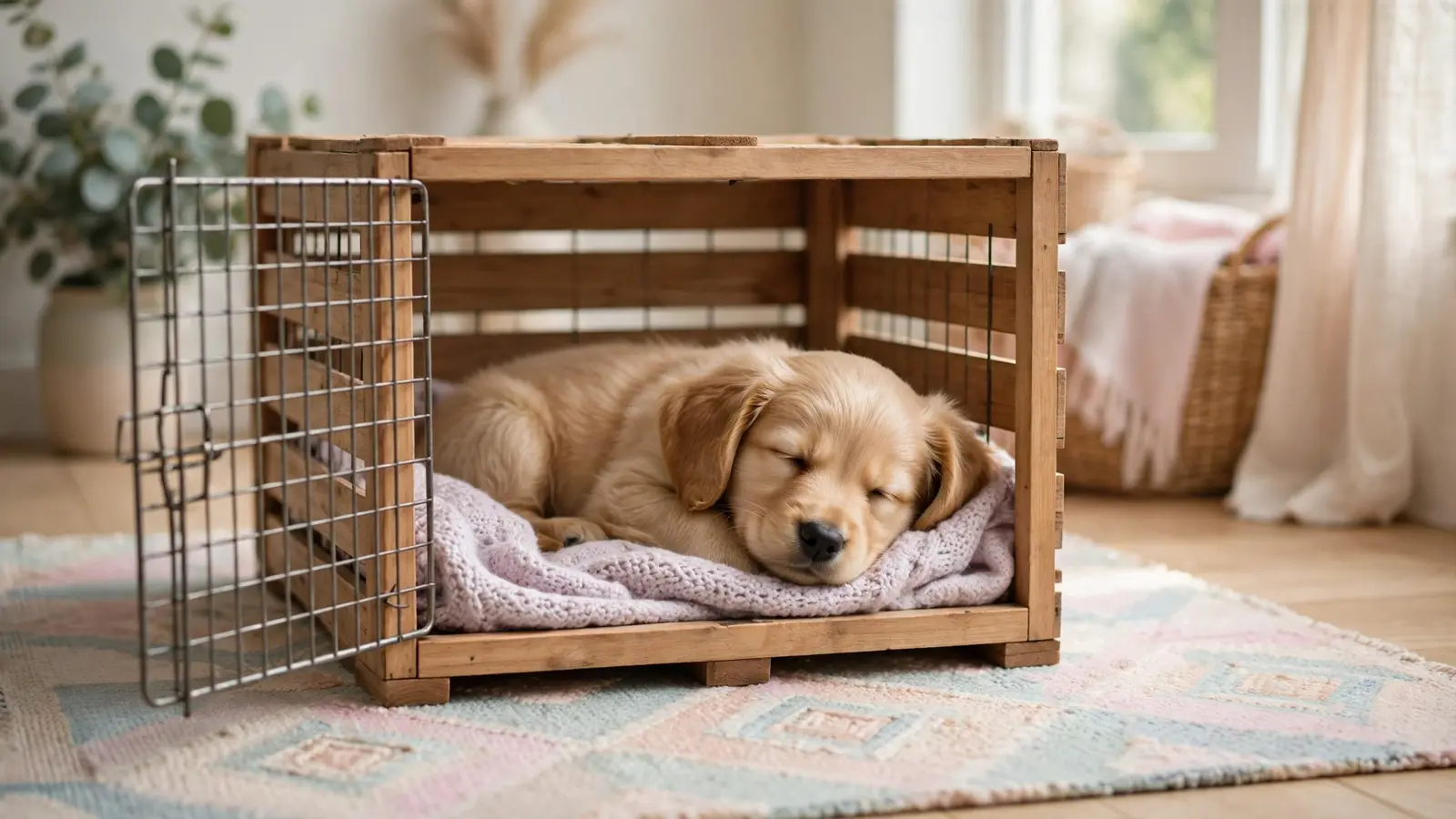
Crate training can start at any age, and starting early makes training easier. A puppy has no opinion about crates yet. An adult dog has already met one, or has already met a life without one, and either story takes a few extra days of treats to rewrite.
What does not change with age is the order. The door opens before it closes, food goes in before the dog does, and the dog is in the room with you long before it is in the room alone. Skip that order with an adult dog and you get a crate that fights back.
What the crate is for, and what it is not
Extended periods of confinement are not healthy for animals, so the crate is a management tool for short periods.
That sentence is the whole philosophy of this plan, and it is the reason the stages are short on purpose. The crate covers the gaps a dog cannot yet be trusted alone: the hour you cook dinner, the delivery that arrives at the door, the walk you cannot take in slippers. It is not the answer to a busy household, and it is not childcare with a fur lining.
Everything else in the day stays outside: play, chewing, company, and the potty trips that the potty training page pairs with this one.
The setup, before stage one
Get the room right once and the week runs itself. In a small apartment, the crate wants the corner of the room you actually live in: a wall behind it, no draught under it, and close enough that the dog hears the television.
- Big enough to stand, turn around and stretch out. Not bigger. Spare floor is where a dog goes to be sick and lie in it.
- One flat mat or a folded towel. Anything fluffy a determined chewer can pull apart goes outside.
- The door propped fully open, or taken off its hinges for the first days, so it never swings into a face.
- Treats in a jar you can open one-handed, not buried in a drawer across the kitchen.
- Nothing that frightens: no crate beside the washing machine mid-spin, no crate under a table a child ducks past.
What never goes inside: the food bowl of a dog that guards it, a toy the dog has already shredded, an angry owner's voice, and a punishment. The crate is the one place in the flat with no consequences attached.
Stage one: the door stays open
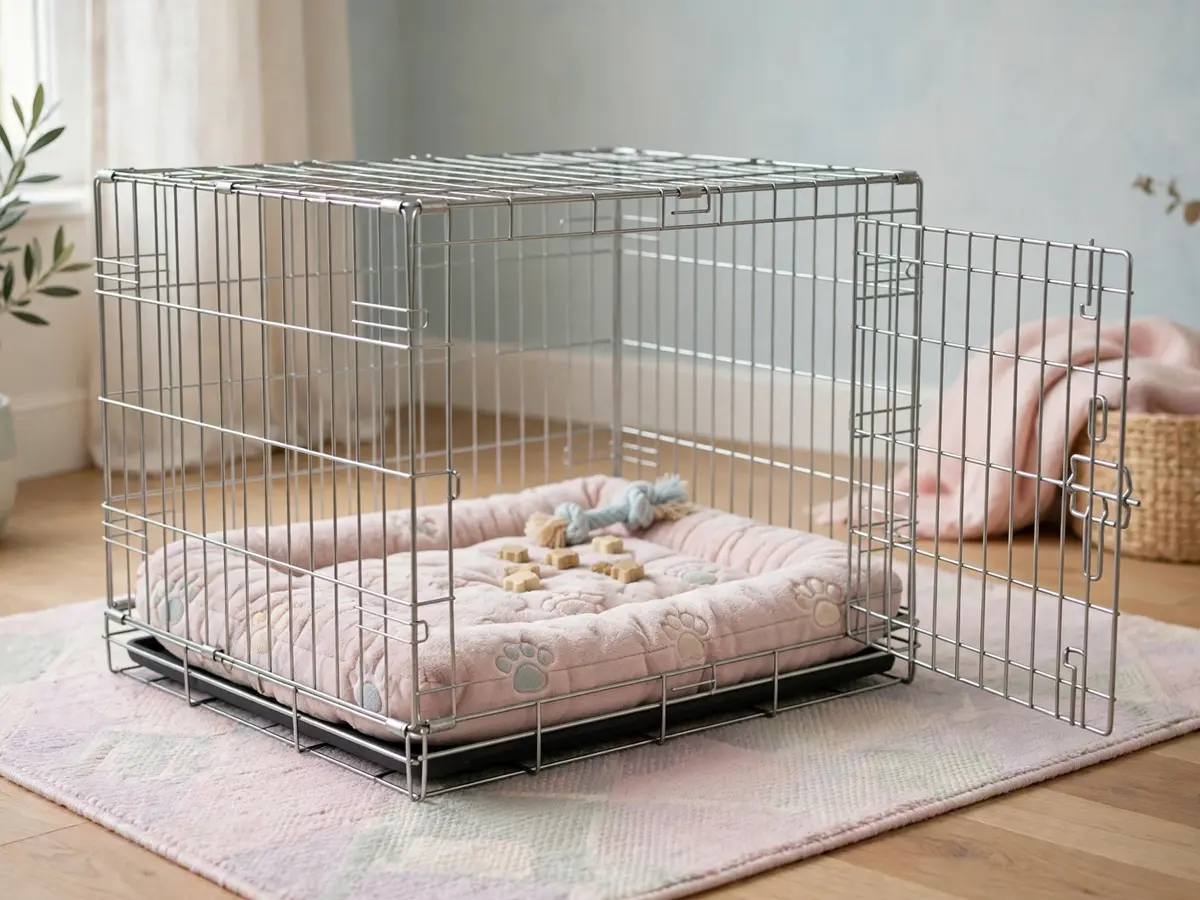
For the first couple of days the crate is furniture with a reward in it, and the dog is free to walk out. Toss a treat inside and let the dog go in for it, then leave. Do not call the dog, do not lure it deep, do not close anything. The lesson is one sentence long: going in is a good idea.
- A handful of repetitions a day, spread across the hours you are home, each one ending with the dog walking out.
- Say nothing dramatic. A bored voice works better than a cheering one, because the crate is not a trick, it is a room.
- If the dog will not step in, put the treat on the threshold. If the dog will not eat there, sit further away. That is the whole troubleshooting.
- Never carry a dog into the crate. It has to be a decision the dog makes on two paws.
Stage two: dinner happens inside
The bowl is the best crate advertisement there is. Set the meal at the threshold while the dog eats, then a step further in each day, until the whole bowl sits at the back. Door open the entire time, and the bowl lifted once the dog loses interest in it.
A dog that eats inside the crate twice a day spends more quiet minutes in it than any number of training sessions buys. This is the stage people skip, and it is the stage the whole plan rests on. For how much food and how often, the new puppy feeding page carries the details, and the crate simply borrows whatever rhythm that page sets.

Stage three: closed, with you in the room
Once the dog walks in for dinner without hesitation, the door starts closing — briefly, and never while the dog is watching you do it. Shut it after a meal, sit on the floor with a book, and open it again while the dog is still calm and full. Then, a day or two later, the same thing around a nap.
- Meal inside, door closed, you in the chair beside it.
- Open the door before the dog asks. That is the trick.
- Repeat with a chew instead of a bowl, same short dwell.
- Add the nap: closed door while the dog sleeps, opened the moment it wakes and stands.
- Stretch the minutes only while the tail stays loose and the whining stays absent.
Naps do the heavy lifting here. A dog that has slept behind a closed door with you breathing across the room is a dog that has decided the door is boring.
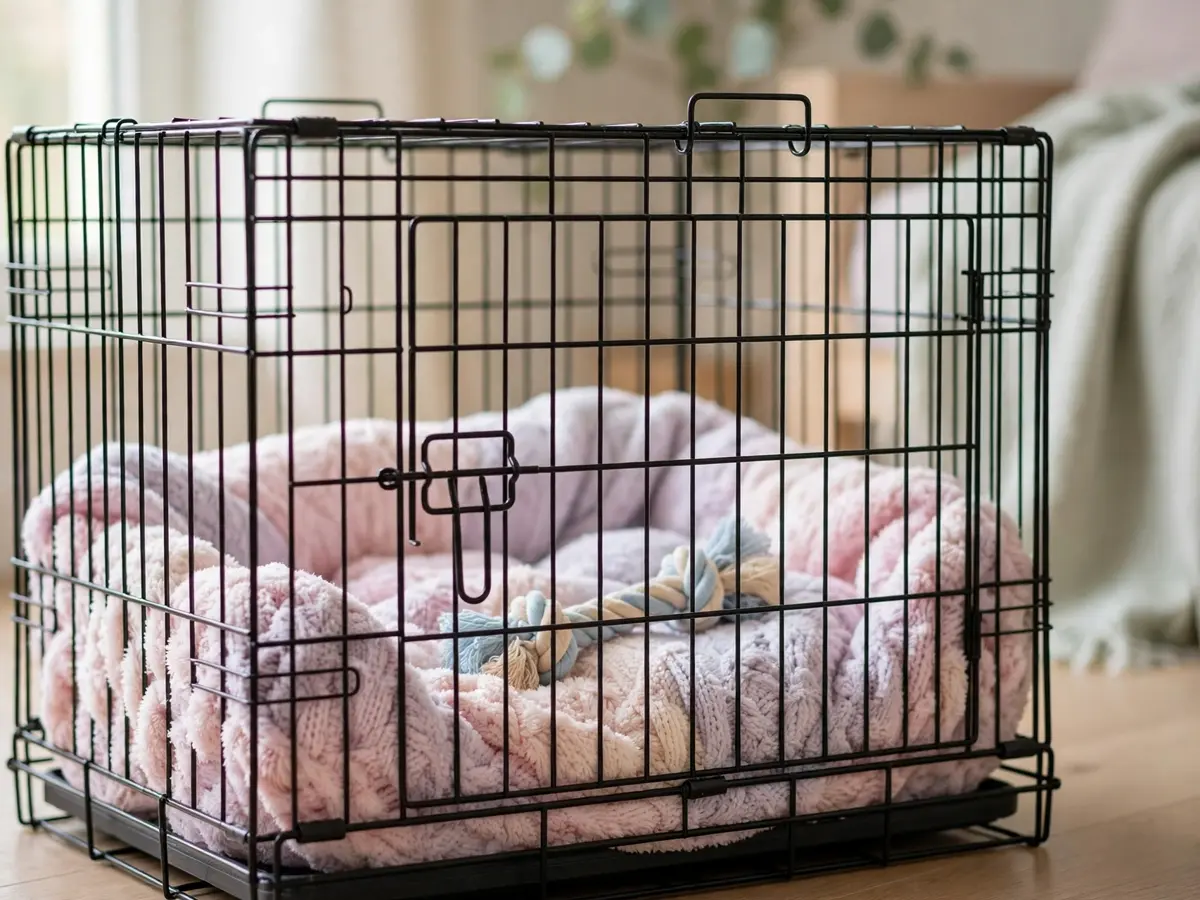
The first week, stage by stage
| Stage | What the dog learns | Move on when |
|---|---|---|
| Open door, treats tossed in | Going inside is a good idea | The dog walks in and out for a treat without asking |
| Meals at the threshold, then the back | The crate is where dinner happens | The whole bowl sits inside and the dog eats calmly |
| Closed, you in the room | The door closing is not an event | The dog lies down and settles behind a shut door |
| Nap practice | Sleep happens inside, with company | Two or three quiet naps in a row |
| First minutes alone | You leaving is not the end of the world | The dog stays settled while you step out of sight |
Short periods only. Extended periods of confinement are not healthy for animals, so the crate is a management tool for short periods.
Stage four: the first minutes alone
This is where the plan stops being about the crate and starts being about the door. Leave the room for a moment, come back before the dog works up a fuss, and let the absences grow across days rather than hours. The moment you walk out is the moment to ignore; the moment you walk back in is the moment to stay uninteresting, because a dramatic reunion makes the next departure louder.
- Start with the crate closed and you in sight, then out of sight, then out of the flat.
- One chew that only appears inside the crate gives the dog something to do rather than something to dread.
- Come back to a dog that is lying down, and slip out again while it is still there.
- A fuss that builds instead of fading means the last step was too big. Go back to it, smaller.
For the nights that follow this week — the crying at odd hours and the bedroom arrangement — the first nights page is the sequel to this one.
Reading distress, and when the plan stops
Fussing is normal. Distress is a different animal, and it has four signs you can see. A distressed dog that salivates, vocalizes persistently, tries to escape or will not settle should be checked by a veterinarian before crate training continues.
Read that sentence again slowly, because most owners mistake the second half of it for stubbornness. Drool on the crate floor, a bark that will not break off, paws scrabbling at the wire, a dog that stands in the corner instead of lying down — those are not a negotiation. They are a question, and the answer belongs to a vet, not to a longer session.
Fussing versus distress
| What you see | Usually what it is | What you do |
|---|---|---|
| A few whines, then quiet | A negotiation about the door | Wait it out; open the door while the dog is calm |
| Whining that restarts every time you move | A habit that is working | Go back one stage and shorten the session |
| Panting, drool on the mat, pacing the wire | Distress | Stop, open the door, and call your vet before the next session |
| A bark that climbs instead of fading | Distress | Same: end the session quietly and get it checked |
| Scratching or clawing at the door | Distress, and a door that can break | End it, do not leave the dog alone behind it, and call your vet |
A distressed dog that salivates, vocalizes persistently, tries to escape or will not settle should be checked by a veterinarian before crate training continues.
Nothing about that is a failure of the plan. A crate is a tool, and a tool that hurts the dog is the wrong tool that day.
Crate training first-week questions
My dog is older, not a puppy. Is it too late?
No. Crate training can start at any age, and starting early makes training easier. An adult dog simply arrives with more history inside the crate, so the open-door stage takes longer and the treats have to be better.
How long is the whole first-week plan supposed to take?
A week is the shape, not the deadline. Each stage earns the next one, and a dog that needs two days at the open door is a dog that gets two days at the open door. Rushing a stage is what turns a week into a month.
Should the crate door close for naps during the day?
Once the dog lies down inside it happily with the door swinging, yes, and only while you are in the room. A nap behind a closed door is the quietest way to teach the door that it is not exciting.
What if the dog whines the moment the door shuts?
Open it before the whine turns into a panic, and go back one stage. Closing the door again while the dog is loud teaches that volume works. If the noise climbs instead of fading, read the distress signs on this page and call your vet.
Can I put the dog in the crate as a time-out?
No, and this is the single fastest way to lose a crate. The crate earns its reputation as the place where good things happen, and a punishment spent inside it spends that reputation. Take the shoe, take the toddler to the hallway, leave the crate out of it.
Where does the crate go in a small apartment?
In the room you use most, out of the traffic lane and away from the draughty window. The crate wants company and a wall behind it, which in a one-bedroom flat usually means the corner of the living room rather than the spare bedroom.
Save these on Pinterest
Pin the five-stage table for the week before the dog arrives, and keep the potty schedule beside it. The Puppy Training collection holds the biting and mouthing guide and the commands and rewards page, which is what a dog learns once the crate is boring.
Short periods only, and the door never closes on a punishment. For informational purposes, consult your vet.