 PawStyle Daily
Puppy Training Tips
Crate Training: First Nights Made Easy
The first week of crate training is five days of setup and two nights of noise, and it goes easiest when the plan is boring: the crate in the bedroom, dinner served inside it, one answer to the midnight cry, and a log that proves the nights are stretching. This page walks the week hour by hour. No bark collars, no ignoring a real need, no giving up on night three. For informational purposes, consult your vet.
By PawStyle Daily · Updated 16 November 2026
Good to know: crate in the bedroom for week one · meals inside, door open · one quiet answer to the night cry · a log instead of guesses.
Day one: the setup earns the crate its reputation
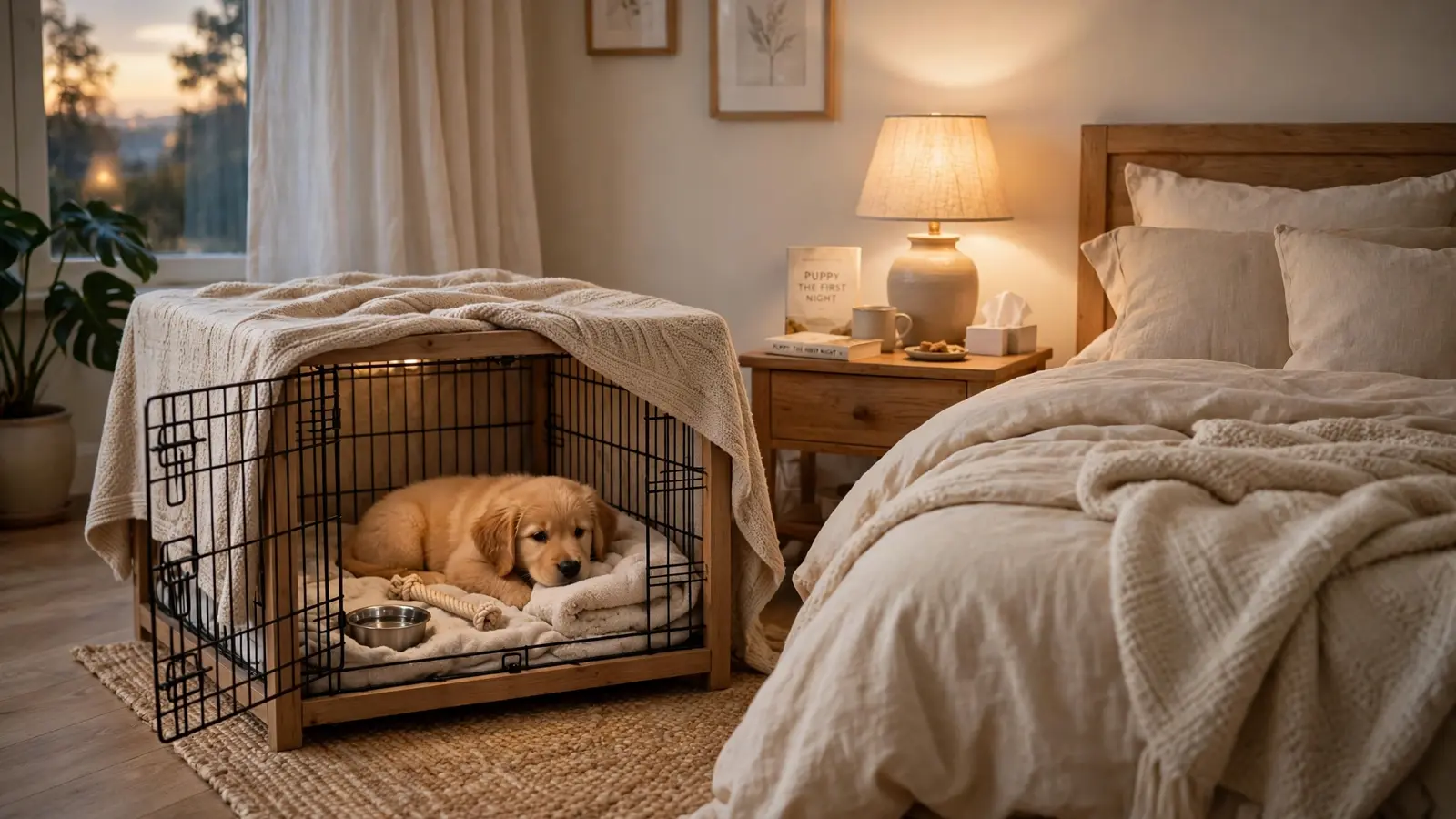
A crate is a bed with walls, and the setup decides which one the puppy thinks it is. Size it so the puppy can stand, turn and lie flat, with no spare corner: a crate with room for a bathroom gives the puppy a bathroom, and the whole point of the crate is that it is all bedroom.
- Place it in your bedroom, close enough to touch without standing.
- One flat mat or towel, nothing the puppy has already shredded.
- A light blanket over the top and three sides, door side open.
- One safe chew already inside, so entering has a prize waiting.
- The door propped fully open all day, so it never swings at a face.
Spend day one feeding every meal at the crate threshold, then a step inside, then the back of the crate, door open the whole time. The puppy learns the room before it ever learns the door, which is the order that skips a week of protest. Weigh the puppy weekly and write the numbers down, because the crate size that fit at week one will not fit at week ten, and the numbers are the reminder.
The meals that run the week
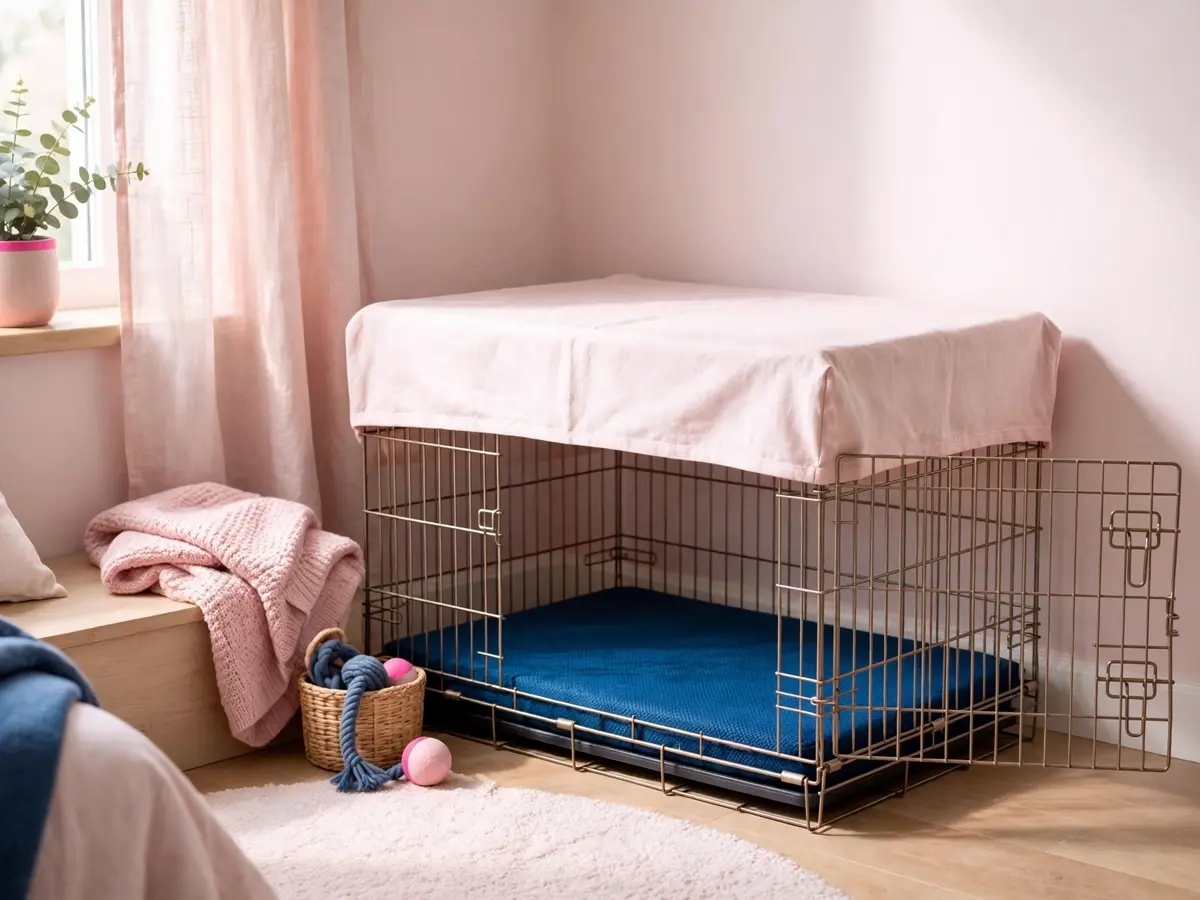
Food is the crate's best publicist, and the meal rhythm runs the night schedule underneath it. Feed at the same times daily, and serve every meal inside the crate, door open for week one. Four feedings a day from 6 to 12 weeks, then three by 3 to 6 months and two after 6 months, so a young puppy spends four quiet stretches a day inside by choice before the first night ever closes the door.
Measured meals beat food left down all day, because a puppy that eats whenever it wants is more likely to eat too much, and a grazing puppy hides the rhythm the night depends on: the last meal lands at a known hour, so the last out-trip lands at a known hour too. Whatever is left in the bowl after 30 minutes goes away, so the puppy learns to eat at mealtimes, and the evening script writes itself from there.
Fresh water stays out all day, and the water bowl gets washed daily. The overnight bowl question goes to your vet, because a spill at 2am soaks the mat and the puppy both, and every household balances that differently. The new puppy feeding page carries the meal counts and the measuring in full, and the potty schedule page is the other half of this one.
The day's meal anchors and what follows each
| Anchor | What happens | What the crate gets out of it |
|---|---|---|
| Morning meal | Served inside, door open, bowl lifted after 30 minutes | First ten minutes of the day spent in the crate by choice |
| Midday meal | Same script, same spot, same quiet voice | A second reputation deposit before noon |
| Evening meal | Served inside, then a calm chew, lights low | The wind-down starts where dinner ended |
| Final out-trip | Quiet trip out, straight back, door closes | The crate is full, the tank is empty, the night begins |
Bowl lifted after 30 minutes, every meal, so the evening anchor stays predictable.
Night one: the closing of the door
Night one has a script, and the script has one law: the door opens for needs, never for noise. Run the final out-trip after the house goes quiet, settle the puppy in with the same words you used at dinner, close the door on the light blanket, and get into bed where the puppy can hear you. Then comes the crying, and the crying is the lesson, not the emergency.
- Feed the last meal three hours before bed so the tank is empty, not full.
- Take the final out-trip to the same door and the same spot as every day trip.
- Settle the puppy in with one marker word and one chew, then close the door.
- Answer a real cry once: out, quiet, back in, no lights, no play, no chat.
- Let restarts run: a puppy that learns volume opens doors will use volume nightly.
- Morning arrives on time: the first trip out is instant, and it is a party.
The one answer rule is where most first weeks go wrong. A cry that earns a cuddle at 1am and a scolding at 3am teaches nothing except that the rules change at night, and a puppy that cannot find the rule will keep auditioning for one. Needs open the door, noise does not, and your vet is the call when you genuinely cannot tell them apart.
The crying protocol, minute by minute
Crying has a shape, and reading the shape is the skill. A need cry starts suddenly, often after hours of quiet, and it has a demanding edge: the bathroom request. A protest cry starts right after the door closes, runs in waves, and pauses to listen: the negotiation. The two get two different answers, and the whole first week turns on telling them apart.
Reading the cry before answering it
| The sound | What it usually is | The answer |
|---|---|---|
| Sharp, sudden, after quiet sleep | A bathroom request | One quiet trip out, same spot, straight back, no play |
| Waves that pause to listen | A negotiation with the door | No answer; a settling word at most, then quiet |
| Rising, frantic, with scratching | Something that needs eyes on it | Check without a fuss; call your vet if it keeps climbing |
| A single grumble, then silence | The puppy rearranging itself | Nothing; that is the sound of the plan working |
| Crying that restarts on door-close | The night one script running again | Same law: needs open the door, noise does not |
A puppy that cannot settle for an hour straight is a question for your vet, not a question for the blanket.
Weigh the puppy weekly and write the numbers down, and keep the night log beside the crate: date, bedtime, wakes, trips out, and how the crying ran. The page proves the pattern the memory insists is not there, and the week you stop reading it is usually the week it stops being needed.
The week, day by day
Seven days, one job each, in the order the puppy can actually absorb them. Move to the next day's job only when the current one is quiet, and hold the whole week steady even when a night goes sideways.
- Day one: threshold feeding, crate open all day, reputation under construction.
- Day two: meals fully inside, first door-close for one chew, door reopens itself.
- Day three: night one with the full script, one answer rule, log started.
- Day four: settle practice after the midday meal, door closed for the nap.
- Day five: the covered night, chew at bedtime, restarts left to run.
- Day six: the crate door closed for a short errand, log watched after.
- Day seven: read the whole log, keep what is quiet, fix what is not.
The errand on day six is the quiet test of the whole week: a puppy that has spent seven days eating, napping and sleeping in the crate holds that calm for a grocery run, and the log the next morning tells you whether it held. Whatever is left in the bowl after 30 minutes goes away, so the puppy learns to eat at mealtimes, and the errand comes after a meal, not before one, because a fed puppy naps through anything.
Common problems and the fix
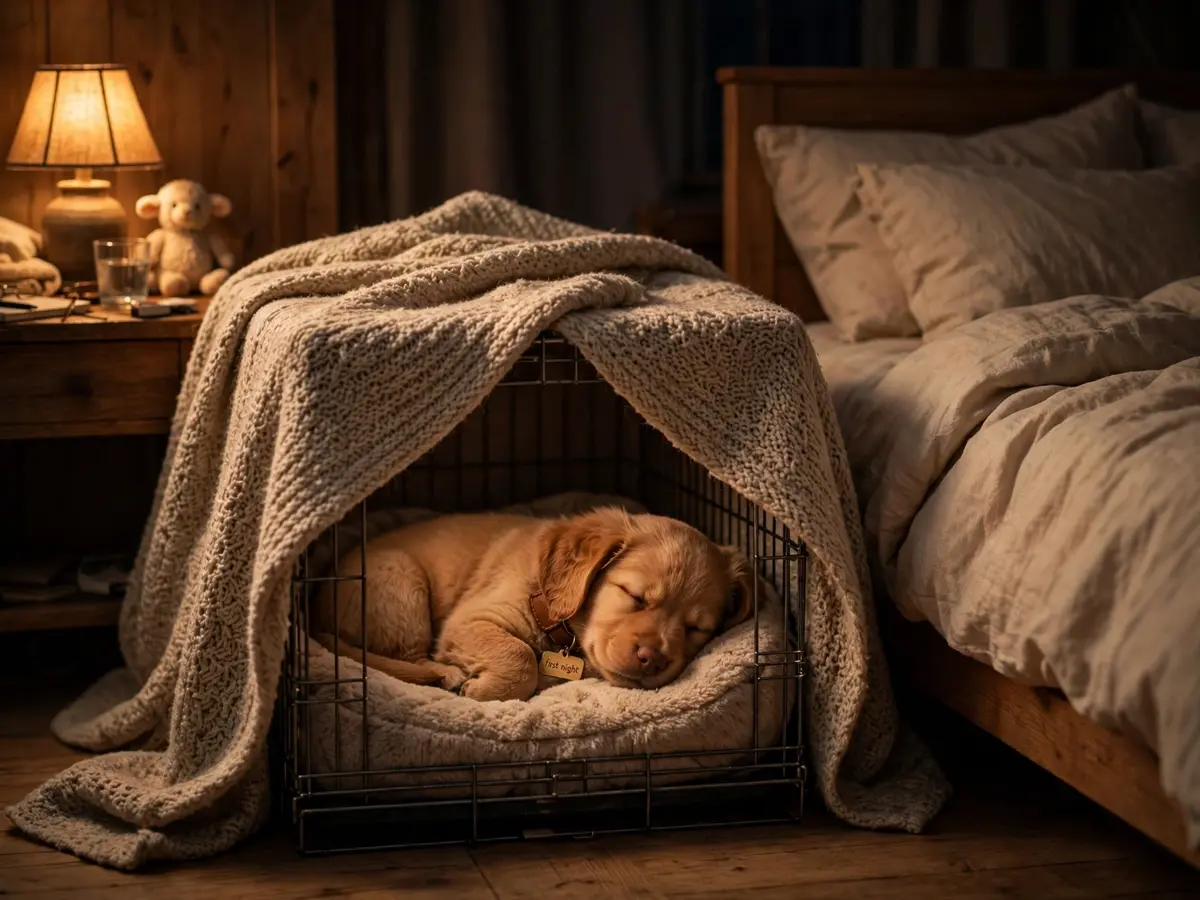
Five snags own the first crate week. Every fix below is a change to the routine, and none of them is a gadget.
What goes wrong and what to do
| Problem | Why it happens | The fix |
|---|---|---|
| Crying every hour, all night | The one answer rule slipped, or the puppy is too young to hold the night | Rebuild the rule for two nights, take the real trips, and ask your vet about the age question |
| Soiling the crate overnight | A crate with a spare corner, or a bedtime meal that ran late | Move the divider up, move the meal earlier, and log the pattern before changing anything else |
| The puppy panics when the door closes | The door arrived before the reputation did | Two days of open-door feeding and chew drops, then close for naps before nights |
| Crying only when you leave the room | A puppy that learned sleep requires your breathing | Move the crate a foot further away each quiet night, and stay in the room until the move settles |
| The crate is shredded by morning | Bedding that was already a toy, or a puppy that was not tired out before bed | One flat mat, an earlier play session, and a chew that outlasts the lights |
Anything that shows up suddenly after a quiet week is a question for your vet, not for this table.
Questions we get about crate training
How long will the first night crying last?
Nobody can promise a number, and the honest version is this: the first night is the loudest, the second is usually shorter, and by the end of the first week most puppies settle into the routine. The protocol decides the speed more than the breed does: a puppy that learns crying never opens the door stops asking, and a puppy that learns crying works asks louder for longer.
Should the crate be in my bedroom?
For the first week, yes, and close enough that you can put a hand near the crate without getting out of bed. A puppy that can hear you breathing settles sooner than one alone down the hall, and the move to another room happens later, one quiet week at a time. The goal is a puppy that sleeps anywhere, not a puppy that needs your bed.
What do I do when the crying starts at 3am?
Answer it once, quietly, as a bathroom question. Out, same door, same spot, no lights, no play, straight back to the crate. If the crying restarts the minute the door closes, the puppy has learned that volume opens doors, so let the restart run and answer only a real request signal. Weigh the puppy weekly and write the numbers down, and you will see the night stretches lengthen on paper before you feel them in sleep.
Should I feed the puppy in the crate?
Yes, every meal, with the door open for the whole first week. Feed at the same times daily, and the crate becomes the place where dinner happens, which is the fastest reputation a floor can earn. Four feedings a day from 6 to 12 weeks, then three by 3 to 6 months and two after 6 months, so each meal is another quiet minute the puppy spends inside by choice.
Can I leave water in the crate overnight?
Fresh water stays out all day, and the water bowl gets washed daily, but the overnight question belongs to your vet, because puppies, households and climates differ. The bowl in the crate is a spillable object, and a soaked puppy is awake for hours, so ask your vet what fits your puppy rather than guessing. For informational purposes, consult your vet.
What if my puppy soils the crate overnight?
Take the trip out, clean with an enzymatic cleaner, and read the log rather than the guilt: a crate that is too big, a bedtime that ran late, or a puppy too young to hold the night. Never scold, and never make the crate the consequence, or the crate becomes the place bad things happen and the whole project stalls. If the accidents repeat nightly, call your vet.
The crate week checklist
- Feed at the same times daily.
- Four feedings a day from 6 to 12 weeks, then three by 3 to 6 months and two after 6 months.
- Measured meals beat food left down all day, because a puppy that eats whenever it wants is more likely to eat too much.
- Whatever is left in the bowl after 30 minutes goes away, so the puppy learns to eat at mealtimes.
- Weigh the puppy weekly and write the numbers down.
- Fresh water stays out all day, and the water bowl gets washed daily.
- Crate in the bedroom, one flat mat, light cover, door open all day.
- Meals inside the crate, door open for week one.
- Needs open the night door; noise never does.
- Log every night: bedtime, wakes, trips, crying shape.

What we use
What we use for crate week
A crate mat, a spill-light bowl and long-lasting chews for the bedtime routine, picks in one list.
See what we use →As an Amazon Associate we earn from qualifying purchases.
Save the week plan on Pinterest
Pin the checklist for the night before the puppy arrives. The Puppy Training collection holds the potty schedule and the commands guide that picks up once the crate is quiet.
Reactivity plans run on rest as much as reps, and the a decompression corner that holds page is the setup half of that.