 PawStyle Daily
Puppy Training Tips
7 Basic Puppy Training Commands With Treat Rewards
Your new puppy learns your rhythm fast: a wag, a glance, a tiny paw pause. These seven first-week behaviors fit real living-room moments, with pea-size bites marking each sweet rep. For informational purposes, consult your vet.
By PawStyle Daily · Updated 26 October 2026
Good to know: pea-size bites only · one bite per rep · training days stay light.
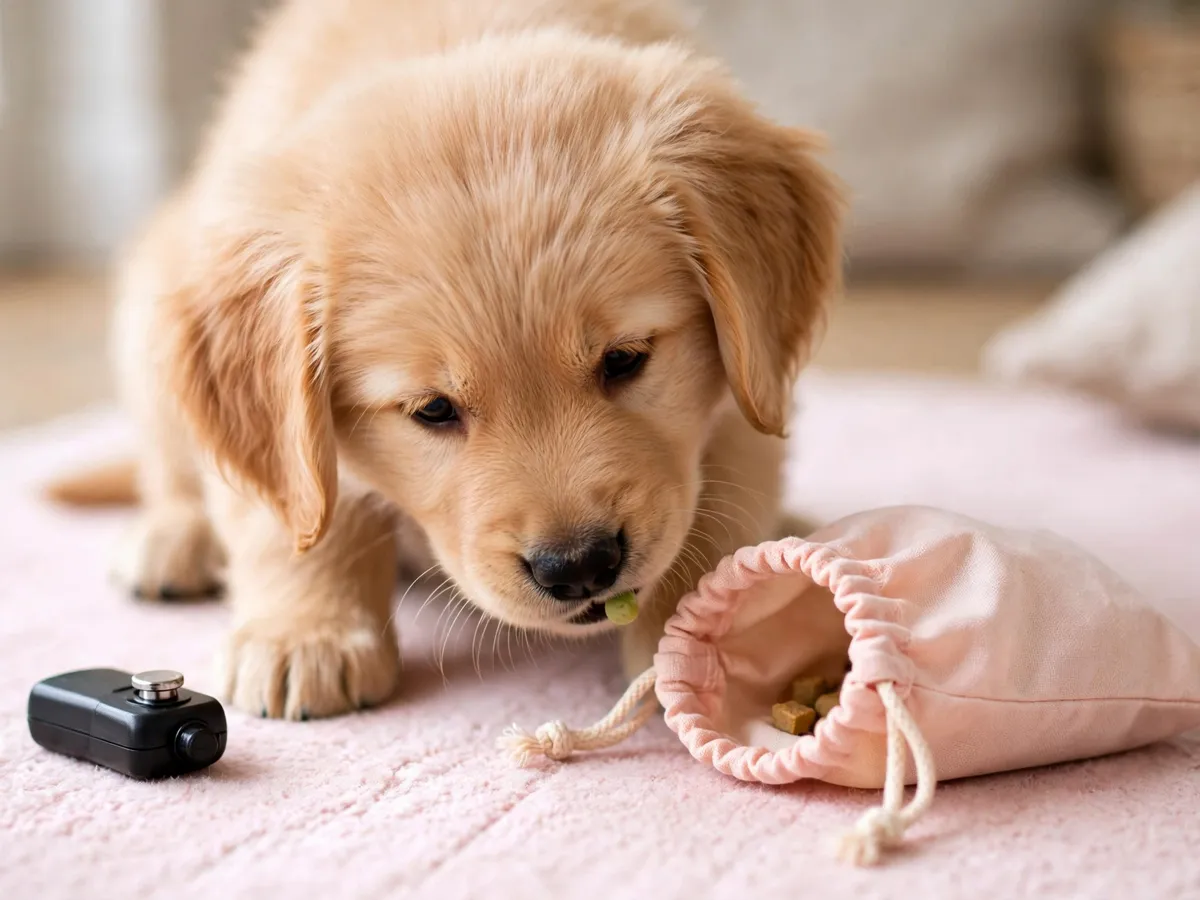
Seven first-week behaviors
Sit means bottom on the floor. Down means elbows on the rug. Come means trotting close. Name means bright eyes up. Leave-it means nose turning away. Stay means holding the same spot. Off means four paws back on the floor.
Pair each moment with one pea-size bite, then a cuddle pause. Stay and off get their own step-by-step below, because both are about waiting rather than moving.
For the meals behind the treats, see the new puppy feeding portions page.
Set up the session
A session is a small room, one word and a loaded pouch. Pick the quietest floor in the house, shut the door, and choose the single cue you will say for the next few minutes. Load the pouch before the puppy comes in, so the first rep is not spent unzipping a bag one-handed.
The phone goes face down on a shelf, out of reach. A five-minute timer is the whole plan, set before the first cue and honored when it rings. Choosing the end in advance keeps the session short on the day both of you are enjoying it, which is usually the day it drifts long.
Choose the hour as deliberately as the room. The hour before a meal is usually the awake and moving one; the hour after a long walk is usually the flat-on-the-rug one. Either hour is a choice you make, and the week holds whichever one you pick.
- One room, door shut, the same floor you will use all week.
- One cue for the session, said once per rep.
- Pouch loaded before the puppy walks in.
- Phone away, face down, on a shelf.
- Timer set for five minutes, ended on the ring.
Load the pouch
The pouch is the smallest piece of gear in the routine and the one that decides whether a rep happens. A waist pouch with a zip top is what we use: it clips on, it opens with one hand, and it does not rattle when you walk. A sandwich bag in a coat pocket works just as well, as long as it is not the pocket with the keys in it.
Load the count you planned, not the count you have. Put the pouch on before the puppy comes into the room, so the first rep is a rep and not a fumble. The bag of spare pieces stays in the fridge, out of reach, and the pouch gets emptied back into the container at the end of the day so the note by the jar stays honest.
Wash the pouch once a week with the tea towels, and shake the crumbs out after every session. A pouch that still holds last week's crumbs is not a treat pouch anymore.
The training corner
One corner of one room can hold everything the week needs: a hook for the pouch, a jar with the batch, a mat for settle, and the sticky note that carries the count. Choose the corner by the door you use most, so the pouch is already on its hook when the puppy walks past.
Keep the jar behind the mat rather than on the counter, out of the puppy's reach and out of the way of a busy morning. The timer lives on the same shelf, beside the note, so nothing in the routine needs a search. A corner that is already set up is a corner you still use on a Tuesday when the day has gone sideways.
- A hook at hand height, for the pouch
- A lidded jar, dated, holding the week's batch
- A mat that stays in one spot for settle
- A kitchen timer on the shelf
- A sticky note and a pen for the count
What to wear, where to sit
Training happens at floor level, so dress for the floor: a pocket that zips, sleeves that stay out of the way, and trousers you can kneel in. An apron with a front pocket works well for a baked batch, and a hoodie pocket is the one place a piece should never go.
Sit on a cushion or a folded blanket rather than the bare floor. A cushion brings your hand down to the puppy's level, keeps your knees out of the session, and gives you somewhere to land when the cuddle pause arrives.
Five minutes, minute by minute
The session has a shape, and the shape is what keeps it short. This is the version we run, and every block can shrink on a busy morning.
- The first minute is a hello. Let the puppy come to you, keep the pouch shut, and say nothing yet.
- The next three minutes are reps. One cue, one word, one pea-size bite, then a pause long enough for the puppy to look at you again.
- The last minute is a cuddle pause. No cue, no count, just the two of you on the floor while the timer finishes.
- When the timer rings, stand up. Standing up marks the end of the session better than any sentence does.
A two-minute morning version is the same shape with one cue and one minute of reps, and it still ends with a cuddle pause. A quiet day can carry two of these, one in the morning and one in the evening, and the note by the jar covers both.
When treats are for training, keep each one as small as possible and count it against the day's food. Most of a pet's nutrition should still come from their regular diet, with treats as the extra bit, so a two-session morning adds two lines to the tally rather than changing the dinner.
The cuddle pause is the part a new routine drops first, and it is the part that makes the session worth coming back to. It is also where a puppy learns that a cue from your mouth is not the only thing that happens when the two of you are on the floor together.
Stay: the pause before the door opens
Start with the puppy sitting, then take one small step back and hold an open palm. Step in again and mark the moment with one pea-size bite before the puppy moves.
Add a second step only once the first one lands twice in a row. Say the word once, keep your voice low, and end the stay yourself so the puppy is not guessing when it is over.
Off: four paws back on the floor
Off is the word for paws on a person, a sofa arm or a counter. Turn your shoulders away, wait for all four paws on the floor, then mark it with one pea-size bite.
Keep the reward low, near the floor, so the puppy stays down for it instead of jumping up to reach your hand.
The pea-size reward system
When treats are for training, keep each one as small as possible and count it against the day’s food. Treats should stay at no more than five percent of a dog’s daily calories, so keep the pieces small.
Most of a pet’s nutrition should still come from their regular diet, with treats as the extra bit. Tuck a small pouch by the door, so each rep stays tidy and sweet.
For doodle-size mouths, the poodle training treat rewards page keeps the same system.
The reward routine
The reward is the whole reason a rep happens, so it gets its own habit: one piece, one bite, one pause. The piece comes out of the pouch after the moment you asked for, not before, so the puppy meets the cue first and the taste second.
Deliver it low, at the puppy’s nose height or below, and keep your hand flat rather than closed. A closed hand turns every rep into a sniffing session at your fingers; an open hand lets the piece disappear in one bite and your hand come back empty.
After the bite, wait. The pause is where the puppy looks up at you again, and it is the part that makes the next rep easy to ask for. Then say the word once more and start again from the top.
When treats are for training, keep each one as small as possible and count it against the day’s food. Most of a pet’s nutrition should still come from their regular diet, with treats as the extra bit, so the reward routine stays a small habit on top of the bowl rather than a second meal.
The reward, cut small
A baked treat comes out of the oven the size it comes out, so the cutting board is part of the reward system. Let the batch cool completely first, then cut each piece in half twice. You want a piece that a pea would look down on, small enough that it disappears in one bite.
Load the pouch with the count you plan to use, not with the whole batch. If the session is five reps, five pieces go in and the rest stays in the container. A pouch loaded to the top turns every rep into a rummage, and it makes the day's count impossible to read later.
The count travels with you: when treats are for training, keep each one as small as possible and count it against the day's food. Treats should stay at no more than five percent of a dog's daily calories, so keep the pieces small.
All seven commands on one line each
Command, cue and reward
| Cue | What you ask for | When to try it |
|---|---|---|
| Sit | A hand raised over the nose until the bottom lowers | The first cue in a session, once the puppy is awake and calm |
| Stay | One small step back with an open palm, then step in again | Before the front door opens, and before a food bowl goes down |
| Off | Shoulders turned away until four paws are on the floor | The moment a paw touches a person, a sofa arm or a counter |
| Come | A crouch and a tap on the floor, said once | Around the house at a walk, and at the end of a garden session |
| Leave-it | A palm closed over the piece until the nose turns | On a walk, at a dropped crumb, and at a doorway threshold |
| Drop-it | An open hand under the chin, offered as a trade | After a chew or a toy has been in the mouth a while |
| Settle | A place mat, a still body and one quiet breath | In the evening, on the rug where the puppy already naps |
One cue per rep, one word said once, and the reward stays pea-size.
The training week
Here is the week we would run. It spreads seven cues across the days so no single session asks for all of them, and each session stays in one room with one word.
One cue per day, one room per day
| Day | Cue of the day | Room | What to watch |
|---|---|---|---|
| Day one | Sit | The living room rug | Whether the puppy settles on the floor before the first rep |
| Day two | Off | The same rug | How fast the shoulders need to turn before paws come down |
| Midweek | Come | The hallway, then the garden door | Whether the name arrives before the word does |
| Midweek, second session | Leave-it | The kitchen threshold | How long the nose stays away from the palm |
| The weekend | Stay | The hallway by the front door | Whether the puppy waits to be released instead of guessing |
| The week after | Settle | The evening rug | Whether the puppy chooses the mat on a quiet evening |
Repeat a day, swap two days, or drop one whenever the week asks for it.
Keep the same pouch count every day of the week, so the only thing that changes is the cue. When a day gets away from you, move its cue to the next session and leave the rest of the week where it is. The week after repeats the same seven cues in the same rooms, with one room swapped for a busier one.
Treats should stay at no more than five percent of a dog's daily calories, so keep the pieces small, and the weekly count on the sticky note covers the whole seven days rather than each session alone. A quiet week with three sessions and a busy week with nine sit on the same note.
Room by room
A cue learned on one rug is a cue learned on one rug. The move that carries it around the house is small: run the same three reps in a second room, on a day when the first room already felt easy, and change nothing else about the session.
Take the rooms in the order you already walk them. The living-room rug first, then the hallway, then the kitchen threshold, then the garden door. Each new room asks the puppy to hear the same word with more going on around it, and each room gets its own week if it needs one.
- The same pouch count in every room, so the reward never changes
- The same five-minute timer, set before the first cue
- One cue per room per session, said once per rep
- A door shut behind you in any room with a tempting exit
- The room you stopped in written on the sticky note, so the next session starts there
If a room reads as too busy, come back to it later in the week and keep the earlier room in the rotation. Two rooms that both feel easy are worth more than four rooms that half work.
When the puppy loses interest
A puppy that starts sniffing the pouch instead of offering the cue is telling you the session is done. That is an ordinary end to a short session, and the answer is always the same three moves.
- End the session where it is. Put the pouch away, let the puppy wander off, and try the same cue tomorrow in the same room.
- Change the room. A cue that fell flat on the kitchen tile often lands on the living-room rug, because the room was the part that was too busy.
- Change the reward. Swap the baked bite for a single piece of the puppy's own food, or move from a treat to a cuddle pause, and keep the count against the day's food either way.
Come back later rather than pushing on. A ten-minute break with the puppy loose in another room is worth more than five more reps on a cue the puppy has stopped offering.
When treats are for training, keep each one as small as possible and count it against the day's food. A reward that has stopped working is usually a reward the puppy has already had a lot of, so change the room or change the piece before you change the plan.
Count the day's treats
The count is a habit worth keeping simple. Count the pieces into the pouch before the session and count what is left when the timer rings, then write the difference on a sticky note by the jar. Over a week the notes tell you the real shape of a training day, and the dinner bowl never has to move.
When treats are for training, keep each one as small as possible and count it against the day's food. Treats should stay at no more than five percent of a dog's daily calories, so keep the pieces small. Most of a pet's nutrition should still come from their regular diet, with treats as the extra bit.
A session that uses more than you planned is not a crisis. Trim the next pouch by the same number of pieces and leave the next meal exactly as it was. A treat is an extra on top of the day's food, so a busy session means a lighter next session, never a skipped dinner.
Store the batch
Once the batch is cut, the container does the rest of the work. An airtight tub with a lid that clicks shut is the one we use, because a treat left open goes stale long before it goes missing. Keep the pieces in a single layer, and lay a sheet of paper towel between layers so the bottom row does not pick up damp from the top one.
Date the container the day you cut it, on the lid in marker. The refrigerated window is the one printed on the recipe you used, and the recipe's own number is the only one worth trusting. Anything past its date goes in the bin, not the pouch.
Portion the week's supply the same afternoon you bake. Fill the door-side tub with this week's count and freeze the rest flat on the tray, so a Thursday session reaches for the fridge tub and never for the freezer bag. The tub opens, the pouch loads, the tub closes, and the fridge door stays open for seconds rather than minutes.
Storage is the part of the batch that keeps the pieces the size you cut them. For the feeding side of the same week, see the new puppy feeding portions page.
Puppy training-day checklist
- Pouch by the door, one pea-size bite per rep
- Sit, down, come, name, leave-it, stay, off: one word each
- Short sessions: five reps, then a cuddle pause
- Roll pea-size bites, chill the tray, and tuck the pouch where you can see it.
- Pin this page to your Puppy board for training-day duty.
- Timer set before the first cue, ended on the ring
- Count the pieces into the pouch, and count what is left after
- Date the container the day you cut the batch
- A busy session means a lighter next pouch, never a skipped meal
- Phone face down on a shelf before the puppy comes in
Common problems and what to do
Six things that happen on an ordinary training week, and the change that needs no new gear and no new plan.
What goes wrong and what to do
| Problem | Why it happens | What to do |
|---|---|---|
| The puppy bolts the treat | A piece cut a little too big, so it is swallowed before the cue is finished | Cut each piece in half twice on the cooled batch and reload the pouch with the smaller count |
| The puppy only works for the good jar | The jar holds the pieces the puppy actually wants, so the pouch is a downgrade | Load the pouch from the same jar for the whole session and keep the jar shut by the door |
| The pouch leaks | A drawstring cinched with one hand while the other holds a puppy | Zip the pouch shut before the first rep, and shake it once over the sink before it goes in the bag |
| The treats crumble | A batch cut before it cooled, or a layer that sat uncovered in the fridge | Let the batch cool fully, keep it in a single layer with paper towel between layers, and cut with a sharp knife |
| The puppy gets bored | The same room, the same cue and the same five minutes every time | Change the room, change the cue for the day, or end the session two minutes early on a busy morning |
| The session runs long | The timer never got set, so nothing marked the end | Set the five-minute timer before the first cue and stop on the ring, even when the last rep was easy |
Every change is to the room, the pouch or the timer, never to the puppy.
When to skip the session
Four days when a training session is the wrong answer, and what to do instead.
- A puppy that is over-tired. A puppy that has been up since dawn, or that has just finished a long walk, has nothing left to offer a cue. Skip the session, put the puppy down for a nap, and run the same cue tomorrow on a rested afternoon.
- A household with visitors. Six new voices in the living room is not a training room, and the cue gets lost in the noise. Skip it, let the puppy meet the guests, and run the session once the house is quiet again.
- A day when the puppy is not himself. Off food, quiet, or off the usual routine, a puppy is telling you something is already off. Skip the session and ask your vet what the day means, because a training cue is not the answer to a puppy that is not right.
- A session you are too frustrated to enjoy. If the last three reps have left you annoyed, the next one will read that way to the puppy too. Skip it, put the pouch away, and come back when the session is something you both want.
Questions we get about puppy training treats
How big should a training treat be?
Small enough that it disappears in one bite. When treats are for training, keep each one as small as possible and count it against the day's food.
Do training treats count toward the day's food?
Yes. Treats should stay at no more than five percent of a dog's daily calories, so keep the pieces small. A pea-size bite per rep keeps the count easy on a training day.
What should the rest of the diet be?
Most of a pet's nutrition should still come from their regular diet, with treats as the extra bit. Keep the pouch by the door for reps and the bowl where it always sits.
How many training sessions should we run in a day?
Two short sessions is our own habit, one before breakfast and one in the evening, and a third is fine on a day with room for it. Pick the times when the puppy is awake and fed, set the timer, and treat the number as a rhythm you choose rather than a rule. A skipped session is not a lost one.
Do store-bought treats work for training?
They can, as long as the pieces are small. Break or cut each one down before it goes in the pouch, and when treats are for training, keep each one as small as possible and count it against the day's food. Most of a pet's nutrition should still come from their regular diet, with treats as the extra bit.
What do I do when the puppy ignores the cue?
Say the word once, wait a beat, and let the pause sit without repeating yourself. If nothing happens, end the session on the last easy rep and try the same cue in a different room later in the day. An ignored cue tells you the room or the moment was wrong for it, so try it again somewhere quieter.
How do I count treats against the day's food?
Count the pieces in the pouch before the session and the pieces left after it, then note the difference on a sticky note by the jar. Treats should stay at no more than five percent of a dog's daily calories, so keep the pieces small. When a session uses more than you planned, trim the next pouch by the same number and leave the dinner bowl as it is.
When is a session too long?
When the timer rings, or when the puppy stops offering the cue and starts sniffing the pouch instead. Five minutes is the shape we like for a first-week session, and a two-minute session on a busy morning still counts. End while the last rep was easy, then load the same pouch count next time.
Can I use the puppy's own food as the reward?
You can. Some puppies take a single piece of their own food from your hand as readily as a baked bite, and the day's count stays easy to follow. When treats are for training, keep each one as small as possible and count it against the day's food. Keep the rest of the bowl where it always sits.
Should I train before or after a meal?
Either works. Before a meal the puppy is usually awake and interested, and after a meal the session is often the calmer one. Pick the slot that fits your morning, keep it the same for a week, and let the pouch count stay small either way.
What we use
What we use for puppy training days
Pea-size molds, pouches and measuring scoops cover training days: picks in one list.
See what we use →As an Amazon Associate we earn from qualifying purchases.
Save these on Pinterest
Pin the checklist for fridge duty. The Puppy Training collection holds this starter page.
The first walk needs gear that stays put, and the best dog harness for dachshunds covers the fit for a long, low body.
A puppy that is ready for a first walk is usually a puppy that answers its name at the garden door, and the new puppy feeding portions page holds the meal side of the same week.
Sources
Every number on this page comes from a veterinary or veterinary publisher source, not from our own head:
The cross-pillar view of the same question lives on the which rewards work for which command page.