 PawStyle Daily
Homemade Dog Treats & Meal Planning
New Puppy Feeding Schedule by Age (Portions Chart)
From 6 to 12 weeks, four small feedings a day are usually enough for a puppy. By 3 to 6 months drop to three feedings a day, and from 6 months two feedings a day. Portion size starts on the food package: the feeding guidelines printed on the bag are the starting point, then you adjust with your puppy's body condition. For informational purposes, consult your vet.
By PawStyle Daily · Updated 21 October 2026
Good to know: print once, follow daily · Puppy-specific food only · Always supervised; fresh water stays out all day, and the water bowl gets washed daily.
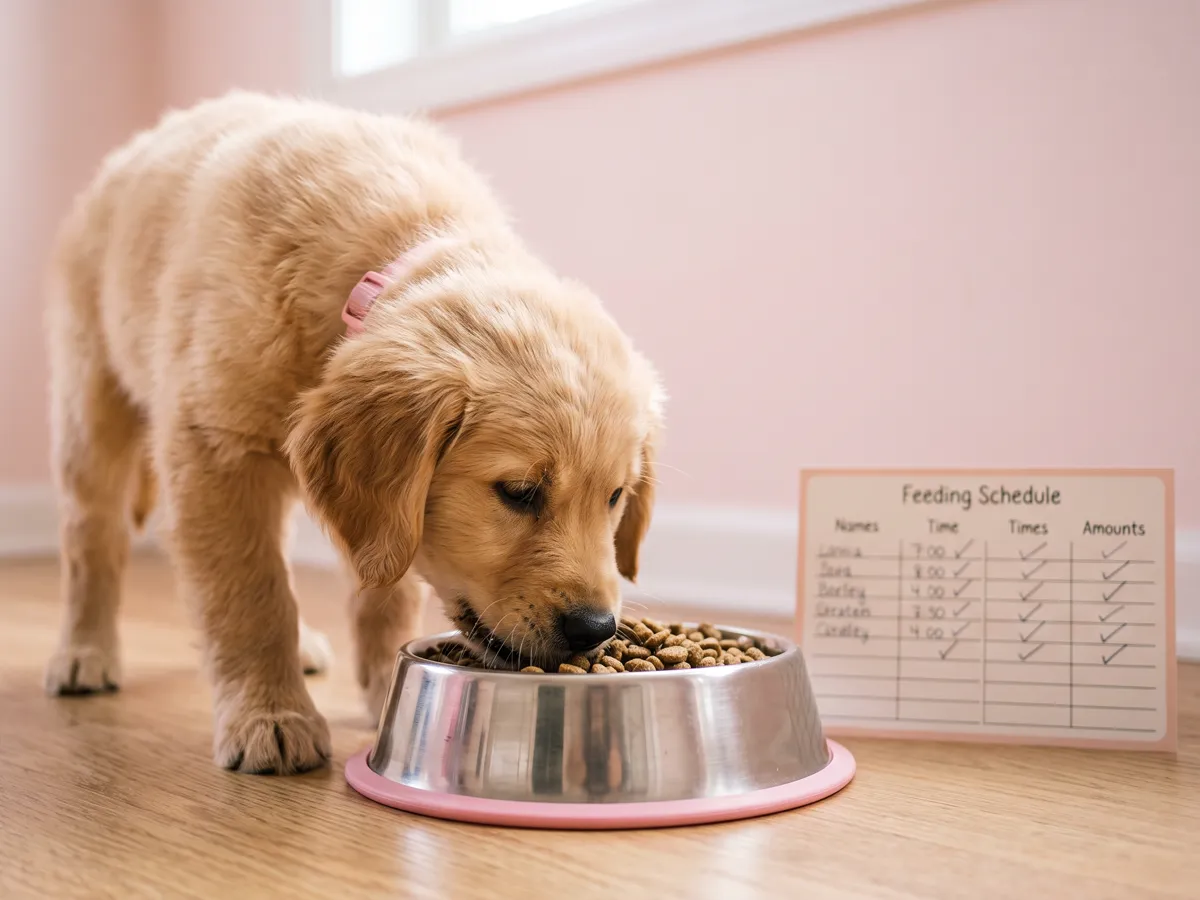
Meals by age: 8 weeks to 12 months
Four feedings a day from 6 to 12 weeks, then three by 3 to 6 months and two after 6 months. Body condition decides the portion, not how much is left in the bowl. Weigh the puppy weekly and write the numbers down. At an ideal weight, a puppy has a waistline that curves in behind the rib cage, a tucked tummy, and ribs you can feel but not see. Small and medium breeds reach adult size around 10 to 12 months, while large and giant breeds keep growing until 18 to 24 months. A puppy that grows too fast has a higher risk of bone and joint problems, so large and giant breeds need slow, steady growth.
How many times a puppy eats each day
| Age | Meals a day | What changes |
|---|---|---|
| 6-12 weeks | Four | Small, frequent feedings |
| 3 to 6 months | Three | Fewer, larger feedings |
| 6 months and older | Two | Two steady mealtimes |
Four becomes three becomes two as the puppy grows.
Any breed · Four → three → two feedings · Slow, steady growth.
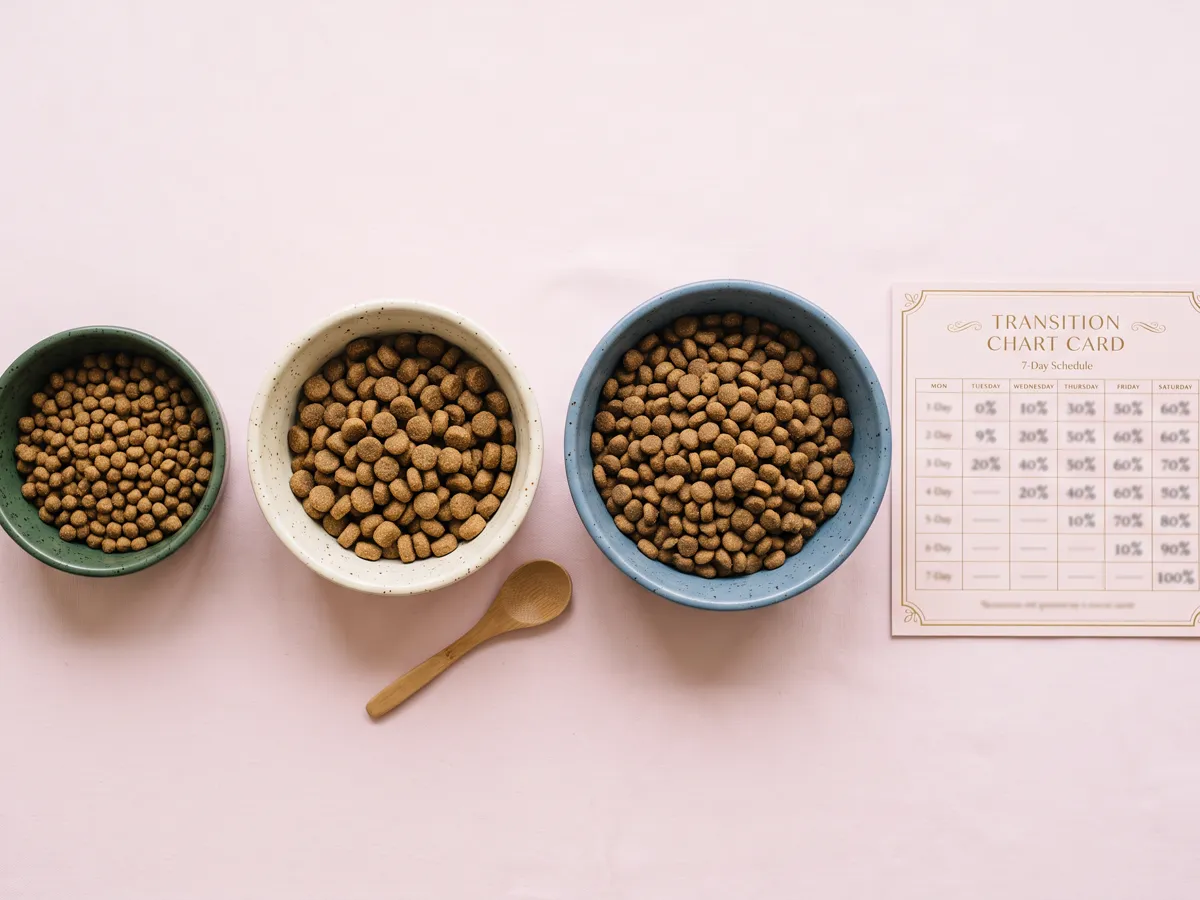
What changes at each stage
Once the count drops, the day rearranges itself around longer gaps. A young puppy eats more often because the puppy is small and the day is long; an older puppy eats less often from a fuller bowl. Two things stay still through every stage: the same bag of food, and the same meal times. If a puppy leaves food behind after a change of count, hold the count for a while and let the weekly check speak before you change anything else.
The meal count at each stage
| Stage | Meals a day | What changes | What to watch |
|---|---|---|---|
| 6 to 12 weeks | Four small feedings | The day is split into short gaps, so the bowl is never far away | A meal left untouched, or a puppy that bolts the bowl |
| 3 to 6 months | Three feedings | The midday gap stretches as the puppy grows and the frame fills out | Body condition at the weekly check, and begging between meals |
| 6 months and up | Two feedings | Two steady mealtimes carry the puppy through the rest of the first year | Weight gain that runs ahead of the frame filling out |
The counts are the ones above: four, then three, then two. The puppy sets the pace, and a check with your vet settles any doubt.
Portion size: where the number comes from
A puppy's daily calories follow their target adult weight. An individual puppy may need up to 50% more or fewer calories than the average. The feeding chart on the bag gives you the daily total, so divide it by the number of meals to get one serving. Portion size starts on the food package: the feeding guidelines printed on the bag are the starting point, then you adjust with your puppy's body condition. In the United States, look for food that has been certified complete and balanced by AAFCO.
Divide the daily total into meals
The number on the bag already did the work: the feeding chart on the bag gives you the daily total, so divide it by the number of meals to get one serving. The chart asks two questions, how old the puppy is and roughly how large the dog will be, and it prints the total for that box. Take the total, divide by the meal count for the puppy's stage, and that is the measure that goes in each bowl.
Measuring with the scoop that came in the bag keeps your measure and the bag's measure the same thing. If the scoop is lost, the chart gives the daily total in the bag's own words, so use a tablespoon to read it the same way rather than guessing. Then write the per-meal number on the bag with tape: the tape stays on the scoop's bag for the life of the bag, and anyone who feeds for you reads the same number you do.
- Find the puppy's age row on the bag.
- Read the daily total printed for the puppy's expected adult size.
- Divide that total by the number of meals for the stage: four, three or two.
- Scoop to the level the chart means, not a heaped scoop.
- Write the per-meal number on the bag with a strip of tape.
No cups or grams from us: the measure is the bag's own. An individual puppy may need up to 50% more or fewer calories than the average, so the number on the tape is a starting point and the body condition is the final say.
The weekly log
Weigh the puppy weekly and write the numbers down. The number only matters when it sits in a row beside other numbers, so a small notebook taped near the food keeps it in the same place every week. Same scale, same time of day, before the first meal: a puppy's weight moves with a full belly and a full bladder, and the morning reading before breakfast is the steadiest one. Write the week, the weight, what the waistline looked like, whether meals were finished, and anything that changed in the week: a food swap, a new treat routine, a trip, a sick day.
Copy this table into the notebook and keep it blank: six weeks fill it fast, and it becomes the note you bring to a check-up.
Weekly log to copy
| Week | Weight | Waistline check | Meals eaten | Notes |
|---|---|---|---|---|
| Week 1 | Waist curve in / tucked tummy / ribs felt not seen | |||
| Week 2 | ||||
| Week 3 | ||||
| Week 4 | ||||
| Week 5 | ||||
| Week 6 |
Same scale, same time, before the first meal. The log is a record for you and your vet, not a score.
Body condition decides the portion, not how much is left in the bowl. When the log and the bowl disagree, the log is the one that changes. For the food itself, the easy crockpot chicken dog food page covers toppers later on, and the weekly dog meal prep planner turns the per-meal number into one Sunday batch.
Set up the feeding station
One spot, chosen once. The puppy learns a feeding station the way a person learns a kitchen table: the same bowl in the same place at the same hours. A non-slip mat under the bowls keeps a pushed bowl from sliding across the floor, and it catches the splash from a puppy that drinks with both paws in the bowl.
Set the food bowl at the height the puppy needs now, not the height the dog will need later, and raise it again as the puppy grows. A flat-faced puppy eats better from a bowl the puppy can reach without standing on it, so a shallow bowl in a low stand beats a tall one. Fresh water stays out all day, and the water bowl gets washed daily: put it at the other end of the room from the food, so the puppy walks between the two and does not sit over both. Keep the wash-up easy: a spot beside the sink, a sponge that is only for the bowls, and the food bin closed. Kibble keeps best in a sealed container, out of the sun, with the bag's date on the outside.
- One feeding spot, used every day
- Non-slip mat under both bowls
- Bowl height set for the puppy's size now
- Water at the other end of the room, washed daily
- Kibble stored sealed, away from light and heat
- Bowls washed after each meal in warm soapy water
Switching food, and how long it takes
Once the food is picked, stay with it, because sudden switches can mean an upset stomach and loose stools. Switch the food over a few days, not in one meal. Keep your puppy on puppy food until they have reached about 80% of their adult size. Puppies need a complete and balanced diet made for growth, and adult food arrives gradually when they are ready for it.
Pick one food and keep it. A bag that arrives in the post mid-week is a reason to finish the old bag first, not to start a new one. If a switch is on the way, mix the new with the old over a few days so the bowl changes shape before the food changes: same dish, same place, same hours, a little more of the new each day. The pace is the puppy's, and the only guide is the shape of the stool. If it runs loose, hold where you are for a day and let it settle before moving again.
Switch shape: same bowl, same times, a little more of the new each day, and a slower pace whenever the stool runs loose. For informational purposes, consult your vet.
Move from three meals to two
The drop from three meals to two is a shape change, not a date on a calendar. Keep the same food and the same meal times, drop the midday meal first, and let the weekly check decide whether the puppy is ready. When the midday meal starts getting eaten slowly, or the puppy leaves it, that is the meal to retire.
- Hold the count you are on for a few weeks before touching it.
- Retire the midday meal first and leave the morning and evening meals alone.
- Watch the next weekly weigh-in and the waistline check before dropping anything else.
- If a meal gets left behind, put the count back for a week.
- Adjust the daily total between two meals, never by adding a third bowl back for one day.
No date is promised here, because the pace belongs to the puppy: a small breed can be ready earlier than a large one, and a slow week at home is not a sign of anything. If the frame fills out faster than the log suggests, bring the log to the vet and ask.
Body condition check
Once a week, hands on, eyes off: look for a waistline that curves in behind the rib cage, a tucked tummy, and ribs you can feel but not see. At an ideal weight, a puppy has a waistline that curves in behind the rib cage, a tucked tummy, and ribs you can feel but not see. Run a flat hand along the rib cage; if you have to press to find a rib, the puppy is carrying more than the frame wants, and if every rib shows in a bright light, the puppy is carrying less. Stand beside the puppy rather than above it, because a view from directly down flattens the waistline out of sight.
Write what you felt in the weekly log, in the same words every week, so a slow drift is visible across a month. When the picture changes, adjust with your vet rather than guessing at a number: the portion is the bag's daily total adjusted with your puppy's body condition, and the check is a picture you bring to someone who can read it. A puppy that grows too fast has a higher risk of bone and joint problems, so large and giant breeds need slow, steady growth.
Bowls, gulpers and routine
Slow-feeder bowls for gulpers, stainless for chewers, and a raised stand if your dog is tall. Feed at the same times daily. Whatever is left in the bowl after 30 minutes goes away, so the puppy learns to eat at mealtimes. Measured meals beat food left down all day, because a puppy that eats whenever it wants is more likely to eat too much. Treats should stay at no more than five percent of a dog's daily calories, so keep the pieces small.
Training reps between meals are paced on the basic puppy training commands page. Treats are part of the day's food, not a free layer on top: when treats are for training, keep each one as small as possible and count it against the day's food. A flat-faced puppy does better from a shallow bowl the puppy can reach without tipping it forward.
Routine · Feed at the same times daily · Fresh water stays out all day, and the water bowl gets washed daily.
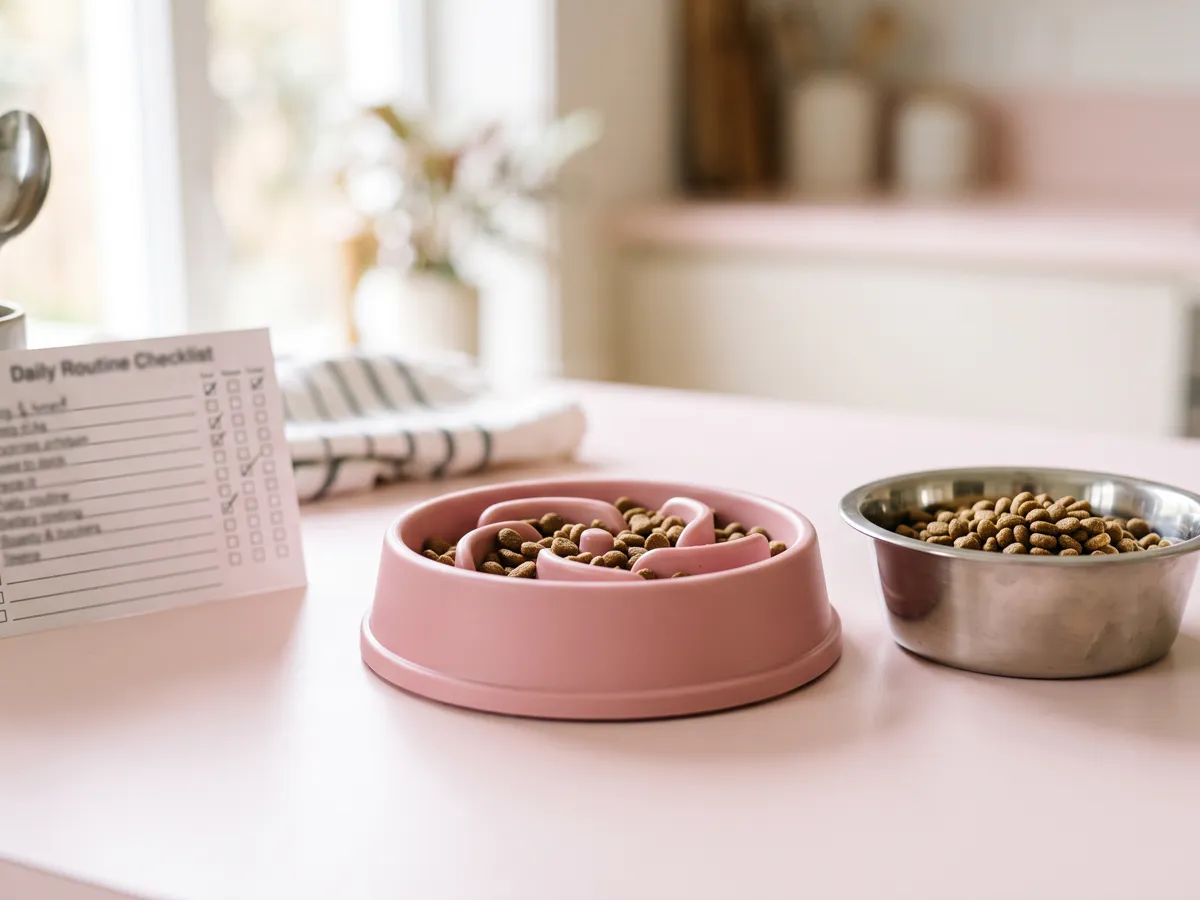
When the meal gets skipped
One skipped meal is not an emergency, and it happens: a hot day, a long car ride, a new home, a morning that ran late. Measured meals beat food left down all day, so the bowl still goes away when the time is up: whatever is left in the bowl after 30 minutes goes away, so the puppy learns to eat at mealtimes. Try again at the next meal rather than at a new hour, because the next meal is the routine.
What to watch in the hours after: the next meal itself, the stool in the next two days, and whether the puppy is bright and playing as usual. A puppy that skips one meal and then eats the next one normally is a puppy that had an off morning. A puppy that skips two meals in a row, skips water too, seems flat, or has a tummy that looks uncomfortable is a reason to call your vet the same day. This page cannot tell you what is wrong and does not try to: for informational purposes, consult your vet, and if anything looks off, call.
Hand the schedule to a sitter
One page, left on the counter next to the bowls, so a sitter does not have to guess at a single hour. Copy the five lines below, fill them in, and add the vet's number at the bottom. Everything a sitter needs is a number and a time, not a judgment call.
- Meal times: the same two or three times every day
- Per-meal measure: the number written on the bag with tape
- Treat rule: small pieces, and counted against the day's food
- Water rule: fresh water out all day, bowl washed daily
- Bowl rule: what is left after 30 minutes goes away
- Vet's name and phone number, plus the address of the clinic
Send the sitter the bag's photo too, so the daily total and the meal count are readable in the kitchen. For informational purposes, consult your vet.
Common problems and the fix
Puppy feeding goes sideways in six predictable places, and every fix below is a routine change rather than a food change.
What goes wrong and what to do
| Problem | Why it happens | Fix |
|---|---|---|
| Puppy bolts food | A hungry puppy, a deep bowl and a race for the bowl | A slow bowl is a choice, not a medical fix: spread the measure out, use a slow-feeder bowl and keep the bowl on a non-slip mat |
| Meal gets left behind | The bowl is warm, the measure is larger than the puppy wants, or the day ran differently | Serve at the same times daily, let the bowl go after 30 minutes, and note it in the weekly log before changing anything |
| Puppy begs at the table | A puppy that eats between meals learns to ask everywhere | Keep treats counted against the day's food, feed away from the table, and give the puppy something to do while the table eats |
| Treats push past the day's food | Training pieces handed out on top of the bowl | When treats are for training, keep each one as small as possible and count it against the day's food |
| Weight jumps in a week | A growth week, a heavier scale or a fuller belly | Weigh on the same scale at the same time before the first meal, and bring the log to the vet if the jump continues |
| Bowl gets pushed around the floor | A smooth floor and an eager puppy | A non-slip mat, a heavier bowl, and a bowl height set for the puppy's size now |
Every fix is a routine change. When a fix does not hold after a week, the weekly log is what you take to your vet.
Questions we get about puppy feeding
How many times a day should a puppy eat?
Four feedings a day from 6 to 12 weeks, then three by 3 to 6 months and two after 6 months. Keep the meal times steady and let body condition decide how much goes in the bowl.
When can a puppy move to adult food?
Keep your puppy on puppy food until they have reached about 80% of their adult size. Small and medium breeds reach adult size around 10 to 12 months, while large and giant breeds keep growing until 18 to 24 months.
How much should a puppy eat each day?
A puppy's daily calories follow their target adult weight. An individual puppy may need up to 50% more or fewer calories than the average. Start from the feeding guidelines printed on the bag, then check body condition.
How many treats can a puppy have in a day?
Treats should stay at no more than five percent of a dog's daily calories, so keep the pieces small. When treats are for training, keep each one as small as possible and count it against the day's food.
What do I write in the weekly log?
Weigh the puppy weekly and write the numbers down, then add what the waistline looked like, whether meals were finished and anything that changed that week. Same scale, same time of day, before the first meal, so the numbers compare with each other instead of moving with a full belly.
How do I turn the bag's daily total into one meal?
The feeding chart on the bag gives you the daily total, so divide it by the number of meals to get one serving. Find the row for the puppy's age, read the total for the expected adult size, divide by four or three or two, and measure with the scoop that came in the bag.
When do I drop the midday meal?
There is no date to promise. Drop the midday meal first when the puppy starts eating it slowly or leaving it, keep the same food and the same morning and evening times, and check the weekly weigh-in before dropping anything else.
How do I switch foods without the upset?
Once the food is picked, stay with it, because sudden switches can mean an upset stomach and loose stools. Switch the food over a few days, not in one meal, by mixing a little more of the new into the old each day while the bowl, the place and the hours stay the same. If the stool runs loose, hold where you are and let it settle.
How much water should a puppy drink?
Fresh water stays out all day, and the water bowl gets washed daily. Set it at the other end of the room from the food so the puppy walks between the two. How much a puppy drinks is a question for your vet, especially if the puppy seems to be drinking more or less than usual.
What should I do when a puppy skips a meal?
One skipped meal happens on hot days, long drives and busy mornings. Let the bowl go at the usual time, then try again at the next meal rather than at a new hour. Watch the next meal and the stool, and call your vet if the puppy skips two meals in a row, skips water, seems flat or looks uncomfortable.
How do I feed a flat-faced breed?
Use a shallow bowl the puppy can reach without standing on it or tipping it forward, set the height for the puppy's size now, and keep the food spread out so the mouth gets at it easily. A non-slip mat keeps the bowl still while the puppy works.
Puppy feeding checklist
- Four feedings a day from 6 to 12 weeks, then three by 3 to 6 months and two after 6 months.
- The feeding chart on the bag gives you the daily total, so divide it by the number of meals to get one serving.
- Look for a waistline that curves in behind the rib cage, a tucked tummy, and ribs you can feel but not see.
- Weigh the puppy weekly and write the numbers down.
- Switch the food over a few days, not in one meal.
- When treats are for training, keep each one as small as possible and count it against the day's food.
- Treats should stay at no more than five percent of a dog's daily calories, so keep the pieces small.
- One feeding spot, non-slip mat, bowl height set for now.
- Fresh water stays out all day, and the water bowl gets washed daily.
- Measured meals beat food left down all day, and what is left after 30 minutes goes away.
- Keep your puppy on puppy food until they have reached about 80% of their adult size.
- Feed at the same times daily.
What we use
What we use for puppy feeding
Slow-feeder bowls, stainless sets and measuring cups cover every age, picks in one list.
See what we use →As an Amazon Associate we earn from qualifying purchases.
Save these on Pinterest
Pin the age chart for fridge duty. The Dog Food collection holds the no-bake treats and crockpot topper.
Safety note: puppies must never eat the usual human food dangers. The ASPCA poison control center publishes a list of the people foods to avoid feeding your pets: open the ASPCA list.
Sources
Every number on this page comes from a veterinary or veterinary publisher source, not from our own head:
- VCA Animal Hospitals: how much to feed your puppy
- VCA Animal Hospitals: puppy feeding for new owners
- VCA Animal Hospitals: feeding growing puppies
- PetMD: how much to feed a puppy
- PetMD: are you feeding your dog the right amount
- AKC: how much to feed a puppy
And if portions are fine but the stool is not, the what to do when the stool runs loose page is the one to open next.
Portions scale with the puppy in front of you, and the portions for a large-breed puppy page takes the same feeding math to the big-puppy end of the chart.