 PawStyle Daily
Puppy Training Tips
Puppy Potty Training Schedule with a Crate Routine
Potty training is a rhythm, not a weekend. The routine below ties every out-trip to something you can already see: the end of a meal, the end of a nap, the end of a play session. The crate is the anchor that keeps naps regular, meals keep everything else predictable, and a one-page log keeps you honest about what is actually working. For informational purposes, consult your vet.
By PawStyle Daily · Updated 16 November 2026
Good to know: print once, follow daily · Meal-anchored trips · Crate for naps and bedtime · Always supervised · Fresh water stays out all day, and the water bowl gets washed daily.
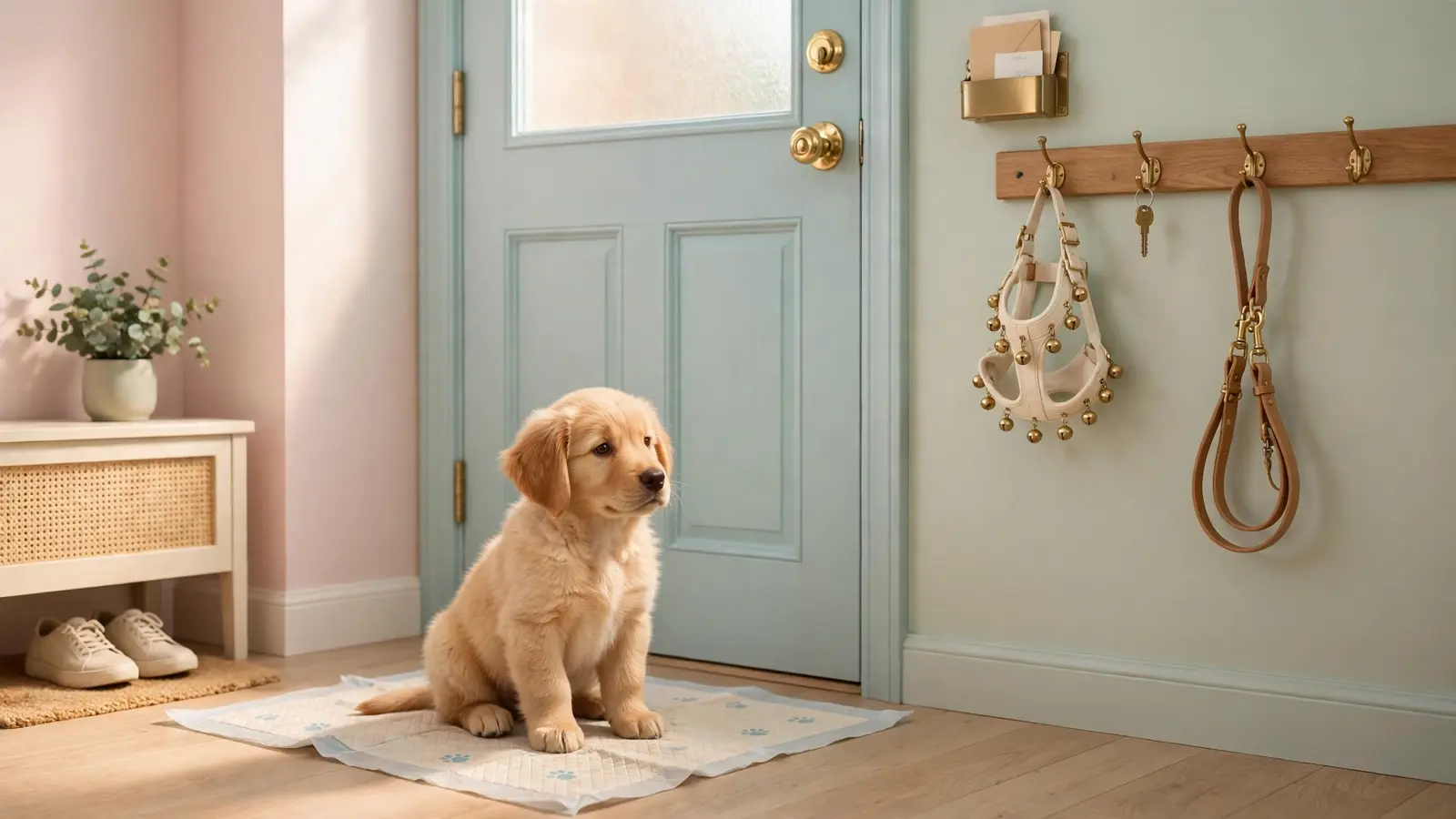
The rhythm: meals first, everything follows
Feed at the same times daily. The meal is the metronome for the whole day, because what goes in on a schedule comes out on a schedule, and a puppy that eats at random hours is a puppy that needs out at random hours. Four feedings a day from 6 to 12 weeks, then three by 3 to 6 months and two after 6 months: the out-trips follow that count down as the puppy grows.
Measured meals beat food left down all day, because a puppy that eats whenever it wants is more likely to eat too much. Whatever is left in the bowl after 30 minutes goes away, so the puppy learns to eat at mealtimes, and you learn when the next out-trip is actually due. A grazing puppy hides the schedule from everyone, including itself.
What happens after each daily anchor
| Anchor | What just happened | The trip that follows |
|---|---|---|
| Wake-up | The puppy opens its eyes in the crate or on the mat | Straight out, carried, before anything else happens |
| Meal end | The bowl is finished or the 30 minutes are up | Out within a minute or two of the bowl going away |
| Play session | A burst of running, tugging or zoomies | Out when the excitement drops, not mid-game |
| Nap end | The puppy gets up from a sleep | Straight out, same as the morning wake-up |
| Big drink | The water bowl gets emptied | Out after a few minutes of settling |
| Bedtime | The last evening trip is done and the crate closes | One final short trip, then quiet until morning |
Every trip goes to the same spot, on lead, and the praise happens outside, never back inside.
Any breed · Meal-anchored trips · Same spot, same words, every time.
Start with the log, not the rules
Before a single rule from this page goes live, spend two ordinary days writing down what already happens: when the puppy eats, when it sleeps, when it goes, and where the accidents land. Weigh the puppy weekly and write the numbers down. The log is the map: it shows the gap between the trips you remember and the trips the puppy actually needed, and every schedule below gets adjusted to that map rather than the other way around.
- Pick one notebook that lives next to the door.
- Log every meal, every nap, every out-trip and every accident.
- Use the same four columns every day: time, trigger, result, spot.
- Read the last seven lines before you change anything.
- Keep the log going for a month, even after the accidents thin out.
The log tells you when the routine is working. The puppy tells you when it is time to widen the gaps.
The crate: a bed with walls, not a cell
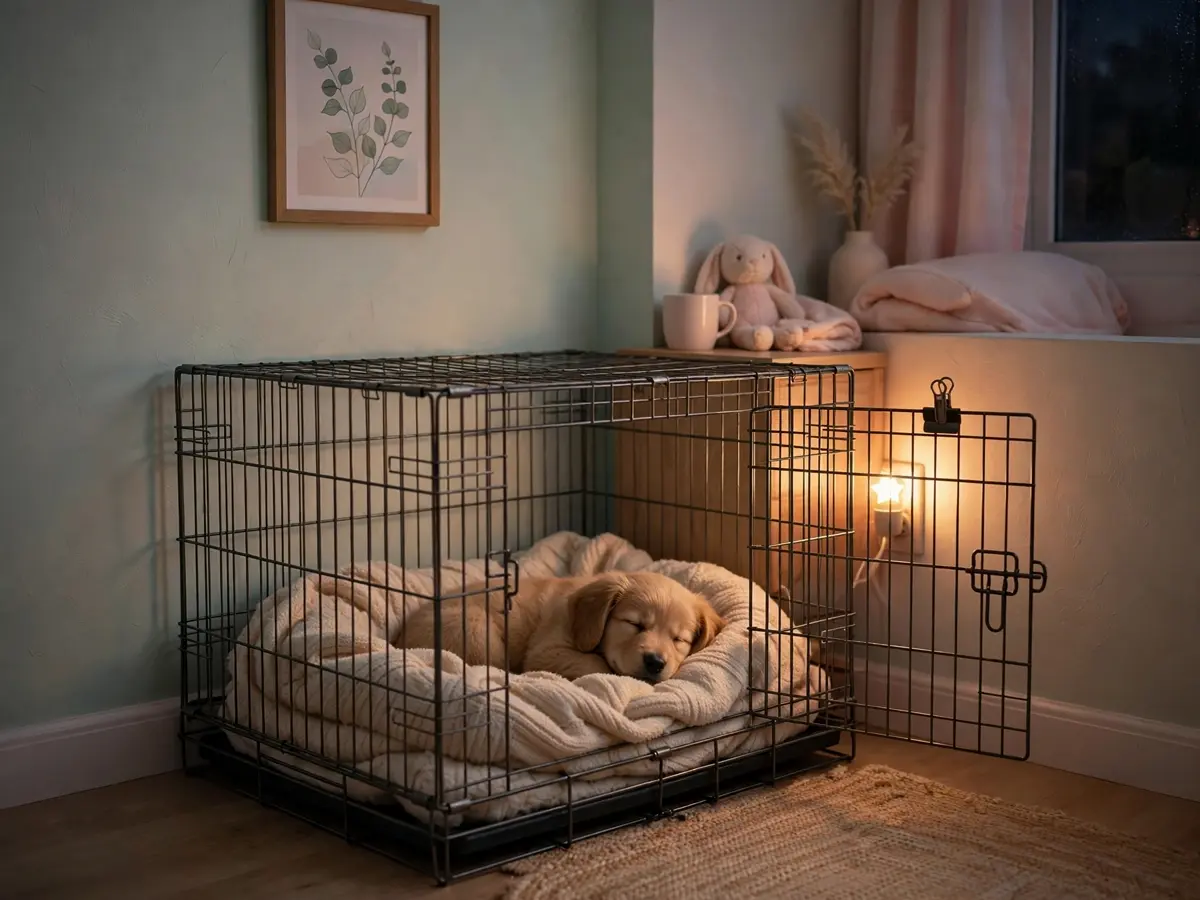
The crate earns its place in potty training by keeping naps regular and bedtime calm. A puppy that naps at predictable hours wakes at predictable hours, and a puppy that sleeps through the night in one spot is a puppy whose first morning trip is easy to time. The crate is one tool in the routine, never the whole plan, and never a consequence.
- Size it so the puppy can stand, turn and lie flat, no bigger.
- Feed meals inside with the door open at first.
- Put it where the household spends the day.
- Nap and bedtime only; the door is never slammed on a fuss.
- No bedding the puppy has already shredded into snow.
A crate that is too large hands the puppy a bathroom corner and a sleeping corner, which is the opposite of the plan. A crate that is used for scolding teaches the puppy to dread the bed, which ruins bedtime for everyone. Keep it boring, keep it warm, keep it part of the day, and the naps do the scheduling work on their own.
A sample day, hour by hour
Here is a day-shape that works for a young puppy on four meals, borrowed from the log and not from a fantasy. The hours are examples for one household; the anchors are the parts that stay true for every household. Feed at the same times daily, and let the anchors, not the clock faces, carry the routine.
A sample day from wake-up to bedtime
| When | The anchor | What happens |
|---|---|---|
| 7:00 | Wake-up | Out to the spot, breakfast after, back out again within minutes of the bowl |
| 10:00 | Nap end | Out, then a calm play session, then out again when the excitement drops |
| 13:00 | Meal end | Lunch, bowl away after 30 minutes, out, then crate nap |
| 16:00 | Nap end | Out, longest walk of the day, water topped up, out again after the drink |
| 19:00 | Meal end | Dinner, out, family-evening chewing time in view of everyone |
| 23:00 | Bedtime | Final quiet trip, crate, lights out until the first cry or morning |
The hours move with your day. The anchors never move: meal end, nap end, play end, wake-up, bedtime.
Whatever is left in the bowl after 30 minutes goes away, so the puppy learns to eat at mealtimes, and the trip after the meal starts the moment the bowl is lifted. The evening is where new homes leak: a tired puppy that falls asleep on the sofa at 9pm is a puppy nobody takes out, and the accident at midnight is the receipt. One last quiet trip at bedtime, every bedtime, no matter how asleep the puppy looks.
Accidents: the fix is the routine, not the reaction
An accident indoors is information, and it is almost always information about a gap in the routine: a trip that never happened, a meal that ran late, a play session that ran long. The response is the same every time, and none of it is a telling-off.
- Interrupt gently, with a happy clap or a marker word, and carry the puppy out mid-job if you catch it live.
- Let the finish happen at the outdoor spot, and praise there.
- Clean the indoor spot with an enzymatic cleaner, fully.
- Write the accident in the log with its time and its spot.
- Close the gap the accident pointed at: add the missing trip, move the meal, shorten the play.
A puppy that gets scolded for accidents learns to hide them, not to stop them, and a puppy that hides them is a puppy whose log goes quiet while the rug quietly fills. The enzymatic cleaner matters for the same reason: a spot that still smells like a bathroom to a puppy is a spot that keeps getting used as one.
Never rub a nose in it, never delay a trip as a consequence, and never crate the puppy as a punishment for an accident.
The out-trip, done the same way every time
Sameness is the training. One door, one spot, one lead, one marker word, one party. The puppy is not learning a rule in the abstract; it is learning a route and a script, and every version of that route it has to unlearn is a week added to the project.
- Same door every trip, so the puppy runs to it on its own soon.
- Same patch of ground, on lead, boring until the job is done.
- One quiet marker word the moment the job starts outside.
- A small party the moment it finishes, right there, not inside.
- Straight back in after the praise: the trip is not a walk.
- Wait calmly if nothing happens, then back in and try after the next anchor.
The trip back inside after the praise is what keeps the puppy from learning to hold the job hostage for extra yard time. If the out-trip turns into play every time, a smart puppy learns the fastest way to extend a trip is to not go. Praise, return, done: the yard earns its playtime at a different hour, on a different script.
Nights, early mornings and the 3am shift
The night trip is real for young puppies, and pretending it is not is how rugs die. Take the trip the same way as every other: carried, same door, same spot, quiet praise, straight back to the crate, no lights beyond what you need, no words beyond the marker. A night trip that turns into a cuddle and a drink teaches a puppy that 3am is an event worth waking up for.
Fresh water stays out all day, and the water bowl gets washed daily. The evening water question is one for your vet: some homes lift the bowl an hour before bed, some never do, and your vet knows your puppy. What is not in question is the final out-trip: it happens, every night, after the house goes dark.
Small apartment, same rules
A walk-up changes the logistics, not the anchors. The trip is longer, so the carry is longer, and the landing or the hallway becomes a place a full puppy might finish early. Build the trip into the day the same way: meals at the same times, trips after the anchors, the log on the counter, the crate by the sofa.
For the home setup around a city puppy, the small apartment layout ideas page covers corner planning in a compact space, and the basic puppy training commands page picks up where potty training ends. When treats are for training, keep each one as small as possible and count it against the day's food.
Common problems and the fix
Six snags come up in almost every first month. Every fix below is a routine change, and none of them is a product.
What goes wrong and what to do
| Problem | Why it happens | The fix |
|---|---|---|
| Accidents right after coming inside | The trip ended before the job did, or the excitement restarted it | Stand at the spot longer, praise only when the job finishes, and add a second trip after a big play session |
| Puppy goes the moment it is back inside | The praise arrived too early or the spot was switched | Same spot every trip, marker word as the job starts, and a calm return rather than a play session |
| Progress stalls after a good week | The gaps were widened faster than the puppy grew | Put the last widened gap back for a week, then widen again from the log rather than from hope |
| Crate crying at night | A bathroom need, a bedtime that ran early, or a puppy that was already napping too late | Take the quiet trip first, then settle the crate with the routine the puppy already knows, and ask your vet if it persists |
| Accidents only when home alone | The alone-stretch is longer than the puppy can hold | Close the gap with a helper, a lunchtime visit or a sitter, and keep the same trip script for every person |
| Puppy refuses the spot in the rain | The surface changed, and the script did not | Same spot, same lead, same words, umbrella over you both, and a faster party when the job lands in the weather |
If the log shows a sudden change in the pattern, that is a question for your vet, not a question for the routine.
Questions we get about potty training
How do meals shape the potty schedule?
Feed at the same times daily, and take the puppy out on the back of each meal rather than on a guessed clock. Four feedings a day from 6 to 12 weeks, then three by 3 to 6 months and two after 6 months, so the out-trips follow the meals as the count drops.
How do I use the crate without it feeling like a punishment?
Feed the puppy in the crate, leave the door open between naps, and put the crate where the day happens, not in an empty room. A crate that the puppy walks into on its own is a bed, not a box. The crate is never a place the puppy lands after an accident.
Should I carry my puppy out or let it walk?
Carry the first weeks, especially first thing in the morning and after naps. A puppy that walks to the door on the way out sometimes finishes the job on the way, and a carried puppy arrives with an empty tank and a clear task.
What goes in the trip log?
Weigh the puppy weekly and write the numbers down, then add the out-trips that mattered: the time, the door, what happened outside, and any accident inside with the spot it landed on. Same notebook, same columns, so a week of pages reads as one story.
My puppy has an accident in front of me. Now what?
Interrupt with a happy clap, carry the puppy out to the same spot, and let the finish happen there. Clean the indoor spot with an enzymatic cleaner rather than a household spray, and write the trip in the log. No telling-off: a puppy that gets scolded for accidents learns to hide them, not to stop them.
When can I stop the night trip?
There is no date to promise, and a puppy that wakes and asks is a puppy that still needs the trip. The pattern is the signal: when the log shows a run of dry nights and a puppy that sleeps through, drop the night trip and keep the morning one early. If the accidents return, put the trip back.
Do puppy pads undo the routine?
A pad is a tool for one specific job, like a high-rise puppy or a first week in a new home, and it is a temporary surface, not the goal. If the plan is outdoor potty, keep the pad in one spot only, treat every pad hit as a logged trip, and shrink the pad's role as the out-trips hold.
How long does potty training take?
Weeks to months, and the honest answer is that the puppy sets the pace. What you control is the routine: feed at the same times daily, trip out after every meal, nap and play session, log what happens, and hold the plan steady while the puppy grows into it.
What if the puppy cries in the crate at night?
Take the puppy out first and treat that trip as a potty question, not a bedtime question: out, same spot, quiet praise, back to the crate, and no play. If the puppy was already out minutes ago and the crying starts again, the answer may be a bathroom break, so take the trip before assuming anything else, and ask your vet when in doubt.
Do I need treats for potty training?
A party at the right spot beats a treat, and a marker word plus praise carries the whole routine. If you use food, keep it tiny: treats should stay at no more than five percent of a dog's daily calories, so keep the pieces small, and count the pieces against the day's food.
How does water fit into the schedule?
Fresh water stays out all day, and the water bowl gets washed daily. Take a trip out after a big drink the same way you do after a meal, and lift the bowl an hour before bed only if your vet agrees with that step for your puppy.
What about leaving the puppy alone during work hours?
Plan the gap around a helper, a lunchtime visit or a sitter, because a long alone-stretch is the one place a routine cannot reach. Write the day's trips on the counter card for whoever steps in, and keep the same words and the same spot for every person who takes the puppy out.
Hand the routine to a sitter
One card, left on the counter next to the bowls, so anyone who steps in runs the same script the puppy already knows. Copy the six lines below, fill them in, and add the vet's number at the bottom.
- Meal times: the same times every day, bowl away after 30 minutes
- Out-trips: after every meal, every nap, every play session
- The door and the spot: the same ones every time, on lead
- The script: marker word as the job starts, small party as it ends
- Accidents: enzymatic cleaner, into the log, never a scolding
- Vet's name and phone number, plus the address of the clinic
Send the sitter a photo of the log page too, so the trip history is readable at a glance. For informational purposes, consult your vet.
Potty training checklist
- Feed at the same times daily.
- Four feedings a day from 6 to 12 weeks, then three by 3 to 6 months and two after 6 months.
- Measured meals beat food left down all day, because a puppy that eats whenever it wants is more likely to eat too much.
- Whatever is left in the bowl after 30 minutes goes away, so the puppy learns to eat at mealtimes.
- Weigh the puppy weekly and write the numbers down.
- Fresh water stays out all day, and the water bowl gets washed daily.
- One door, one spot, one marker word, one small party.
- Trip after every anchor: meal, nap, play, big drink, wake-up.
- Accidents: enzymatic cleaner, into the log, never a scolding.
- Widen the gaps from the log, never from a calendar.
What we use
What we use for potty training
Enzymatic cleaner, a crate mat and treat pouches for the marker-word party, picks in one list.
See what we use →As an Amazon Associate we earn from qualifying purchases.
Save these on Pinterest
Pin the routine card for fridge duty. The Puppy Training collection holds the commands guide, and the new puppy feeding page is the metronome this routine runs on.
Sources
Every meal count and routine habit on this page comes from a veterinary or veterinary publisher source, not from our own head:
- AKC: puppy feeding fundamentals
- VCA Animal Hospitals: puppy recommendations for new owners
- VCA Animal Hospitals: how much to feed your puppy
- PetMD: how much to feed a puppy
The routine lives in a notebook at the door, and the the chart that backs the schedule page is that notebook drawn as a printable.