 PawStyle Daily
Puppy Training Tips
Potty Training Chart for Puppies: The Printable Tracker
A potty training chart is the piece of paper that turns a messy first month into data. Every trip out gets a row, every miss gets a row, and after a week the paper shows a pattern no memory can hold: which hours leak, which triggers run late, and which stretches of the day are already clean. This page owns the chart itself. What goes on it, how to mark a win and a miss, why the marking matters on the dog side, and how the rows tune the daily routine without rewriting it.
By PawStyle Daily · Updated 23 November 2026
Good to know: one row per event | the chart lives where the whole house sees it | misses are data, not failure | the log feeds the schedule, never the other way around.
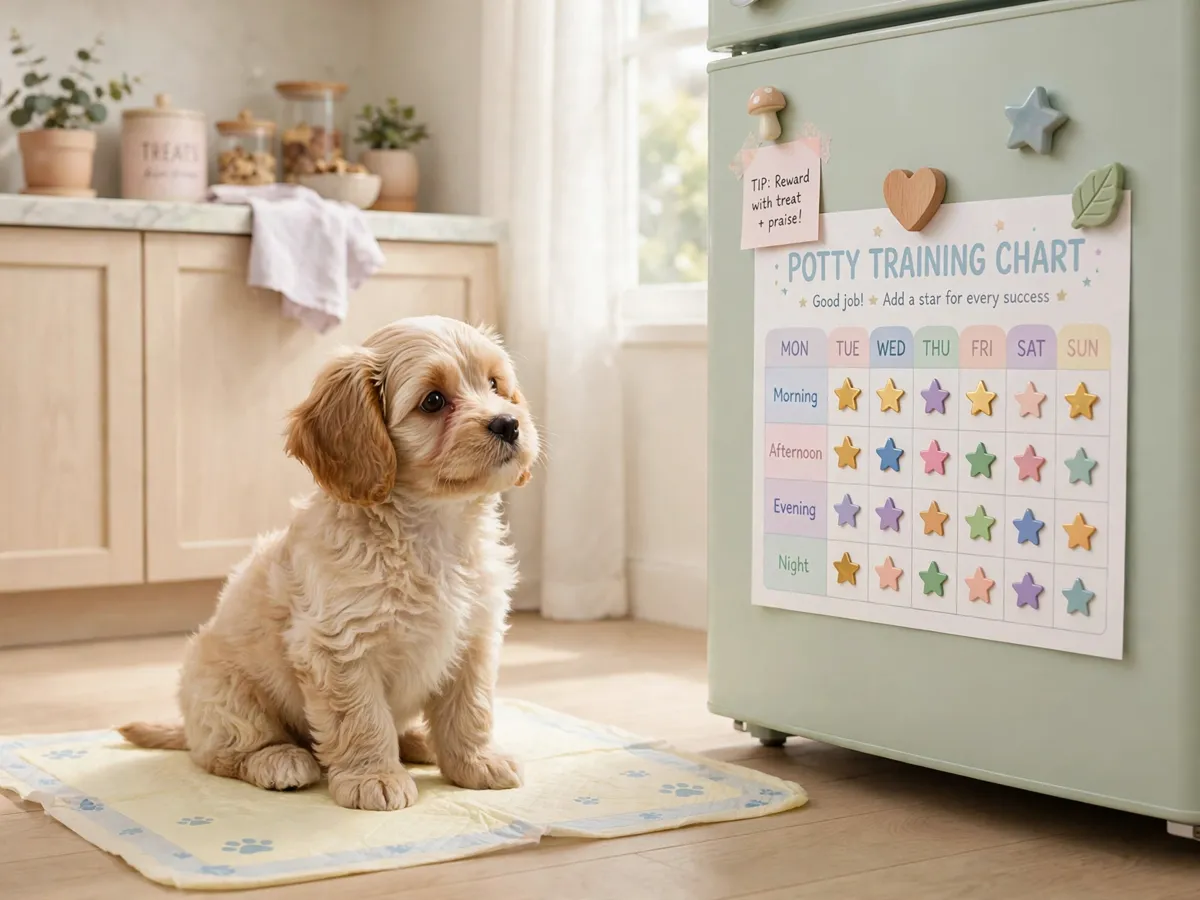
The Chart That Turns Misses Into Data
Every potty training household keeps a mental chart, and every mental chart lies. Ask a tired owner when the last miss happened and the answer drifts: yesterday, or maybe this morning, or was that the one by the sofa. The chart on the fridge does not drift. It remembers the hour, the trigger and the spot with the same flat honesty at week six as at day one, which is exactly when memory starts smoothing the story over.
The miss is the row that pays for the paper. A win confirms the schedule is working, but a miss names the hour the schedule was late, the trigger that ran long, the gap nobody noticed. Households that treat misses as report cards hide them, and a chart with hidden rows is a chart with holes. Households that treat misses as coordinates mark them fast and read them weekly, and the routine moves toward the puppy instead of the other way around.
This page owns the tracker as an artifact: the grid, the marks, the ritual around the marking. The hour by hour day itself lives on the puppy potty schedule and crate guide page, and the weeks when the pattern backs up belong to the potty regression reset guide. The chart is the thread that runs through both.
What Goes on a Potty Training Chart
Four columns carry the whole log, and every one of them is something you can see at a glance. Time, because the clock is what the schedule runs on. Place, because a puppy that goes outside is a different row from a puppy that went behind the sofa, and the two belong in the same column so the week reads as one story. Trigger, the word for what happened just before: nap, meal, play, drink, wake, none. And result, win or miss, written plainly. Nothing else earns space. Weight, food brand and weather belong in a notebook if they belong anywhere; the chart stays a potty log.
One row per event, and one page per day. A sheet that runs for a week without a break hides the boundary between Tuesday and Wednesday, and the boundary is half the value: the evening cluster means something different on the day of a late dinner than on the day of an early one. A fresh sheet each morning also gives the household a natural moment to look back at yesterday, which is the reading habit the next sections build on.
The chart lives on the refrigerator with the pen on a string beside it. A chart in a drawer gets filled in from memory at bedtime, and a chart filled from memory is fiction with a grid on it. The chart lives where the trips happen and the pen lives with the chart.
How to Mark a Win and a Miss
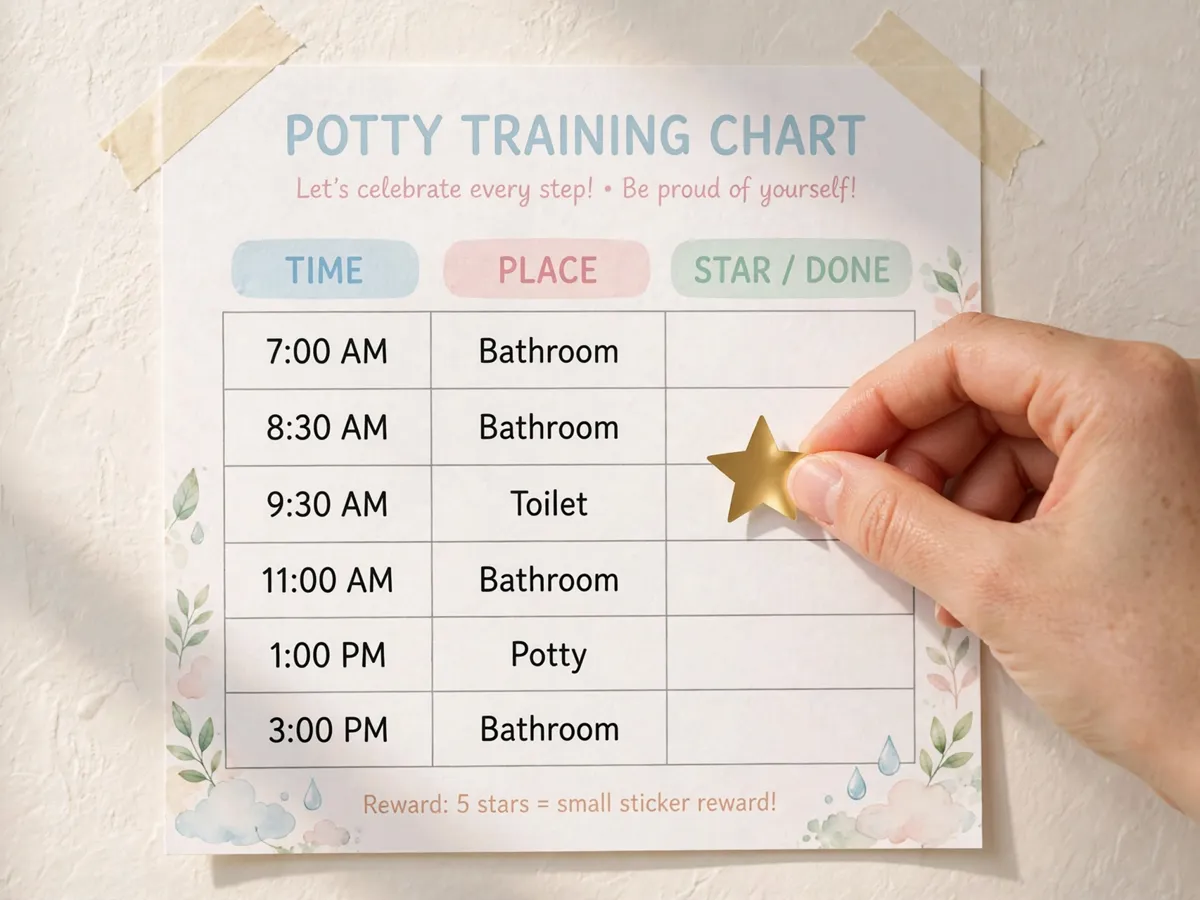
A win is marked the moment it happens, outside, with the puppy still standing in the spot. The sequence is the one that matters: the puppy finishes, the marker word lands, the party happens at the spot, and the sticker goes on the row while the moment is still warm. A sticker applied at bedtime from memory marks nothing but a guess. The timing of the mark is part of the event, not a bookkeeping chore after it.
A miss is marked the same way, in the same columns, with the same speed. Time, place, trigger, miss, and a plain circle rather than a star so the two results read differently at a glance. No comment written next to it, no exclamation, no name for the puppy. The miss is a coordinate, and a coordinate with a sentiment attached is a coordinate somebody stops writing down. Clean the spot with an enzymatic cleaner, mark the row, and the event is closed.
Whoever takes the puppy out marks the row, whoever that is. The partner, the teenager, the sitter, the neighbor who steps in at lunch: the pen is on the string precisely so the chart does not care whose hand holds it. The one rule is that the row is written by the person who saw the event, at the time they saw it. A household where one person transcribes the day for everyone else has put a narrator between the events and the log, and narrators smooth things.
Why the Chart Works on the Dog Side
The puppy never looks at the chart. The chart works on the dog side anyway, because the chart works on the household first, and the household is the half of the training the puppy can see. A home that marks every event in the moment is a home where the reward lands on the event instead of arriving late, where the same trip runs the same script every time, and where the people around the puppy act like a routine the house can count on. The chart is what keeps the humans consistent, and consistency is the thing the puppy is actually learning from.
The sticker is the cue for the people, not the dog. A star pressed onto the row in the moment is a small public act: the win got seen, it got named, it got recorded, and everyone in the kitchen at that minute watched it happen. That is the ritual that keeps the marking honest, and honest marking is what keeps the reward timing tight. The craft of the marker word itself, and the timing that carries it, belongs on the reward timing on the marker word page. The chart only makes sure the timing happens.
There is a quieter effect: the chart removes the mood from the routine. A missed puddle at the end of a long day lands differently on a tired owner than the same puddle on a relaxed one, and a puppy reads that difference. The row does not. The row is the same at midnight as at noon, so the response around the event stays the same, and sameness is the currency the puppy is paid in.
Reading the Pattern After the First Week
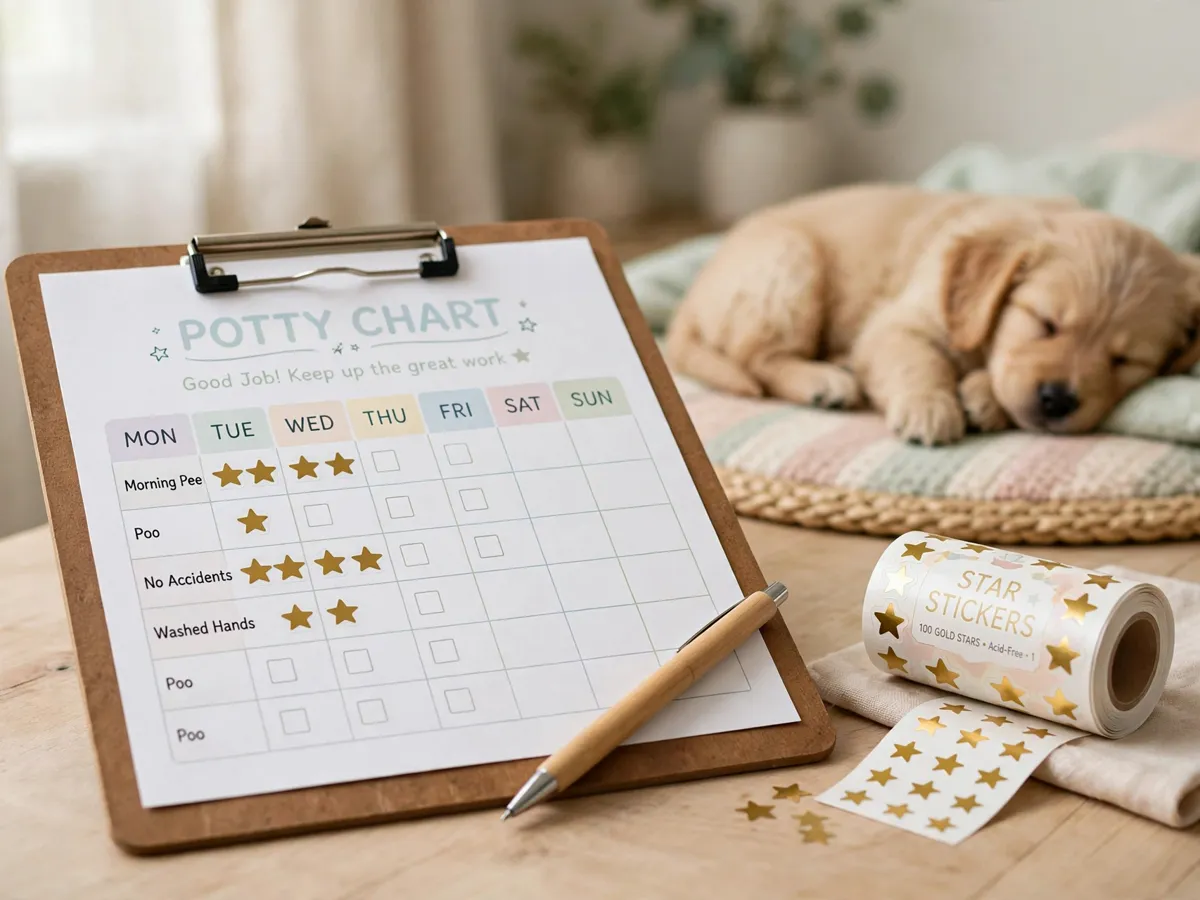
Clip the week of sheets together and read them as one document rather than as seven separate days. Read for clusters, not single rows: the hour column first, the trigger column second. A run of misses that all sit inside the same stretch of the day is a schedule with a hole in it, and the hole has an address. The scatter of one miss here and one miss there, spread across hours with no shared trigger, is a different story and usually a younger puppy story.
Read the wins too, because the wins set the baseline. A week where the paper fills with star rows after meals and naps is a week where the anchors are carrying the day. A week where the wins cluster around one person is a week where the script belongs to one handler, and the other household members have some rows to write.
Two patterns belong to other pages, and the chart is the thing that points at them. Misses that return in a block after a dry stretch are the regression signature, and the reset protocol lives on the regression page rather than here. A miss pattern that arrives with other changes, drinking more, asking out at odd hours, a sudden shift in the win rate, is a pattern to show the vet rather than to tune a schedule around.
The Chart Feeds the Daily Schedule
The schedule is a guess until the chart signs off on it. The puppy potty schedule and crate guide builds the day from anchors, meals, naps, play, wake-up, and the chart says whether those anchors are landing where the puppy actually needs them. The after dinner cluster is an instruction: the evening trip moves earlier, or a second short trip joins it. The play hour cluster is another one: a break lands mid-game instead of after it. The change is always small, one slot at a time, because two changes at once make the next week unreadable.
Change the schedule in pencil, then give the change a week of rows before judging it. A moved trip that clears the cluster is a change that stays. A moved trip that only shifts the cluster an hour sideways is a change to try differently, and the difference is visible on paper in a way it never is in memory. The chart does not hand out a verdict on day two, and neither should the household.
The quiet long game is the widening. As the win rate holds, the gaps between trips stretch, and the chart is the record of which gap stretched on which week and what happened after. A household that widens from the log stretches the gaps the puppy is ready for. A household that widens from a calendar stretches the gaps the calendar is ready for, and the paper tells that story in circles.
Potty training chart questions
What do I write on a potty training chart for a puppy?
Write the time, the place the puppy went, and whether it was a win or a miss, and add a word for the trigger you saw: after a nap, after a meal, mid play. One row per event, on the fridge where the whole house sees it. The chart is a log, not a scorecard: the misses are the rows that tell you where the schedule was late.
How does a sticker chart work with potty training, not just with the kids?
The chart does two jobs: it keeps every win marked in the moment, so the reward and the marker word land on the event, and it collects the pattern the schedule is built on. The puppy never sees the chart, the household does. The sticker is the cue that the log stays honest, row by row, and the routine around the marking is what the training rides on.
What does the chart tell me that a schedule alone does not?
A schedule says when the puppy should go out, a chart says when the puppy actually went, and the gap between the two is the training. Read the misses by hour and by trigger: the after dinner cluster moves the evening walk, the play hour cluster moves the play breaks. When misses return after a dry stretch, the regression page takes over, and the chart points the reset.
Save the Potty Training Chart
Pin this tracker for the first month with a new puppy, and keep the pen on the string even on the days the rows are all stars. The chart is the cheapest piece of gear in the routine and the one that remembers the most.
For informational purposes, consult your vet.