 PawStyle Daily
Cat-Friendly Apartment Decor
7 Small Apartment Cat Corners That Look Aesthetic (300sqft)
A 300sqft apartment works when vertical space does the work: one window perch, one shelf highway, one hidden litter nook. These seven corners are renter-friendly, with no big drilling, and every piece doubles as decor you would keep anyway. Give each resource its own spot and let the cat choose: a minimum of two resting areas, two feeding areas and two toileting areas. For informational purposes, consult your vet.
By PawStyle Daily · Updated 14 November 2026
Good to know: one weekend · Renter-friendly, no big drilling · Anchor tall pieces; supervise new climbers.
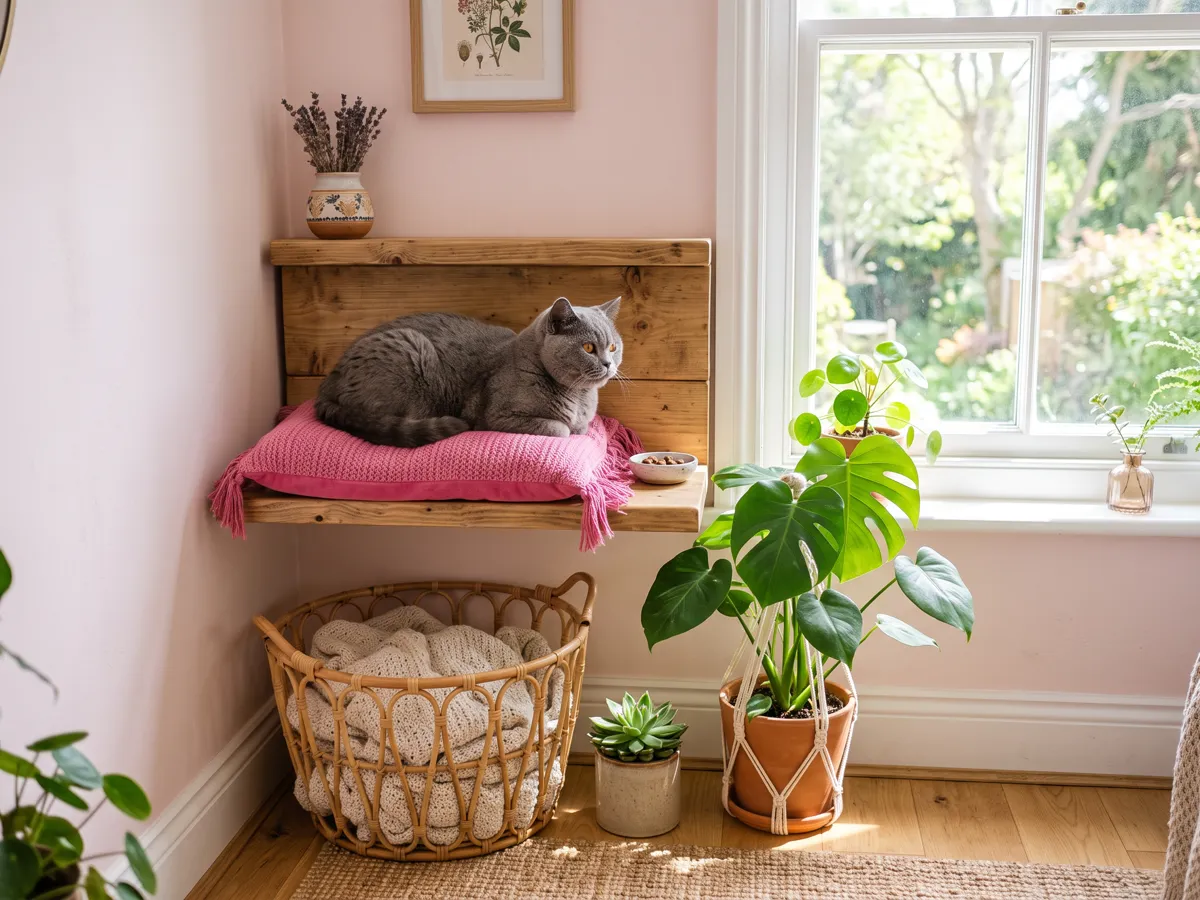
Walk the room first
Ten quiet minutes with a notebook, before a single bracket goes on the wall, will save a weekend of moving things twice. Walk the room at the hour your cat is most awake, stand in each corner, and write down five observations.
- Where the cat already sleeps. A cushion, a chair arm, the top of the fridge. That spot is where the new perch belongs.
- Where the sun lands. Check twice, once in the morning and once in the afternoon. Watch which patch of floor or sill the light crosses, and note the hour, because a perch in that patch gets used and one in the dim side gets ignored.
- Where the noise is. The entry door, the kitchen sink, the television, the street window. Write down the loud wall, then keep the resting corner off it.
- Where the door opens. Stand with the door shut, open it, and watch the arc it sweeps. A perch inside that arc is furniture you will move every week.
- Where the box can sit. Keep the litter box away from the food and water bowls, and give each resource its own spot so the cat has a choice. In practice the box takes the hall nook or the closet return, and the bowls stay in the kitchen half of the room.
Plan the corners on paper
A sketch on the back of an envelope beats a shopping trip. Draw the floor plan as a plain rectangle, then work through four marks in this order.
- Mark the window as a single line on the wall it belongs to, and mark the door as an arc. Those two marks decide the layout.
- Mark the sun path with two arrows, one for the morning and one for the afternoon, so you can see which strip of floor is bright and which one never is.
- Draw the cat's routes: the line from the sleeping spot to the bowls, the line from the bowls to the box, the top of the sofa, the edge of the hallway. Routes matter more than open floor, because a corner sitting on a route gets walked around.
- Draw the furniture footprints, including the pieces you cannot move. Whatever is left over is the real estate you are decorating.
Then place the corners on the sketch, one wall at a time, and check that no two compete for the same stretch of plaster. The window wall belongs to the perch and the sill bed. The long blank wall belongs to the shelf highway. The nook beside the hall belongs to the cabinet and the gallery wall above it. A tower takes the short wall at the end of the sofa, and the scratching panel takes the back of a door, where nothing else wants to live.
Two rules keep the sketch honest. If two corners land on the same wall, move one of them rather than stacking them. If a corner blocks a route you drew, turn it or drop it.
Order of work
Build in this sequence and the room settles once. Doing it in the order the boxes arrive means drilling twice and walking around a half-finished corner for a month.
- Start with the window perch. It is the one piece that needs the glass, so it decides everything else on that wall. Fit it, check the suction cups or the bracket, then leave it alone for a day.
- Add the tower next to it, on the same wall, set so the top platform faces the same view. For kittens and older cats with limited mobility, keep boxes, perches and shelves low or reachable by a ramp.
- Run the shelf along the long blank wall, at a height that meets the top of the tower. Two shelves with a gap between them read as a walkway. One shelf on its own reads as a shelf.
- Add the hide and the gallery wall last, once the big pieces are fixed and you can see which plaster is still free. Hang the frames above the cabinet rather than beside it, so the corner gets one vertical line.
- Move the litter box once, at the very end, into the nook you chose on the sketch. Set the box down, put the rug under the exit, and leave it there.
One weekend · Drill on the first day only · Move the box last, and once
1-3. Window trio: suction perch, sill bed, side tower
A suction-cup window perch at the glass. A padded sill bed for nap rotation. A slim floor tower beside the window, low enough to step up to: for kittens and older cats with limited mobility, keep boxes, perches and shelves low or reachable by a ramp. Indoor resting areas, such as a perch or a secluded surface, should include a spot where the cat can see outdoors.
Three heights, one window · Perch rated for cat weight · Suction check monthly
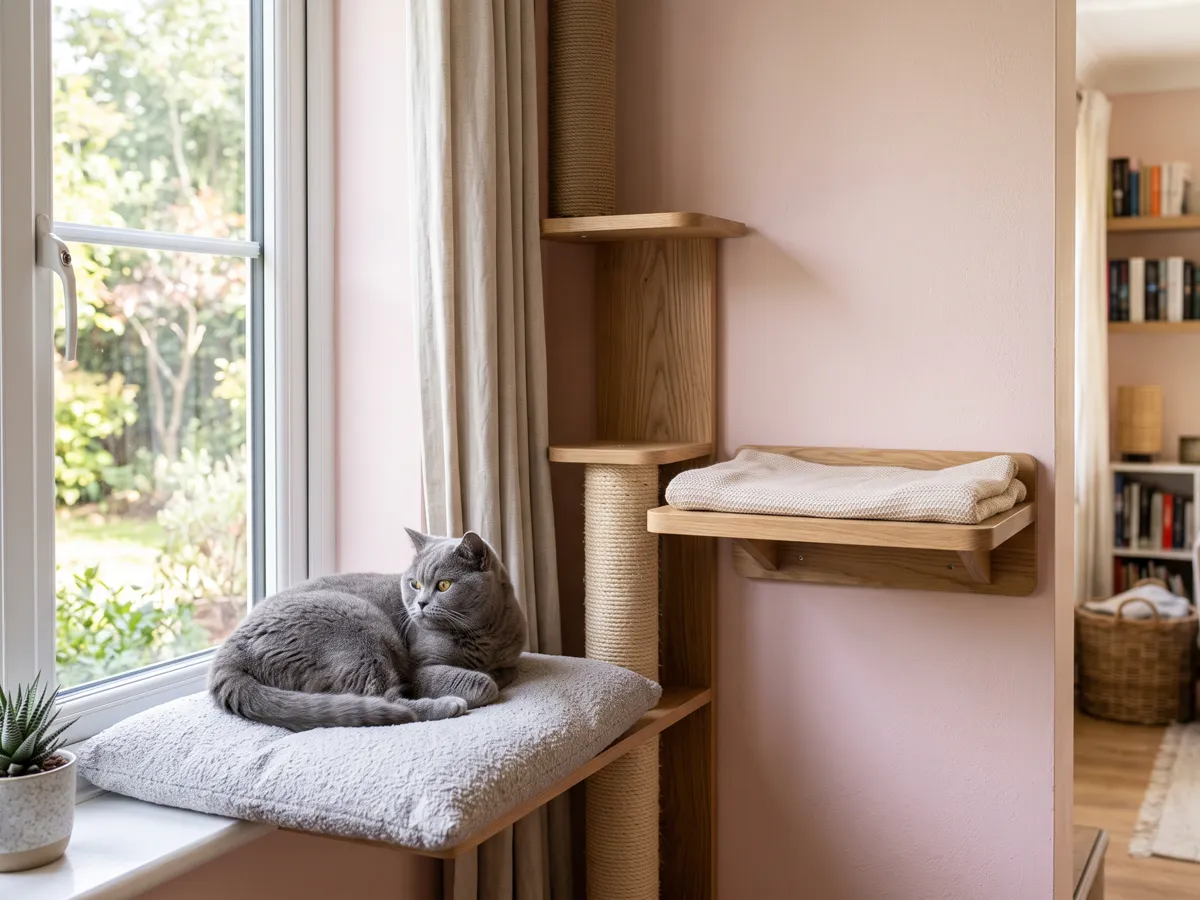
4-5. Vertical pair: shelf highway, door climber
Two staggered wall shelves make a highway over the sofa. Pad the top shelf with a folded blanket. An ideal perch is elevated, with a padded cover, and an elevated area gives a cat vertical space to monitor its environment. An over-door sisal climber gives a scratching spot without taking floor space: scratching areas can be a sisal-covered surface on an elevated perch or a scratching pad, and key resources should be available in multiple locations.
Renter-friendly · Stud or rated anchors only · 12-inch shelf gaps, ramp for older cats
For the box-based version of a climbing corner, see our DIY cardboard cat castle plans before you cut the first door.
Mount it so it stays
A shelf that comes off the wall takes paint, plaster and the cat with it. The fix is boring and it works: check the wall, choose the fixing, then test the shelf before anything climbs it.
Check the wall. Knock along the line where the bracket will sit, moving one hand width at a time. A solid note is usually a stud, a hollow note is the cavity between two of them. Run a stud finder over the same line and mark each hit with masking tape, so you can see the pattern before you commit to a height.
Give the bracket what it needs. A shelf bracket wants one fixing into a stud or into a rated anchor, and it wants that fixing through the round hole in the bracket rather than the slot. Slots are for levelling once the fixing is in. Hang the bracket, then put the shelf on last.
Test with a hand press. Set the shelf, then press the outer edge with a flat palm and hold for a slow count of five. Watch the plaster at the screw head for a hairline crack, listen for a creak, and look for daylight between the bracket and the wall. Any of those three means take it down and start the fixing again.
Renters: skip the bracket. A freestanding unit does the same job when it is chosen for its base. Pick a tower or a bookcase with a footprint wider than its top, stand it against the wall, and keep the weight over the base rather than the front edge. Nothing goes into the plaster. Our cat tree buying guide covers the base-to-top check before you pay.
When to skip the wall entirely. Crumbling plaster, a tiled splashback, brick you cannot drill, a wall you do not own, and any spot where the studs fall in the wrong place for the height you want. In all five cases a floor piece or a door-hung piece is the better answer, and the room loses nothing.
6-7. Hidden pair: cabinet litter, gallery wall
A ventilated cabinet hides the litter box with a cat-flap side entry: the box sits out of sight and the vent keeps the air moving. Keep the litter box away from the food and water bowls, and give each resource its own spot so the cat has a choice. Above it, a boho gallery wall with one printable cat portrait ties the corner into the room instead of screaming litter zone. Skip the flower vase. Lilies are especially toxic to cats and can cause life-threatening kidney failure even in tiny amounts, and poinsettias, mistletoe and holly are toxic as well.
Pair this corner with our hidden litter box ideas for small apartments for the cabinet cut and the cleaning routine behind nook 6.
Small space · Ventilated cabinet with a cat-flap entry · Washable rug under every litter exit
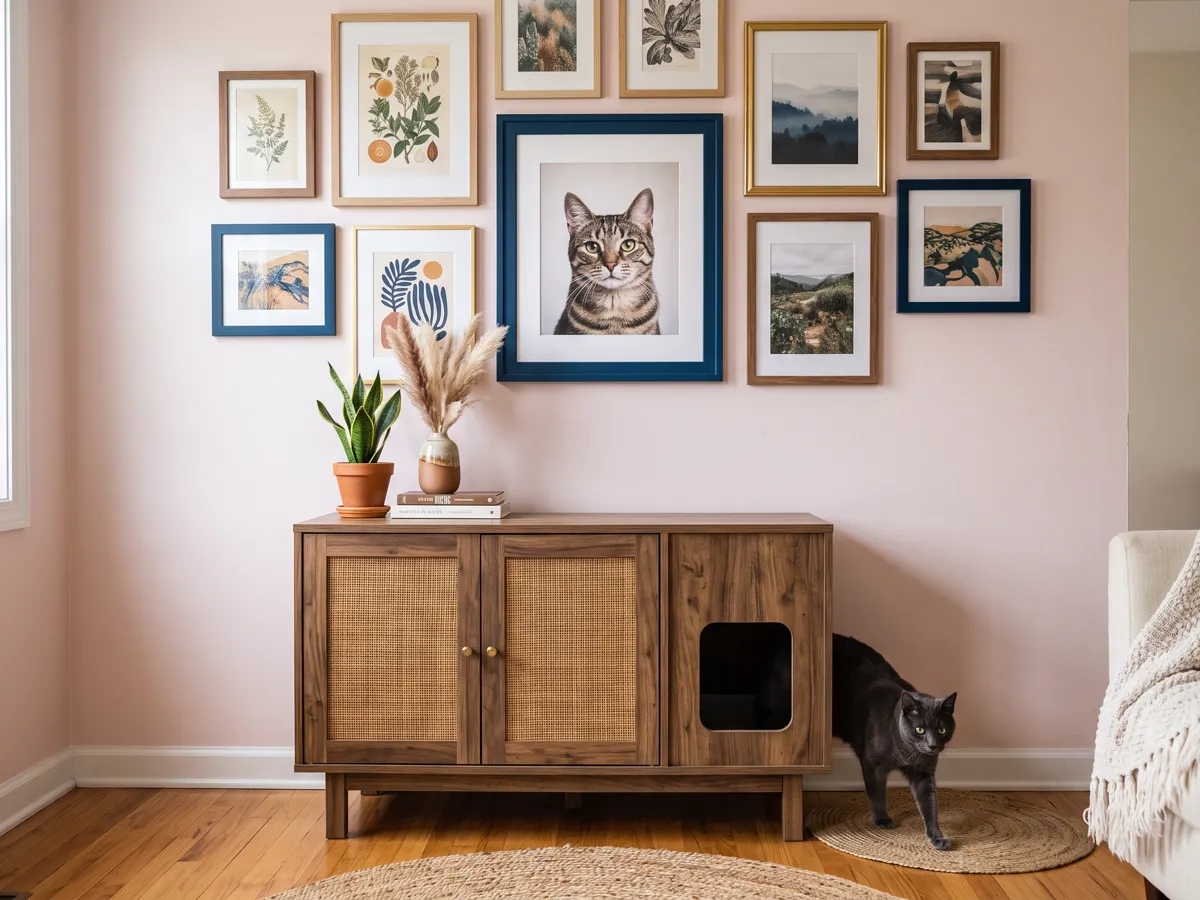
The gallery wall
A boho gallery wall is what turns the litter cabinet from something you hide into something you decorate. It is also the one corner that reads as a mistake when it is done in a hurry, so build it slowly.
- Pick frames of one colour. Black, walnut and brass in a single grouping looks like three collections. One colour, three or four sizes, and the eye reads the wall as one piece.
- Lay the whole arrangement out on the floor first, frames facing the wall, and stand back. Slide the outer pair outward and drop the centre piece a hair until the group looks deliberate.
- Hang from the top down, not from the centre out. Put the top pair in first, then level the next pair to them, then the bottom row last. Working from the centre outward is how you end up with a group that slopes.
- Keep the art away from the scratching surface. Put the wall panel and the sisal climber on another stretch of wall, so the framed side stays art only.
- Swap a print without moving the frame. Open the frame on a flat table, lift the old print, drop the new one in, and put the back on before you hang it again.
One colour, three to four frames · Hang top down · Keep prints away from the scratching surface
Watch a cat space get designed
The corners above are a plan on paper. This video walks the design side of the same job: where the litter box hides inside a tidy closet, how floor and wall materials get picked for a room a cat actually uses, and how a cat corner gets carved out of an apartment that was not built for one. Watch it before you commit to a layout.

Design tips for carving a cat corner out of a small apartment, with the litter box tucked into a closet. Video by Kaitlynn Stone on YouTube.
The seven corners at a glance
Seven corner layouts
| Corner | What goes there | Why it works |
|---|---|---|
| 1. Suction window perch | At the glass | Corners 1-3 use one window |
| 2. Padded sill bed | On the windowsill | Second nap spot, same view |
| 3. Slim floor tower | Beside the window | Step-up height, no drilling |
| 4. Shelf highway | Two staggered shelves | Walkway over the sofa |
| 5. Over-door sisal climber | On a door | Scratch spot, zero floor space |
| 6. Ventilated cabinet | Hall or laundry nook | Box out of sight, air moving |
| 7. Boho gallery wall | Above the cabinet | One printable portrait ties it in |
Anchors rated for climbing weight, checked monthly.
What each corner has to cover
Two of each resource, in separate spots, is the baseline: one window seat for naps, one shelf for height, one quiet feeding corner and one hidden box, all apart from each other.
Resource map
| Resource | How many | Where it goes |
|---|---|---|
| Resting areas | Two minimum | Window perch and elevated shelf |
| Feeding areas | Two minimum | Quiet corner, away from the box |
| Toileting areas | Two minimum | Hidden cabinet nook |
| Scratching surfaces | Multiple spots | Sisal panel on a door or shelf |
| Elevated perch | One | Top of the shelf highway |
| Outdoor view | One spot | Window perch or sill bed |
Two of everything
A small room can still hold two of everything, once you stop imagining that means two full feeding stations side by side. Give each resource its own spot and let the cat choose: a minimum of two resting areas, two feeding areas and two toileting areas.
Two resting spots. The window perch is the first, because indoor resting areas, such as a perch or a secluded surface, should include a spot where the cat can see outdoors. The second one belongs at the other end of the room, on the shelf top or in a hide. One sunny, one shaded, and the cat picks by the hour.
Two feeding spots. The main bowls sit in the quiet kitchen corner, the one furthest from the door swing and the noisiest wall. The second water bowl gets its own place across the room from the first, on a stable surface that is easy to reach during your usual refill routine. Keep the litter box away from the food and water bowls, and give each resource its own spot so the cat has a choice.
Two quiet spots. The hidden cabinet is the first, and the second one takes an even smaller footprint: a tray in a closet return, a hooded box under a stair shelf, a lid on the hall side of the washing machine. Two quiet corners, one on each half of the flat, means the cat never has to cross the whole room in the middle of the night.
Watch which one gets used, not which one photographs well. If the second bowl by the window empties and the main bowl sits full, the window bowl is the main bowl now.
Keep the wires tucked away
Keep electrical wires and batteries out of reach, because a wire can deliver a potentially lethal electrical shock. Three small jobs keep a corner honest.
- Route the cord behind the furniture. Start at the outlet, lay the cord flat against the skirting, and pass it behind the cabinet or the bookshelf before it rises to the lamp. Cord covers snap over whatever remains visible.
- Tame the battery lamp. A battery-powered lamp wants the same treatment: put it where the base cannot be pushed off, store the spare cells in a drawer with a latch rather than on an open shelf.
- Move the charging cable. A cable draped over the sofa arm is a lure. Run it over the back of the desk, through a clip on the wall above the work surface, and let it drop straight into the drawer.
Plant check before you buy
Boho corners love a plant, and this is the one place to be slower than the nursery wants you to be. Lilies are especially toxic to cats and can cause life-threatening kidney failure even in tiny amounts, and poinsettias, mistletoe and holly are toxic as well.
- Read the label on the nursery pot before it goes in the bag. Find the botanical name, not just the cute common name.
- Check that name against a veterinary list while you are still in the shop, not at home with the plant in your hand.
- Choose the shelf first and the plant second. A plant the cat cannot reach belongs on a high closed shelf or in a hanging basket.
- Skip the flower vase in this corner entirely. Cut bouquets shed petals onto rugs.
A corner with no plants is a finished corner, and a plant you are not sure about stays at the shop. For informational purposes, consult your vet.
Maintenance rotation
A cat corner is never finished, but it stays quiet work when it is split into six small jobs on a rotation.
Maintenance rotation
| What to check | How often | What to use |
|---|---|---|
| Perch cover | Weekly | Pull it off, shake it, wash on cool, and dry it flat |
| Shelf dust | Every two weeks | A dry microfibre cloth along the top edge, then the bracket |
| Gallery glass | Monthly | A microfibre cloth and a spray of plain water, frames left hanging |
| Litter box area | Weekly | Sweep the rug and the floor around the exit, wipe the cabinet base |
| Scratching surface | Monthly | A stiff brush against the sisal to lift loose fibre, then a lint roll |
| Tower fabric | Seasonally | Wash the covers, vacuum the seams, and rotate the pads between corners |
The rotation keeps each corner doing its own job: a clean perch gets used, a clean box keeps the corner worth looking at.
Common corner problems and the fix
Six problems show up in almost every small room, and none of them needs a rebuild. Each one is fixed at the wall or at the floor.
Corner problems and fixes
| Problem | Likely cause | Fix |
|---|---|---|
| The shelf wobbles when the cat lands | One fixing missed the stud and the other is not tight | Take the shelf down, find both stud marks, refix through the round holes, and re-test with a hand press |
| The perch cover slides off mid-nap | The cover is cut square and the perch has no lip | Cut the cover slightly oversized, fold it under the pad, and clip it at the two front corners |
| The cat ignores the new perch | It faces a blank wall instead of the view | Turn the perch toward the window, drop the height so it matches the sofa, and leave it alone for a week |
| A gallery print fades in the sun | The frame sits in the direct sun patch from the sketch | Move that frame one shelf down, swap the print for a spare, and put the prints away from the warm wall |
| The litter box crowds the feeding spot | Both ended up on the same wall when the sketch changed | Split them across the room, keep the box in the quieter nook, and leave the feeding spot clear |
| The tower tips when the cat jumps for the top | The cat launches from the same direction every time | Move the tower so the jump runs along the wall rather than across the room, and test it with a hand press |
Test each fix with a hand press before the cat does it for you.
When to skip a corner
Four honest cases where the right move is fewer corners, not better corners.
- A rental where nothing can be mounted. Peeling plaster, a landlord who counts holes, a brick wall you cannot drill. Build the room freestanding instead: a tower against the wall, a bookcase that does double duty, a suction perch at the glass, and a cabinet for the box.
- A room the cat has already mapped. If your cat already runs one route ten times a day, add to that route rather than drawing a new one. A new perch on an unused wall has to earn its place.
- A kitten still learning to jump. For kittens and older cats with limited mobility, keep boxes, perches and shelves low or reachable by a ramp. Start with the window and the hide.
- A cat that prefers the box. Some cats pick a cardboard box over a padded perch every single time. One box on a washable mat, turned to face the view, is a fine corner.
One corner done well beats four corners that fight each other, and a quiet room is the goal from the first day.
Corner checklist: copy before you buy
- One window seat + one high perch + one hidden litter
- Anchors rated for climbing weight, checked monthly
- Sisal scratch patch on one vertical surface
- Wires and batteries tucked out of reach
- Washable rug under litter exit
- One decor piece per corner (a gallery print counts)
Questions we get about small-apartment cat corners
How do I make a cat corner work in a really small space?
Give each resource its own spot and let the cat choose: a minimum of two resting areas, two feeding areas and two toileting areas. Keep the litter box away from the food and water bowls, and give each resource its own spot so the cat has a choice. For informational purposes, consult your vet.
Does my cat need vertical space in an apartment?
An ideal perch is elevated, with a padded cover, and an elevated area gives a cat vertical space to monitor its environment. For kittens and older cats with limited mobility, keep boxes, perches and shelves low or reachable by a ramp.
Which plants and cords should stay out of a cat corner?
Lilies are especially toxic to cats and can cause life-threatening kidney failure even in tiny amounts, and poinsettias, mistletoe and holly are toxic as well. Keep electrical wires and batteries out of reach, because a wire can deliver a potentially lethal electrical shock.
How many corners should I start with?
One. Fit the window perch first and live with it for a week before you add the next piece. A room that gains one corner at a time stays readable, and you learn which spots your cat actually uses before the rest of the budget goes out the door.
Where should the second water bowl go?
Across the room from the food bowls, on a surface that will not tip and is easy to wipe. Keep the litter box away from the food and water bowls, and give each resource its own spot so the cat has a choice. Refill both bowls on the same round so neither one sits stale.
Will a freestanding tower work instead of a wall shelf?
In a rental, yes. Choose one whose base is wider than its top, stand it against a wall, and keep the weight over the base rather than the front edge. You give up a little floor space in exchange for no holes in the plaster, and the height job still gets done.
How do I keep the gallery wall out of the scratch zone?
Hang the frames above the top of the sisal panel and keep the scratching surface on a different stretch of wall. A panel on a door or a shelf end gives the corner its scratch spot, and the prints stay where you hung them.
How do I introduce a new perch?
Set it in place and leave it empty for a day. Then add a blanket that smells of your cat's usual spot, and put the perch where the cat already likes to sit rather than where the room looks emptiest. If a week passes and nobody has used it, move the perch instead of buying another one.
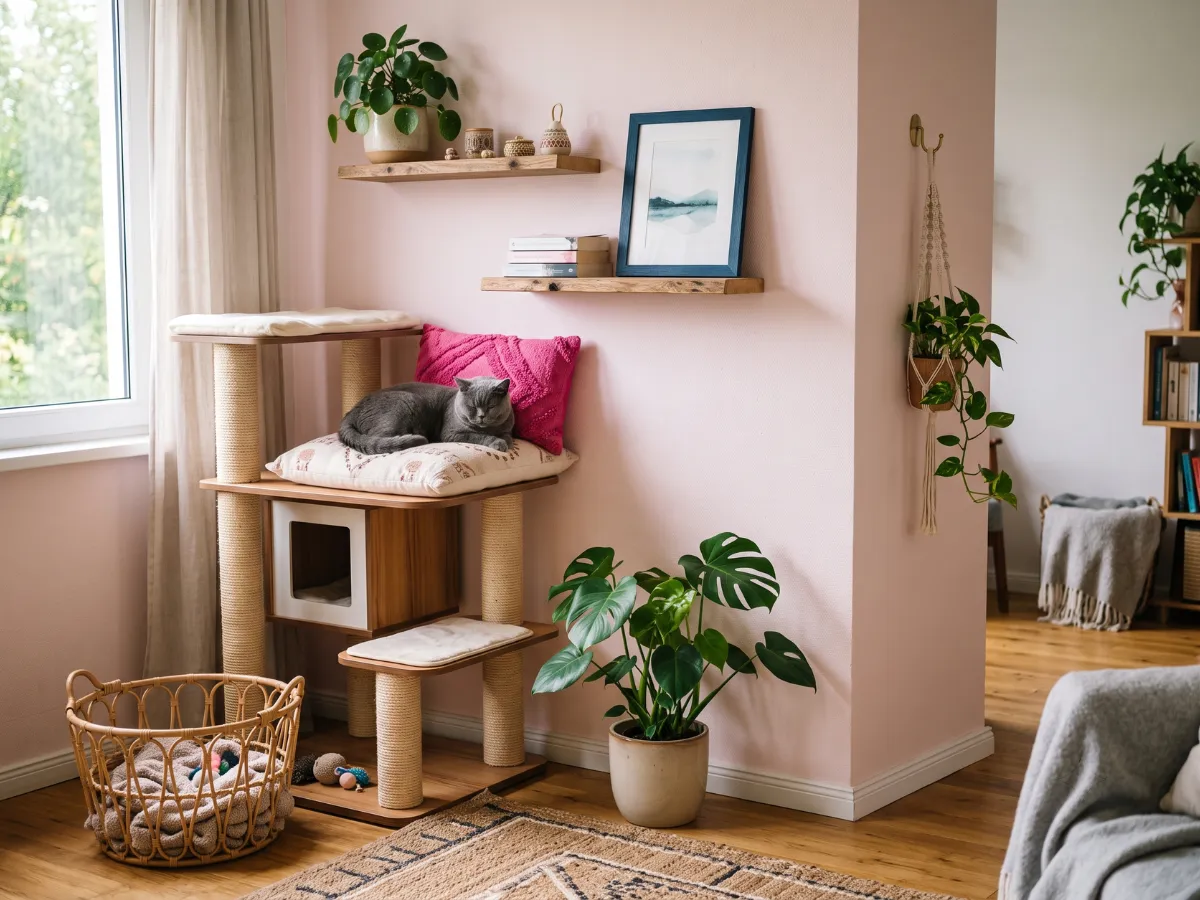
What we use
What we use for cat corners
Window perches, wall shelves and cabinet latches cover all 7 corners, renter picks in one list.
See what we use →As an Amazon Associate we earn from qualifying purchases.
Save these on Pinterest
Pin the corner that fits your floor plan. The Cat Home collection holds the DIY tree and hidden litter guides.
Sources
The placement, safety and plant rules on this page come from feline veterinary and animal-welfare guidelines, not from our own head: