 PawStyle Daily
Puppy Training Tips
Litter Box Training a Small Dog in an Apartment
A toy breed on the third floor does not always get the outdoor trip the training books assume. An indoor tray gives a small dog a bathroom that is open in every weather, and it gives you a routine that does not depend on the elevator. The tray is a back-up spot, not a replacement for the walk.
By PawStyle Daily · Updated 18 November 2026
Good to know: tray far from the bowl · meals set the clock · reward on the tray · always supervised · for informational purposes, consult your vet.
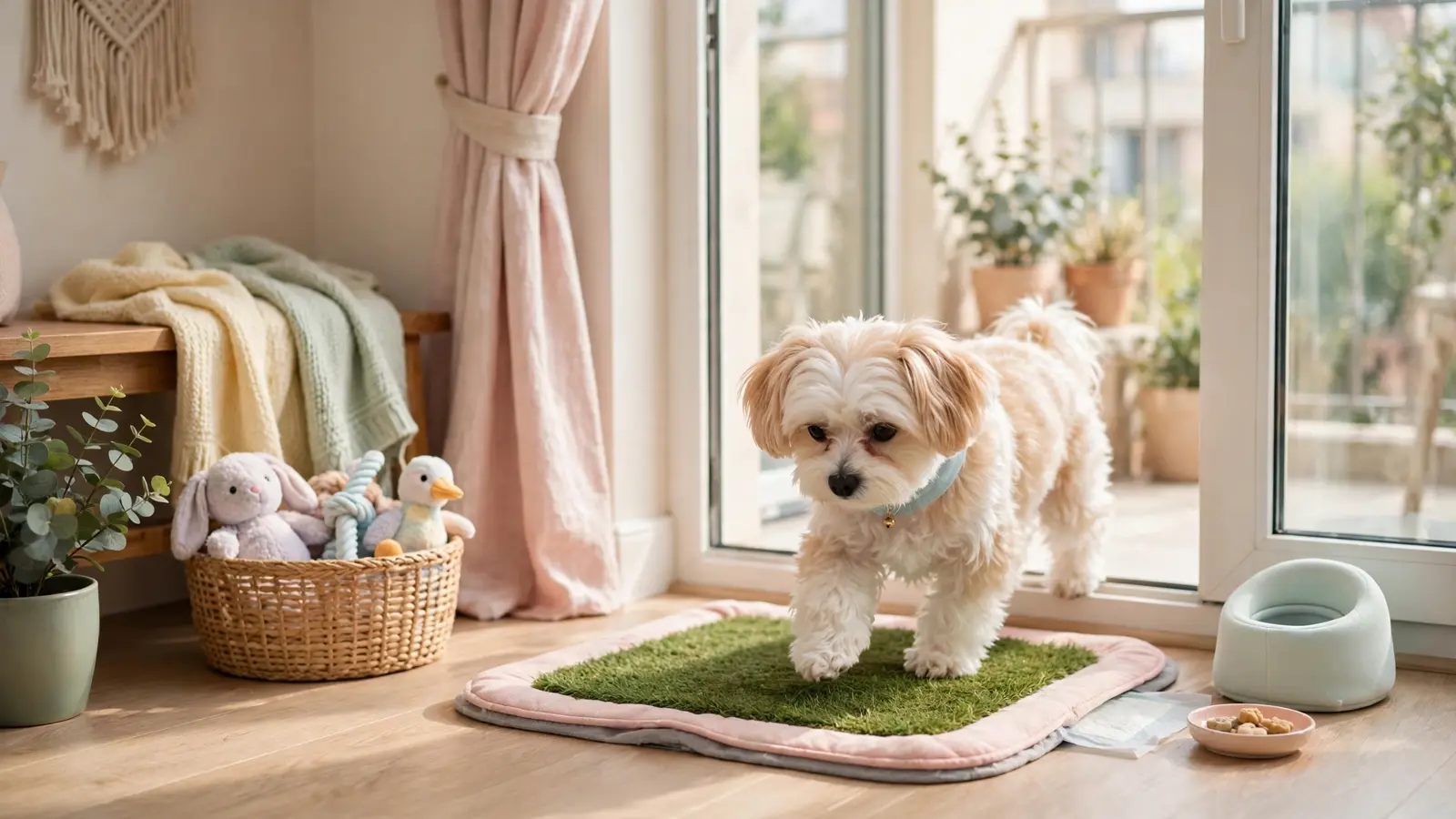
Why an indoor spot fits a small apartment
A very small dog holds very little, and a cold morning or a full elevator can stretch a trip past what that bladder can hold. The tray removes the weather from the equation, and it removes the lift queue too.
This is not a shortcut around house training. The dog still learns a place, still learns a surface and still earns a reward for getting it right; the place simply happens to be inside.
For a dog in a one-bedroom flat, the honest math is that the tray gets used at night and on the worst mornings. The daytime walks stay, and the tray quietly saves the rug in between.
Choosing the spot before the first accident
The corner matters more than the equipment. Keep the litter box away from the food and water bowls, and give each resource its own spot so the cat has a choice. Read that line for a small dog and nothing changes except the noun.
In a studio that usually means the tray near the balcony door and the bowl at the other end of the kitchen run. The bathroom is the other good answer, because the floor is already washable and the door already closes.
- Away from the food station and the water bowl, with a clear path at night.
- On hard flooring or a washable mat, never on carpet you love.
- Somewhere the dog can turn around and sniff, with a little privacy.
- Not behind a door the dog cannot open, and not in a closed cupboard.
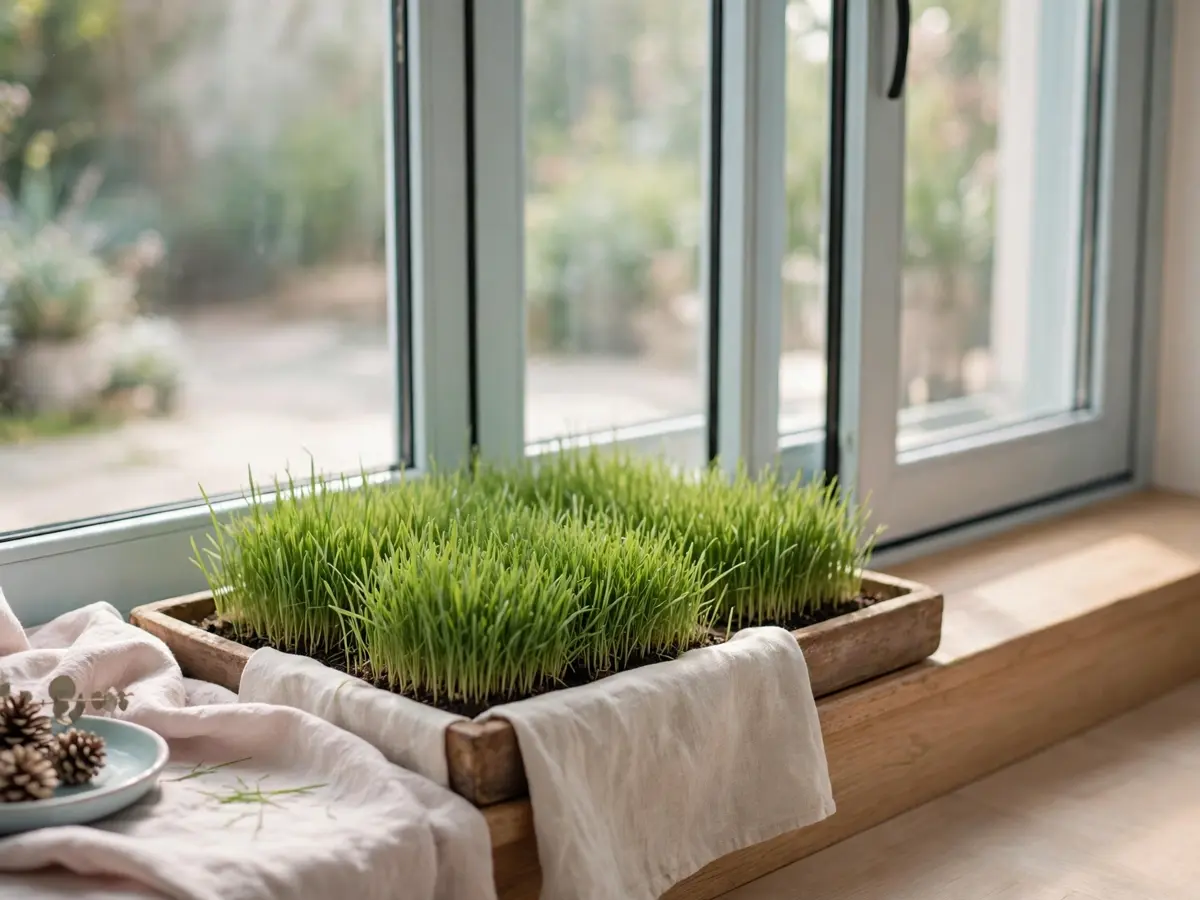
Setting up the tray
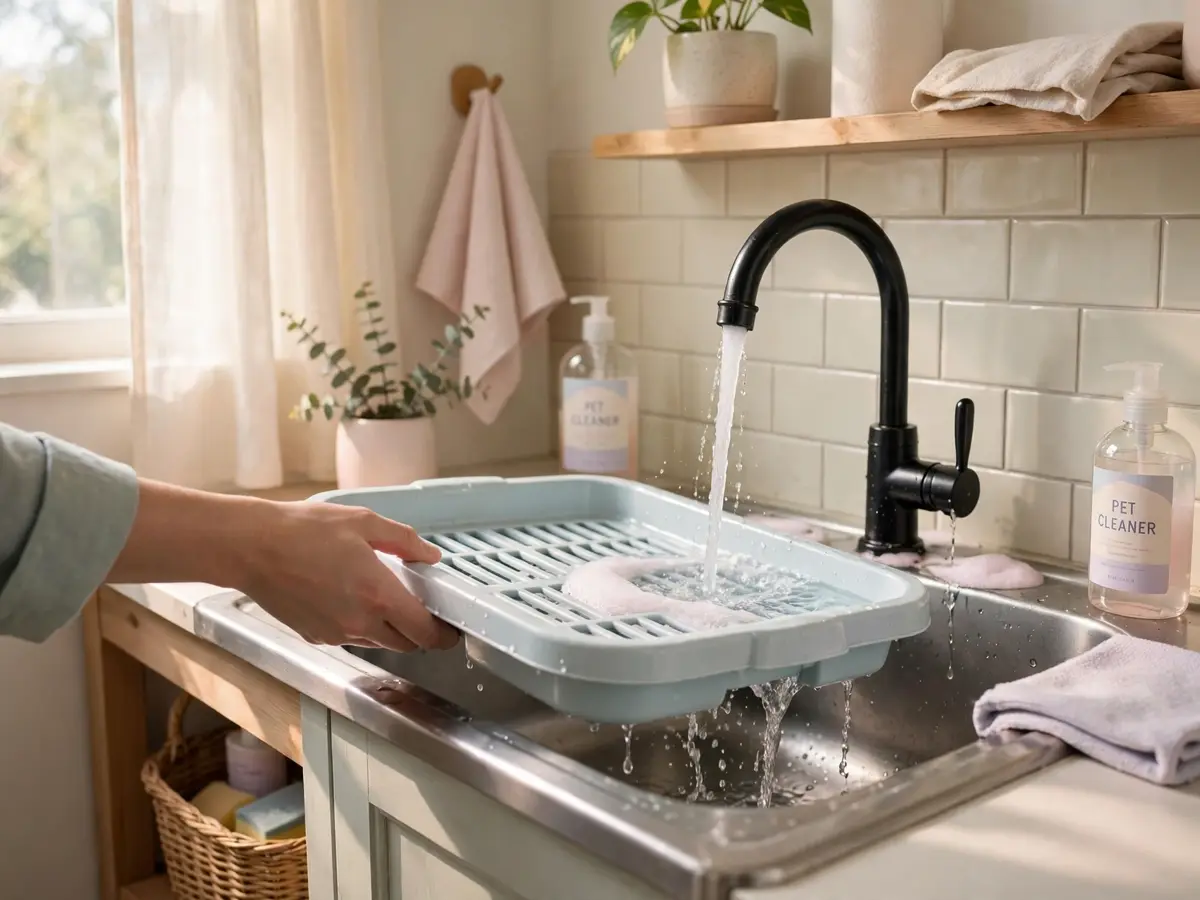
An indoor potty is a tray with something absorbent inside, and the tray should not slide when a small dog steps on the edge. A lip around the rim catches the misses, and a washable base makes the whole thing a quick job at the sink.
Pick one surface and stay with it for a few weeks. Grass patches suit a dog that already prefers grass outdoors, washable pads suit a dog that has only known pads, and a pellet tray sits between the two for a household that wants a tray which rinses easily.
Keep the tray on the same floor of the flat as the dog’s daytime room. A bathroom two flights down is a bathroom the dog will not ask for at the wrong moment.
Meals are the potty clock
Feed at the same times daily. The meal is the clock the rest of the day runs on: a small dog eats, then needs the tray a short while later, and the pattern repeats once the meals do.
Take the dog to the tray after every meal, every nap and every play session, and stay there for a few quiet moments rather than a passing look. The trips that happen on a pattern are the ones that land on the tray.
Write the meal times and the trips on a note by the bowl for the first week. Anyone who feeds the dog then knows when the next trip is due, and the routine survives a busy Tuesday.
The reward at the right second
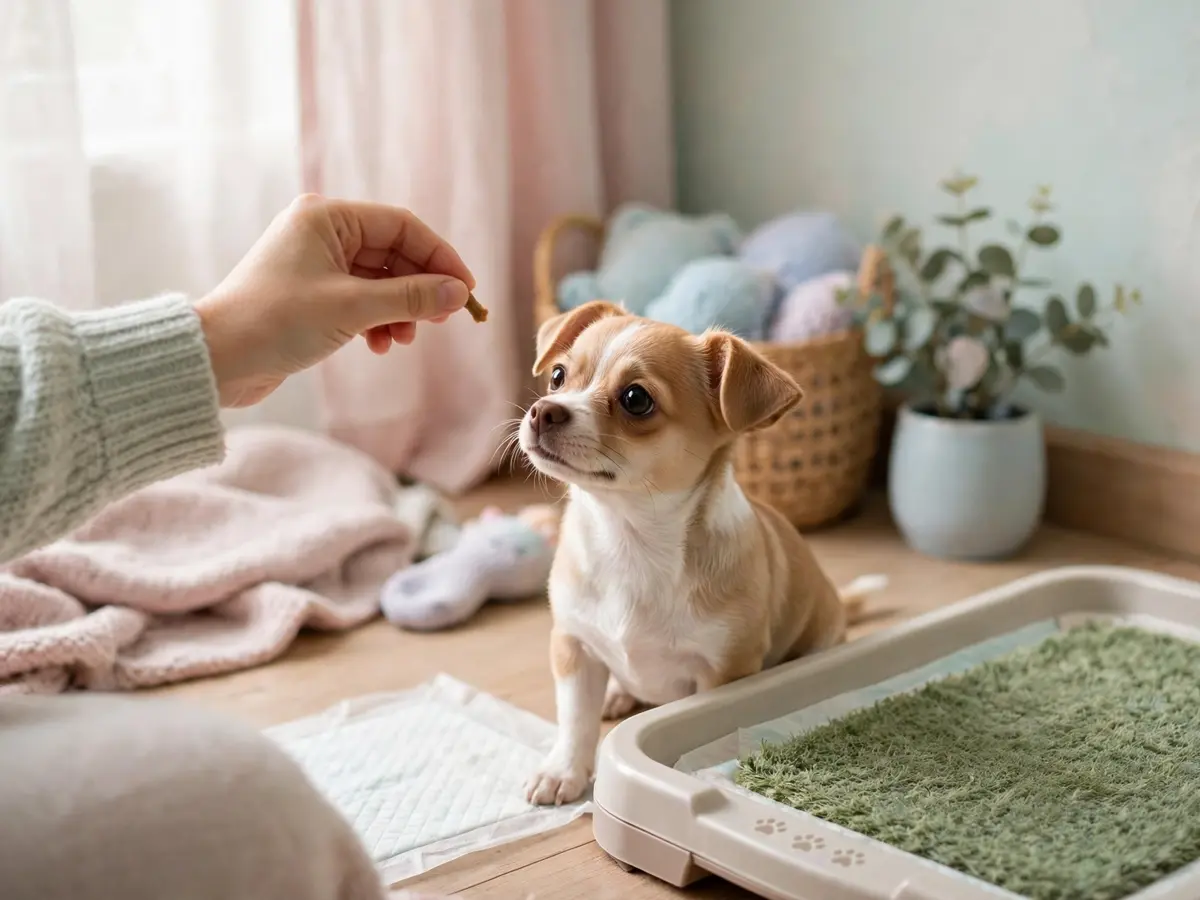
The reward lands while the dog is still on the tray, not after it has walked back to the kitchen. When treats are for training, keep each one as small as possible and count it against the day's food. Praise first, treat second, and the order matters less than the timing.
A marker word works the same way: say it the moment the dog finishes, then hand the piece over. Two or three successful trips in a row are worth more than an afternoon of reminders.
Accidents without the scolding
An accident is information, not defiance. Clean it with an enzyme cleaner, keep the dog out of the room while the floor dries, and take the next trip to the tray rather than to the scene of the accident.
Scolding teaches a small dog to hide the next puddle behind the sofa, which is the opposite of what the tray is for. A quiet clean-up and an earlier trip tomorrow is the whole correction.
Indoor potty options at a glance
| Option | What it is | Best for |
|---|---|---|
| Grass patch in a tray | Real or artificial grass on a drainage tray | Dogs that already choose grass outdoors |
| Washable pad | A cloth pad on a non-slip base | Dogs that have only ever used pads |
| Pellet tray | A shallow tray filled with pellets | Households that want a tray which rinses easily |
| Balcony patch | A second grass patch outside the door | Flats with a balcony and no lift queue |
Whichever you pick, the tray keeps the same corner every day, and a rinse at the end of the day keeps it a spot the dog wants to visit.
When repeated accidents mean a vet visit
A dog that had the routine and suddenly stops using the tray may be telling you something medical, especially when the trips get sudden, the dog strains, or the floor is wet in places the tray never sees.
The same is true for a dog that drinks far more than it used to, or one that starts wetting at night after months of dry ones. Book the vet first and change the setup second, because a routine cannot fix a body that needs attention.
If the indoor spot is a second bathroom rather than the only one, the potty training routine with a crate covers the outdoor half of the same week.
Indoor potty training questions
Can a small dog really learn to use a litter box?
Yes, and the lesson is the same one a cat learns: same corner, same surface, same quiet moment. A toy breed picks a spot up quickly when the tray never moves, because the dog is learning a place rather than a command.
Where should the tray sit in a studio apartment?
Away from the bowl. Keep the litter box away from the food and water bowls, and give each resource its own spot so the cat has a choice — read that line for a dog and nothing changes except the noun. In practice, the tray sits by the balcony door and the bowls stay at the other end of the kitchen run.
Should I use pads, grass or a tray with pellets?
Pick the surface your dog already chooses outdoors, then stay with it long enough for the lesson to settle. Washable pads suit a dog that has only ever known pads, and a grass patch suits a dog that already prefers grass. Changing surface every week restarts the lesson.
What do I do when I catch an accident happening?
Move the dog to the tray, calmly, mid-stream if you can, and praise whatever lands there. Then clean the old spot properly so the smell does not call the dog back. No shouting: a scolded dog learns to hide the next puddle, not to use the tray.
How long does indoor potty training take?
There is no fixed date, and a calendar is the wrong scoreboard. Progress looks like fewer misses each week and a dog that walks to the tray on its own. A week of steady trips tells you the routine is working before the dog is perfect.
When do accidents mean a vet visit?
When a trained dog starts missing the tray, when the trips get sudden and frequent, or when the dog strains and nothing much comes. Those are questions for your vet rather than for another week of cleaning.
Save these on Pinterest
Pin the tray checklist for the next rainy week, then pair it with the basic puppy commands and treat rewards, the litter box setup and cleaning routine and the puppy training collection. One tray, one corner, one calm week.
When treats are for training, keep each one as small as possible and count it against the day's food. For informational purposes, consult your vet.
The small dog learns to use a box; the cat's box teaches a different lesson, which the when the dog is the visitor page handles.