 PawStyle Daily
Cat-Friendly Home
Dog-Proof Cat Litter Box: Three Barriers, Cat Still Gets In
A dog at a cat's litter box is a layout problem before it is anything else. The pan sits at nose height, in a hallway the dog patrols, holding a loose texture a paw can move in one swipe. No amount of correcting teaches a dog to walk past that, and a cat that has to defend its own box stops using it. This page builds three physical barriers instead: a tall gate with a cat-sized opening at the bottom, a room the cat owns behind a flap, and a cabinet with a door cut low. Each one answers the same question.
By PawStyle Daily · Updated 22 November 2026
Good to know: three layouts, one shared rule · read the opening off your own cat, not off a tape · a barrier the cat will not use is not a barrier.
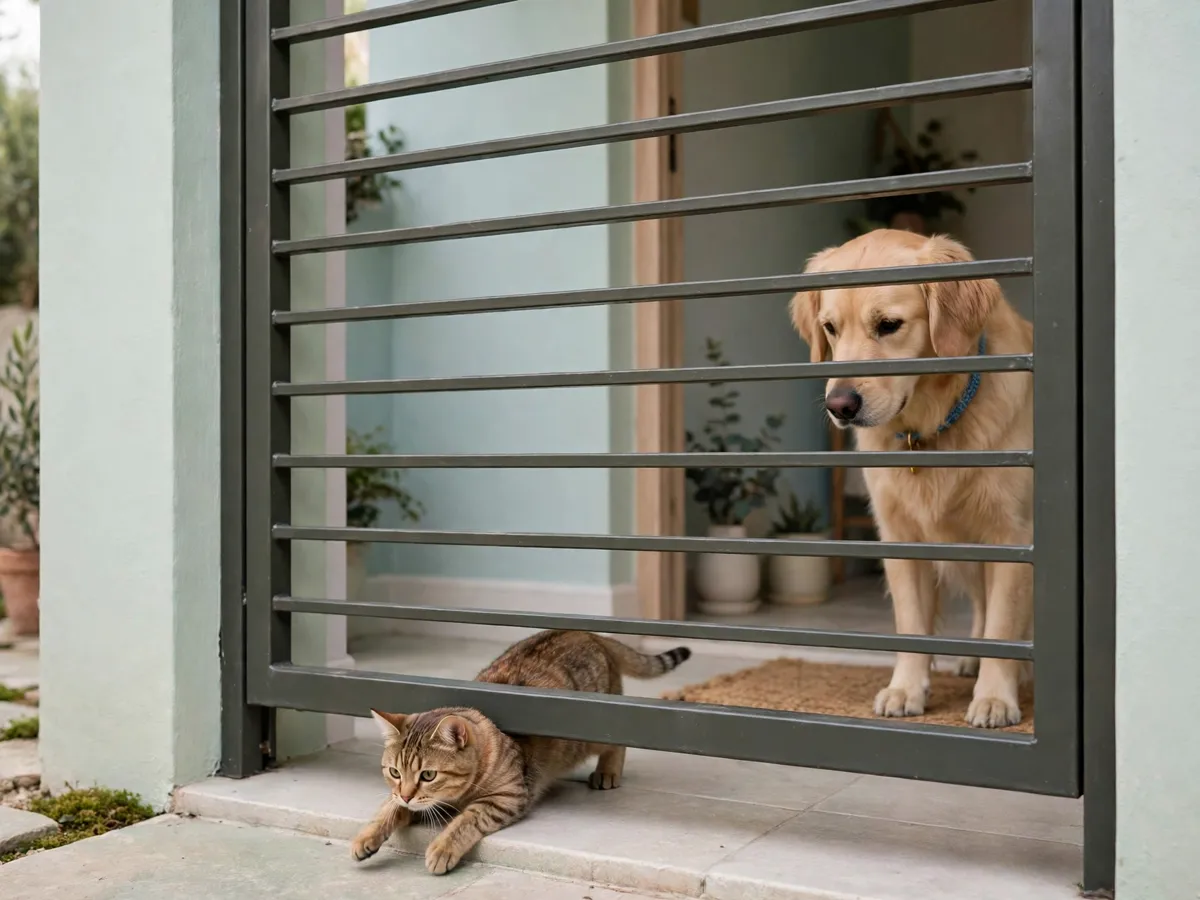
The Box Sits Where a Dog Can Reach It
Most households put the litter box where it is convenient for the human: the kitchen corner, the bathroom door, the hallway by the laundry. Those are also the rooms a dog walks through twenty times a day. The pan sits in the middle of the dog's route, low to the floor, and the dog investigates everything, nose first and paw second.
Moving the pan is the free answer, and it is rarely available, because the new spot has to work for the cat too. The practical answer is a barrier: something between the dog's route and the pan that the cat can pass through and the dog cannot.
Why Dogs Reach Into a Litter Box
Curiosity comes first, and boredom right behind it. A dog with an empty afternoon works through every interesting object in the house, and the litter box sits at the top of that list. It carries the smell of the cat's meal, it holds a dig-shaped hollow from that morning, and it sits at a height where a nose reaches it without effort.
What a dog does with the box varies by dog. Some take a mouthful of litter and walk off. Some rake the floor outside the pan until the hallway looks like a sandbox. Some do nothing at all and stand there watching the cat use it, which is its own problem: a cat that is watched while it goes starts holding it in or going elsewhere. All three read the same from the layout's point of view: the dog can reach the pan.
That is why the fix is physical. A correction teaches one object in one place, and the dog forgets it when you leave the room. A barrier works while you sleep.
Three Barrier Layouts to Build
Pick the layout that matches the door or the furniture you already own, not the one in the photograph. All three work on one rule: the opening is sized for the cat's body and refused by the dog's.
One. A tall gate with a low slat gap
The gate goes across a doorway or a hallway break: tall enough that a dog cannot jump it, with wide horizontal slats whose lowest pair leaves a slit a cat slides through and a dog's shoulders cannot. Mount it with pressure pads or a top brace rather than a spring tension rod, because a dog leans on the bottom rail and a spring rod walks down over a week. A gate with no gap the dog can shoulder open is the whole requirement, and a latched hinge keeps a curious dog from swinging it wide.
Two. A room the cat owns
A spare room, a laundry, or a bathroom under a vanity, with a cat flap cut into the door. This is the strongest layout and the one that also solves the watching problem, because the cat gets a door of its own. The flap sits low, the door stays shut, and the pan lives on a washable mat inside. The catch is the human habit: anyone who closes that door for their own reasons has taken the cat's toilet away, so the room wants a doorstop or an outside hook for the hours nobody is in it.
Three. A cabinet with a flap cut low
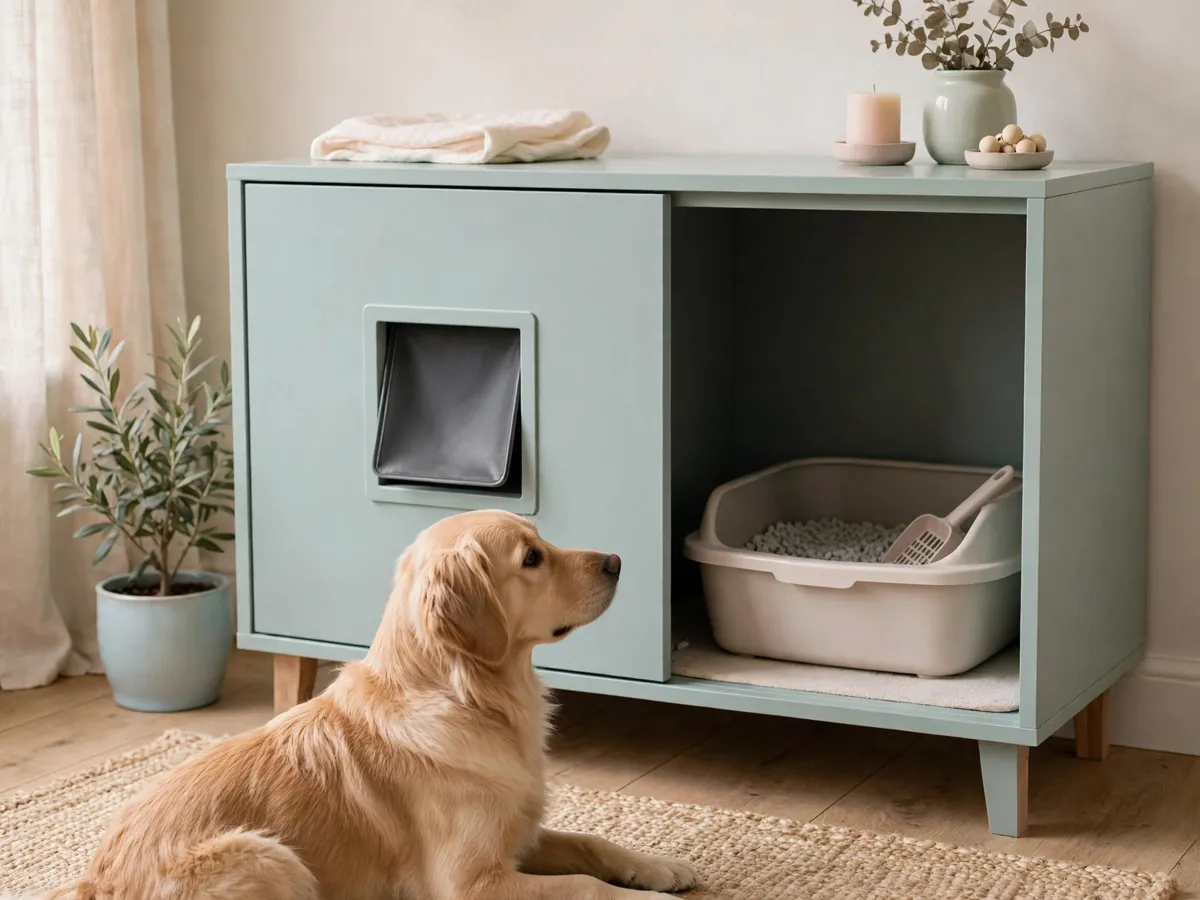 The furniture answer for a home with no spare door. A low sideboard or a bench with a square hole cut near the bottom of the door, a flap in the hole, and the pan inside. It hides the box, which is the reason most people build it, and it refuses the dog as a side effect. The door needs a hinge that holds the weight of a full pan's worth of traffic, and the base needs a mat because every exit shakes litter out of the paws. The styling of the outside is its own subject, and the aesthetic litter box cover ideas page covers what a cabinet can look like on the outside.
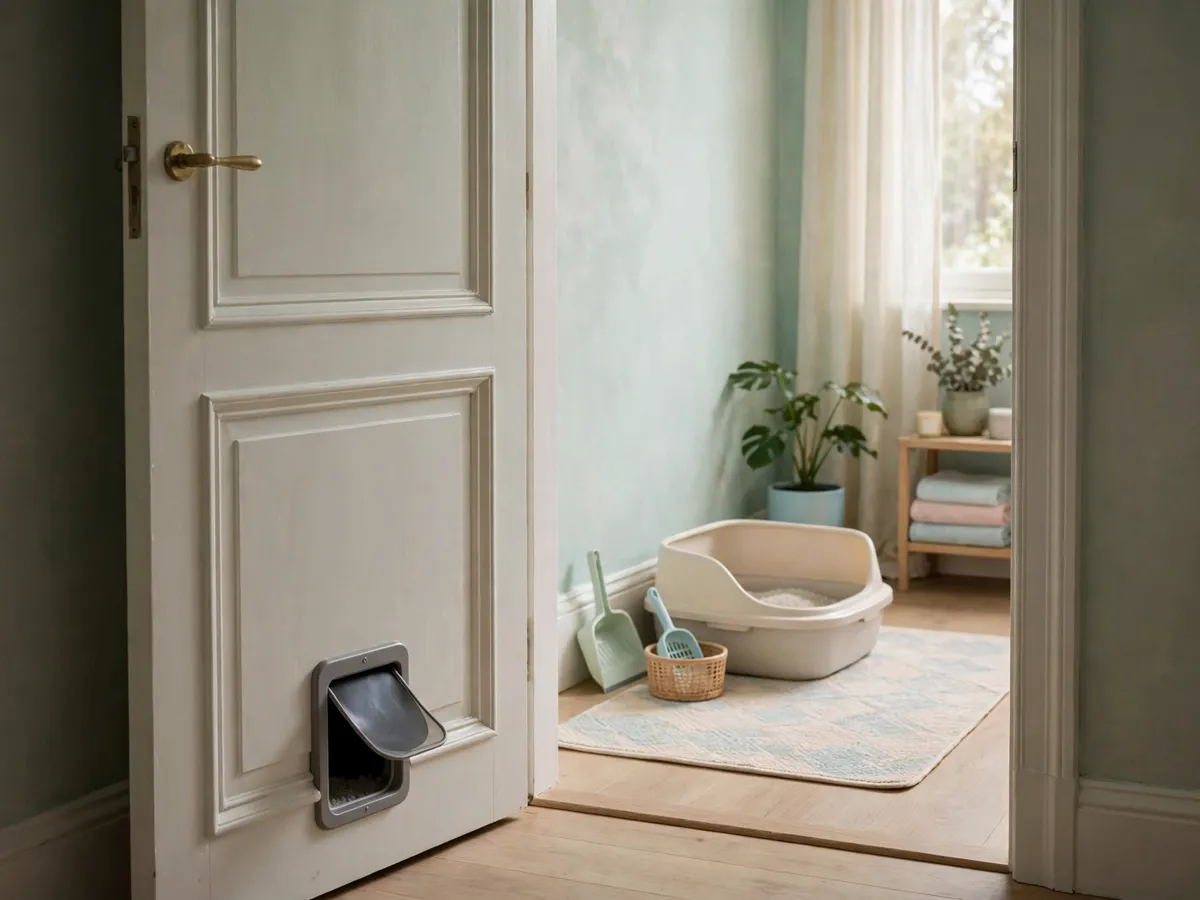 The same flap works on an interior door when the spare room layout fits your floor plan better. Cut the hole near the bottom, hang the flap, and the far room becomes the cat's own: the pan on the washable mat, the door shut, the dog watching a wall. Give the flap the same hand test the cabinet flap gets, and give the door a hold-open habit, because a door closed out of habit is a barrier that only works when someone remembers it.
Reading the Gap Off Your Own Cat
Every diagram on the internet quotes a number, and every number is wrong for your cat, because the opening has to match the animal that uses it. Read it off the cat instead. Look at the widest part of the body, which for most cats is the ribcage behind the front legs. That width is the minimum slit. The height is the shoulder line, because a cat ducks its ears on the way through.
Then test it with cardboard. Cut a window in a large box, lay the box on its side, and put a treat-free lure on the far half. Walk the cat through once so you can watch the shoulders, not the head. If the cat turns sideways, the window is too narrow, and a cat that has to turn sideways at every visit will start choosing the floor next to the barrier instead. Add room to the whiskers as well: a flap that brushes the face on the way in is a flap a cat learns to dislike.
Read the dog side the same way. A gap the cat walks through upright is only worth having if the dog has to think about it. A dog that lowers its head, plants two paws and hauls forward will get through a slit that stopped it on the first try, so the barrier needs a height the dog cannot clear standing up and a base the dog cannot dig under. If your dog has solved one layout, build the harder one.
The Materials List Before You Build
For the gate layout: a metal or heavy wood gate with horizontal slats, a top brace or pressure mounts, a latch a human opens with one hand, and a rubber foot for the bottom rail so it does not walk across a hard floor. Skip a mesh or fabric gate, because a dog leans on a flexible panel as if it were a door.
For the room and the cabinet layouts: a plastic cat flap with a removable cover, a jigsaw or a sharp utility knife depending on the door, a fine file for the cut edges, and a screwdriver long enough to reach through the door thickness. Hold the panel you remove so you can put it back the day you decide the flap was a mistake. On a fabric-covered door, the opening is held with a stitch and a bonded edge rather than a bare cut, or the weave frays out of the rectangle within a month.
Shared by all three layouts: a washable mat under the pan, a lidded bin inside the enclosed space so the scoop does not have to cross the barrier twice, and a scoop with a handle you can pass through the opening. The last one is the detail people miss, and a long-handled scoop is the difference between a daily tidy and a barrier you stop opening. For the smell side of an enclosed pan, the hidden litter box ideas page covers what a closed space does to odor and how to air it out.
Habits That Make the Digging Worse
A barrier buys you the layout; the habits decide whether the dog keeps trying it. A box that goes a full day unscooped smells louder through every flap and slit, and a louder box is a more interesting box. The how often to clean a litter box page sets the rhythm, and the rhythm is the first habit on this list.
The rest are human. Keep the dog's bowl out of the cat's corner, because a bowl there turns the area into a dining room the dog walks back through. Do not leave the dog alone with an empty afternoon and an interesting hallway. A tired dog ignores a pan, so the walk before the work-from-home hours does more than the barrier does. And do not let the dog into the room at night if the barrier is a door you close for yourself: one midnight raid teaches the dog the door is a schedule, not a wall.
If a dog has been raised on scatter and still will not leave the corner alone, the training half is a separate subject, and the litter training for a small dog guide covers a dog with a box of its own.
Dog-proof litter box questions
Why does my dog go into the cat litter box?
Usually curiosity, and usually a dog with nothing else to do. The box carries the smell of the cat's meal, the shape of a small dig, and an easy height for a nose. Some dogs eat the litter, some scatter it across the floor, and some stand there and watch the cat use it. The layout is what answers it, not a correction.
Does a top entry box keep a dog out?
It changes the reach. A dog has to lift a paw and haul itself up to get inside, and many dogs lose interest after one try. The cat climbs in the way it already knows. The rim still has to stay low enough for the cat you own, and a heavy or older cat may not manage a deep pan at all.
Will a cat flap in the cabinet door bother my cat?
Most cats ignore it. Test the flap with your hand before the box goes inside: it should swing open without a shove and fall closed on its own. Leave the cabinet door unlatched at first, so the cat finds the pan without meeting the flap. A cat that has to shove a stiff flap open stops using the cabinet.
Save the Barrier Layouts for the Build
Pin this page before the weekend you build, so the materials list is on the counter and not in a tab you closed. The Cat-Friendly Home collection holds the corner setups, the covers and the cleaning rhythm the barriers sit inside.