 PawStyle Daily
Cat-Friendly Apartment Decor
Hidden Litter Box Ideas for Small Apartments
Odor control is a routine, not a piece of furniture. A hidden cabinet, a storage bench and a closet nook each give a cat a private spot that still fits a small apartment, and every one of them depends on the same cleaning routine. For informational purposes, consult your vet.
By PawStyle Daily · Updated 14 November 2026
Good to know: one afternoon · Ventilated enclosure + washable rug · 7-inch side entry.
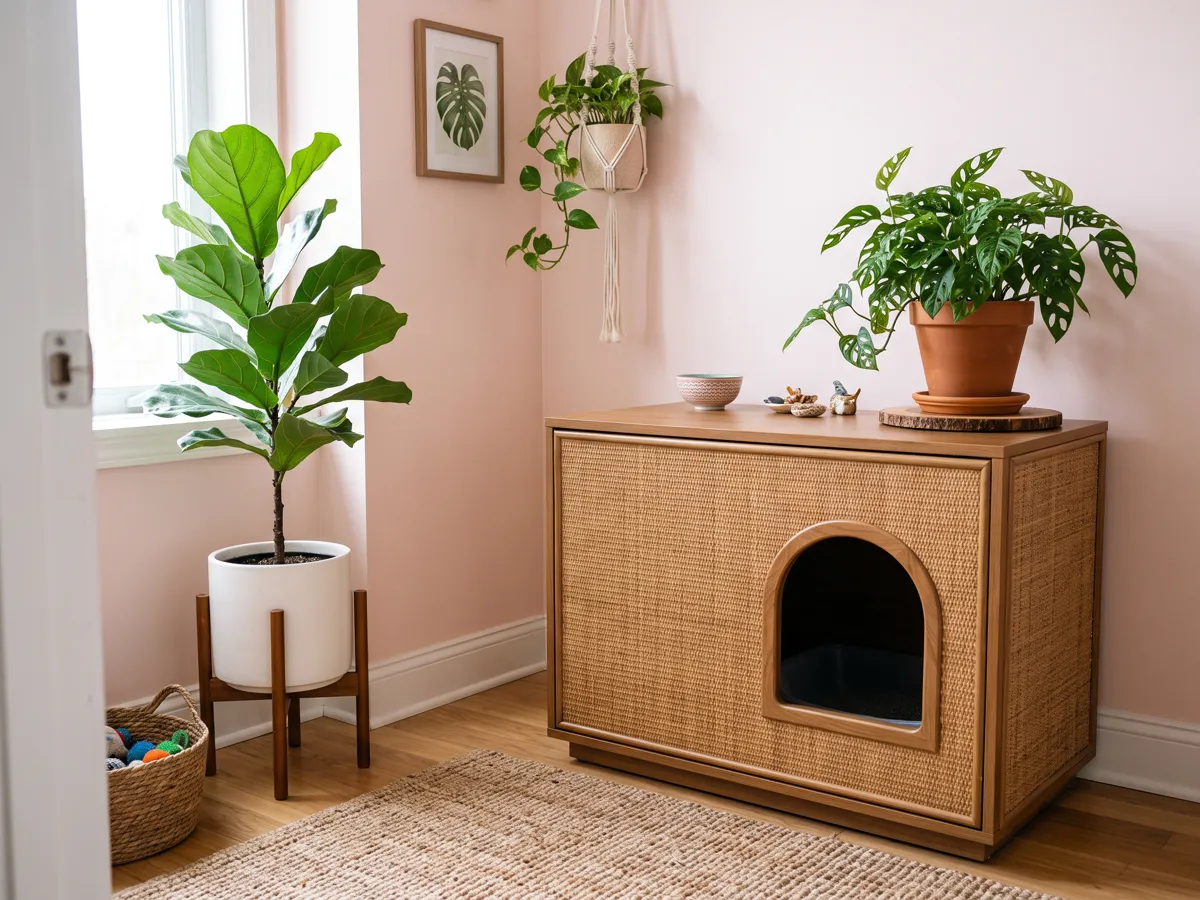
1-2. Cabinet hide: side-entry box, bench double-duty
Cut a 7-inch side entry in a ventilated cabinet: the box stays easy to reach, the door keeps the litter out of sight, and the vent keeps the air moving. A storage bench works the same with a front flap. Both need a washable rug outside catching every exiting paw.
Small space · 7-inch side entry · Washable rug at the exit
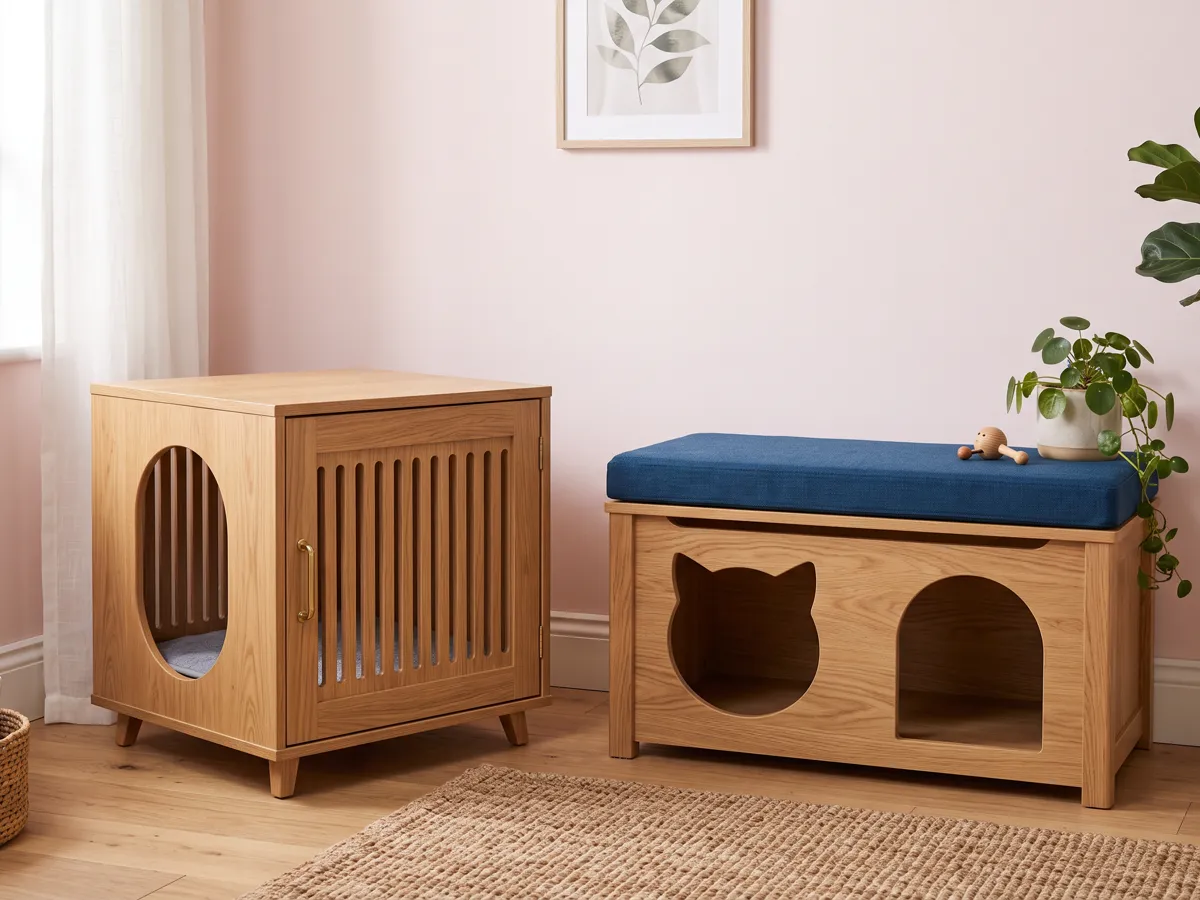
3-4. Layouts: laundry corner, closet nook
Laundry rooms already ventilate, so tuck the box beside the machine with a lidded step trash. A closet nook with the door propped 6 inches gives a cat somewhere to hide while still seeing out. Keep the litter box away from the food and water bowls, and give each resource its own spot so the cat has a choice. For kittens and older cats with limited mobility, keep boxes, perches and shelves low or reachable by a ramp.
Layout · 6-inch door gap · Low entry, ramp for older cats
For the perch and shelf side of the same floor plan, see our small apartment cat corner guide for the rest of the room.
Hidden-box layouts
| Layout | Where it fits | What to check |
|---|---|---|
| Ventilated cabinet | Laundry or hall nook | 7-inch side entry, vent at the top |
| Storage bench | Entry or living room | Front flap, washable rug at the exit |
| Laundry corner | Beside the machine | Lidded step trash, room already ventilates |
| Closet nook | Spare closet | 6-inch door gap, low entry for older cats |
| Bathroom corner | Behind the door | Washable rug, away from food and water bowls |
5. The cleaning routine that matters more than furniture
Remove waste from the litter box at least once a day, and wash the box every one to four weeks. Wash the box with soap and hot water only, and avoid strong chemicals or any ammonia-based product. Cats often find aromatic litter and litter deodorizers offensive, and no product removes the need to clean the box. The litter should be a fine, sand-like, non-scented, clumping material, and liners, slotted grills and deodorizing powders are best avoided.
An open box is recommended where possible, because it is easier to monitor and scoop and it does not trap odors. A rectangular box one and a half times the length of the cat from nose to base of tail is the recommendation, and bigger is better. A cat that stops using its box needs a veterinarian, because house-soiling has its own veterinary guidelines.
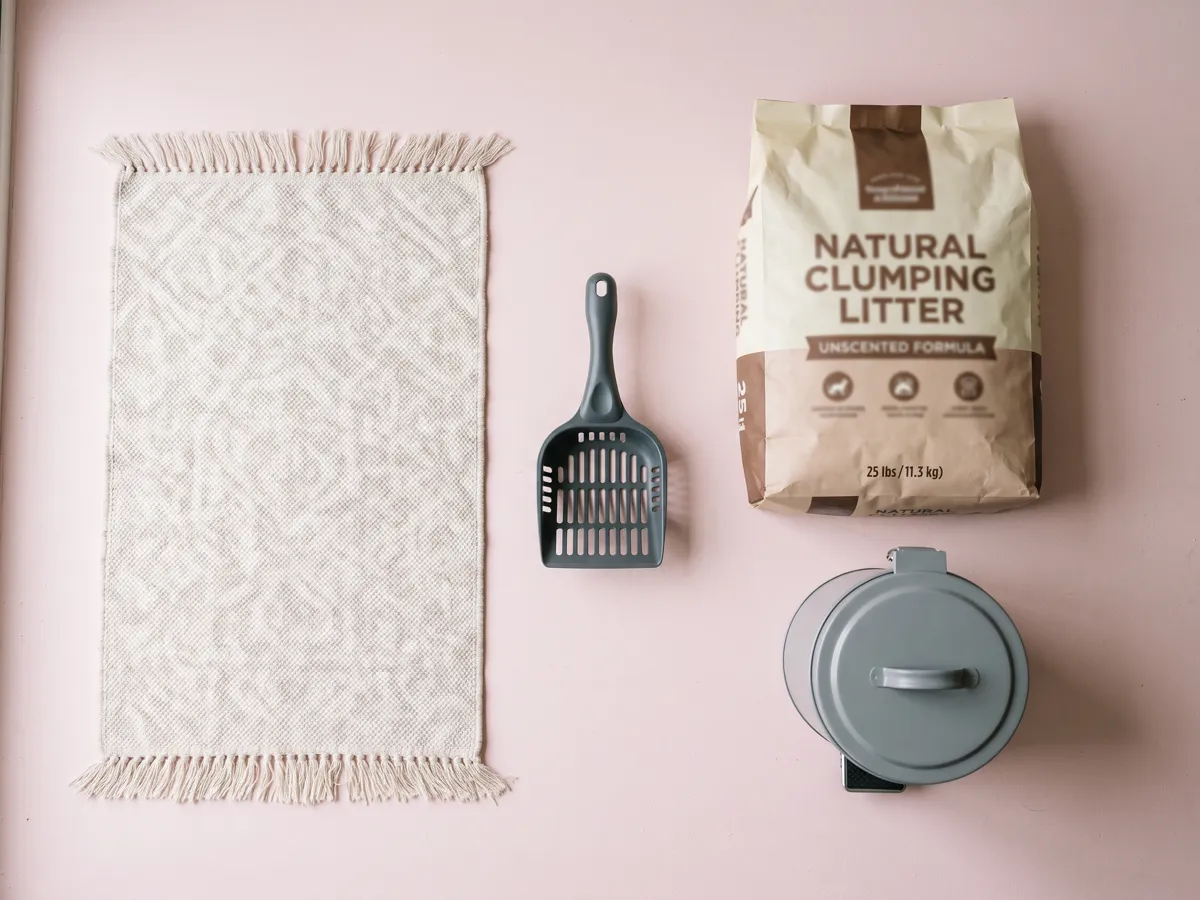
Routine · Box washed on a schedule · Scoop tool by the door
Cleaning rhythm
| Job | How often | What to use |
|---|---|---|
| Scoop waste | Daily | Scoop tool by the box |
| Wash the box | Every 1-4 weeks | Soap and hot water only |
| Choose litter | Every refill | Fine, sand-like, unscented, clumping |
| Skip these | Always | Ammonia cleaners, liners, deodorizing powders, aromatic litter |
Scoop daily, wash the box every one to four weeks, keep the litter fine and unscented.
For a Sunday-reset checklist on the bird side of the apartment, see our budgie cage setup checklist.
Place it first, hide it second
The shortlist above covers where the box goes. This section covers how the furniture lands on top of it, and the order those two decisions happen in. Start with a quiet spot away from the food and water bowls, and only then decide how much furniture goes over it. A cabinet is the last thing you choose.
A route that runs clean beats a look that photographs well. A cat that has to squeeze past a laundry basket, turn around a chair leg and step over a rug will start looking for somewhere easier. Keep the litter box away from the food and water bowls, and give each resource its own spot so the cat has a choice. That spot is a placement decision, and the cabinet is a covering decision made on top of it.
Work the two questions in order. First, can the cat walk in without touching anything? Second, can you open the lid with one hand and still reach the box? A hide that passes the first and fails the second gets scooped less often, and scooping is the part that keeps a small apartment fresh.
Order of work · Spot before furniture · Open with one hand
The route the cat takes
Stand in the doorway for a minute and watch. Note where the cat comes in, where it sleeps, and which corner carries the noise. The box belongs on the path between the bed and the door, and nowhere near the loudest part of the room.
Most small apartments have three usable zones: the sleeping corner, the feeding side, and the walkway between them. Look for the quiet stretch of that route rather than the emptiest floor space, because a cat settles for the spot it can walk to without thinking.
- Mark the entry door, the bed and the noisy corner (kitchen, radiator, window) on a rough sketch of your floor plan.
- Draw the line the cat actually walks, then choose the quietest point on that line for the box.
- Check that the path from the bed to the box is clear of a step up, a tight turn, or a piece of furniture in the way.
- Keep the food and water bowls on a different stretch of the same route, not across the room from the box.
- For kittens and older cats with limited mobility, keep boxes, perches and shelves low or reachable by a ramp.
- Move the box once, not five times. A cat treats a move as a new place to learn, so give it a week before you judge it.
Route mapping · One move, then leave it a week
Build a hide that still opens
A hide is only as good as the moment you open it. These six covers each solve a different corner of a small apartment, and the column that matters most is the last one: how you reach the box without moving anything else.
Six hides, and how you reach the box
| Hide | What it hides | What to watch | How you reach the box |
|---|---|---|---|
| Side-entry cabinet | The whole box, door and all | A side entry keeps the front clear, and a vent at the top lets air move | Open the cabinet door and scoop straight in, no lifting |
| Bench with a lift lid | The box plus the scoop | A lid that lifts beats a lid that slides, and it needs a stop so it cannot fall shut | Lift the lid, set it against the wall, scoop, close it |
| Closet nook with a curtain | Everything, from the room | The door needs a gap so the cat can come and go, and the curtain must not brush the litter | Slide the curtain, step in, scoop, slide it back |
| Plant stand with a skirt | The lower half of the box | The skirt needs a split rather than a wrap, so the cat can push through | Lift the skirt on its hook, scoop, drop it back |
| Laundry hamper with a door | The box behind a working basket | A door flap needs a magnet or a latch, or the cat will learn to open it | Unlatch the flap, lift the inner basket, scoop |
| Built-in shelf with a flap | The box inside the joinery | A flap on a hinge needs clearance above it, or it rubs every time you open it | Lower the flap flat, reach in, lift it back |
Whatever the cover, the box itself stays open to your hand: a hide you cannot open one-handed is a hide you stop cleaning.
Two rules hold for all six. First, the cat has to be able to walk in and turn around without brushing the lid. Second, you have to be able to open it with one hand while the other holds the scoop. For the build side of the same corner, see our DIY cardboard cat castle plans and keep the hide corner clear.
Make it before you buy the cabinet
A cardboard or fabric hide costs an evening and teaches you whether a cover suits your cat at all. Build it in this order, because a hide built from the top down never sits level.
- Set the box down where it will live, then build the cover around it in place, not on the floor elsewhere.
- Cut the base panel first and check it sits flat, with no rock and no gap under a corner.
- Stand the sides up and tape them to the base before anything else goes on, so the frame is square while the tape holds.
- Cut the opening the cat uses, and make it a flap rather than a fixed hole, so you can close it while you clean.
- Hang the flap on one edge as a hinge and leave a gap on the other three, so the cat can push it and it cannot jam.
- Add the lid last. A lid that lifts beats a lid that slides, and it needs a stop so it cannot drop on the cat.
- Weight-test the whole cover with a flat hand before the cat gets a vote, and re-test it if you move it.
- Leave the hide alone for a day. A cat that is still choosing a door treats a rebuild as a new place to learn.
One evening · Cardboard or fabric · Lid lifts, flap pushes, base does not wobble
Watch a three-drawer cabinet hide
The written build above gets you through the first evening. If you would rather see a cabinet hide go together before you cut anything, this one turns a three-drawer plastic storage unit into the hide: the top drawer keeps the scoop and the spare litter, the middle drawer is cut for the cat's entry, and the bottom drawer holds the pan. Watch where the cut goes and how the drawer front comes back on before you pick your own unit.

A litter box hidden inside a three-drawer plastic cabinet: storage on top, a cut-out entry, the pan below. Video by Avenue Alex on YouTube.
The daily routine
Five steps, about ninety seconds, and the order matters more than the speed. Run it at the same time every day and it stops being a chore.
- Scoop the waste out first, before you add anything. Remove waste from the litter box at least once a day, and wash the box every one to four weeks.
- Top the litter back up to the level the cat likes, so the clumps have something to form against.
- Wipe the rim and the door frame while you are already standing there, so the litter dust does not build a shelf.
- Close the lid or the flap, so the cover goes back to being furniture.
- Tie the bag and take it straight out, rather than parking it by the door until evening.
Ninety seconds · Same time every day · Bag out the same minute
Wash day rotation
The box is the headline, but the parts around it carry the smell in a small apartment. Wash the box with soap and hot water only, and avoid strong chemicals or any ammonia-based product, and keep the same rule for everything that touches it.
Wash day rotation
| What | How often | What to use |
|---|---|---|
| The litter box | Every one to four weeks | Soap and hot water only, dried fully before the litter goes back in |
| The scoop | Every wash day | Soap and hot water, then dry it beside the box |
| The mat at the exit | Every one to two weeks | Washable mat, machine wash, dry flat |
| The cabinet floor | Every wash day | Soap and hot water on a cloth, dry before the box goes back |
| The tray under the box | Every wash day | Soap and hot water on a cloth, no liner left underneath |
| The litter storage bin | Every refill | Empty, wipe with soap and hot water, refill dry |
Wash the box every one to four weeks, wash the small parts every wash day, and let everything dry before the litter goes back.
Litter level and what goes in
The litter should be a fine, sand-like, non-scented, clumping material, and liners, slotted grills and deodorizing powders are best avoided. That single line settles most of the litter aisle.
Depth is a feel, not a number: fill until the box holds enough for a clump to form without touching the base, and the cat can dig to the bottom of it. Top up rather than emptying, because a full change throws away litter that was still working.
A clump that breaks apart on the scoop tells you the level has dropped, not that the litter is finished. Add a little more and try again. Cats often find aromatic litter and litter deodorizers offensive, and no product removes the need to clean the box, so the fix is always more litter and another scoop, never a powder.
Store an open bag folded shut inside a lidded bin, kept dry and off the floor. A bag left open in a humid bathroom clumps in the bag and pours in lumps.
When the smell is still there
Most lingering smell in a hidden box traces back to one of six things, and every one of them is a routine fix rather than a product to buy. Work the table top down, and give each change a few days before you judge it.
What to try first, and what to check next
| What is going on | First thing to try | What to check next |
|---|---|---|
| The box was not scooped daily | Scoop it now and set a fixed time tomorrow | Wash the box with soap and hot water only, on a one to four week schedule |
| The litter is too shallow | Top the litter up until a clump forms clear of the base | Whether the level holds, or the cat is digging to the floor |
| The box is too small for the cat | Move to a bigger box, rectangular and open where you can | That the cat can turn around and dig without touching the sides |
| The cabinet traps air | Open the door or the flap between visits and let the space breathe | That the vent at the top is clear, and the box is not walled in on all sides |
| A liner has creased | Take the liner out and run the box bare for a week | How the litter sits on a flat base, with nothing holding a clump off the floor |
| A deodorizer powder was added | Empty it, wash the box with soap and hot water only, and start again | That the litter is fine, sand-like, non-scented and clumping |
Scoop first, wash second, and change the box last. A product that promises to remove the need to clean the box is not part of this table.
Hand it to a sitter
A sitter who can find everything without a phone call is a sitter who scoops. Write this note, tape it inside a cupboard door near the box, and photograph it before you travel.
Scoop the litter box once a day, at the same time as breakfast. The scoop hangs on the hook beside the cabinet. The litter lives in the lidded bin under the sink, and the box itself is in the cabinet at the end of the hallway, away from the food and water bowls. Waste bags are in the drawer beside it, and the tied bag goes straight into the hall bin. Wash the box with soap and hot water only if it needs it, and never use anything scented or ammonia-based. The vet is on the fridge magnet, and a cat that stops using its box is a vet question, not a furniture one.
Sitter note · One scoop a day · Vet number on the fridge
When to skip the hide
A cover is not always the kind thing. Four situations where the box stays open, and what to do instead.
- A cat that has stopped using the box. A vet visit comes first, because house-soiling has its own veterinary guidelines, and a cabinet over the box only makes the next step harder. Keep the box open and easy to reach until the vet has had a look.
- A kitten still learning. A kitten needs to find the box without thinking about it, and a flap, a hinge and a lid are three things to work out. Skip the hide until the routine is a habit, then add the cover a corner at a time.
- A household with several cats and one quiet corner. One covered box in the only quiet spot turns the box into a queue. Give the household more than one spot for the box, and cover the one in the busiest room rather than the one in the quiet corner.
- A rental where the cabinet cannot be anchored. A tall cabinet that cannot be fixed to the wall is a cat launch pad and a tipped box. Build freestanding instead, pressed into a corner with nothing on top, and leave the anchoring to the landlord.
Litter checklist
- Side entry 7 inches, ventilated top
- Washable rug at the exit, scoop tool within reach
- 6-inch door gap on a closet nook, low entry for older cats
- Box washed on a one to four week schedule
- A cat that stops using the box is a vet question, not a furniture fix.
Questions we get about hidden litter boxes
How do I stop a hidden litter box from smelling?
Remove waste from the litter box at least once a day, and wash the box every one to four weeks. An open box is recommended where possible, because it is easier to monitor and scoop and it does not trap odors. Wash the box with soap and hot water only, and avoid strong chemicals or any ammonia-based product. For informational purposes, consult your vet.
Should I use scented litter or a deodorizer?
Cats often find aromatic litter and litter deodorizers offensive, and no product removes the need to clean the box. The litter should be a fine, sand-like, non-scented, clumping material, and liners, slotted grills and deodorizing powders are best avoided.
My cat stopped using the hidden box. What now?
A cat that stops using its box needs a veterinarian, because house-soiling has its own veterinary guidelines. A rectangular box one and a half times the length of the cat from nose to base of tail is the recommendation, and bigger is better. Keep the litter box away from the food and water bowls, and give each resource its own spot so the cat has a choice.
How often do I scoop?
Remove waste from the litter box at least once a day, and wash the box every one to four weeks. Pick a fixed time, run the five steps in order (scoop, top up, wipe the rim, close the cover, take the bag out), and keep the scoop hanging where you can reach it one-handed.
Can I keep a liner in the box?
The litter should be a fine, sand-like, non-scented, clumping material, and liners, slotted grills and deodorizing powders are best avoided. If a liner is already in there and it has creased, take it out, run the box bare for a week, and see how the litter sits on a flat base.
How do I stop the mat sliding across the floor?
A washable rug at the exit is the simplest fix that still works: it catches litter on every exiting paw and it can go through the machine. Put the cabinet or the bench on top of one corner, or set the mat against a wall so the cat pushes into it rather than along it.
How do I keep the cabinet itself from smelling?
Scoop daily first, then wash the box with soap and hot water only, and avoid strong chemicals or any ammonia-based product. Wipe the cabinet floor on every wash day, let it dry before the box goes back, and leave the door or the flap open between visits so the space breathes. Cats often find aromatic litter and litter deodorizers offensive, and no product removes the need to clean the box.
When should I call the vet?
A cat that stops using its box needs a veterinarian, because house-soiling has its own veterinary guidelines. That is the line for us: a change in where the cat goes is a vet question, and furniture, litter and cleaning come after the vet has had a look. For informational purposes, consult your vet.
Is a covered box bad for my cat?
An open box is recommended where possible, because it is easier to monitor and scoop and it does not trap odors. A covered box a cat uses happily is still a covered box that works, so keep the entry wide, the lid easy to open and the scooping daily.
How deep should the litter be?
Fill until the box holds enough for a clump to form without touching the base, and the cat can dig to the bottom of it. Top up rather than emptying the box, and if a clump breaks apart on the scoop, add a little more litter rather than changing the whole tray.
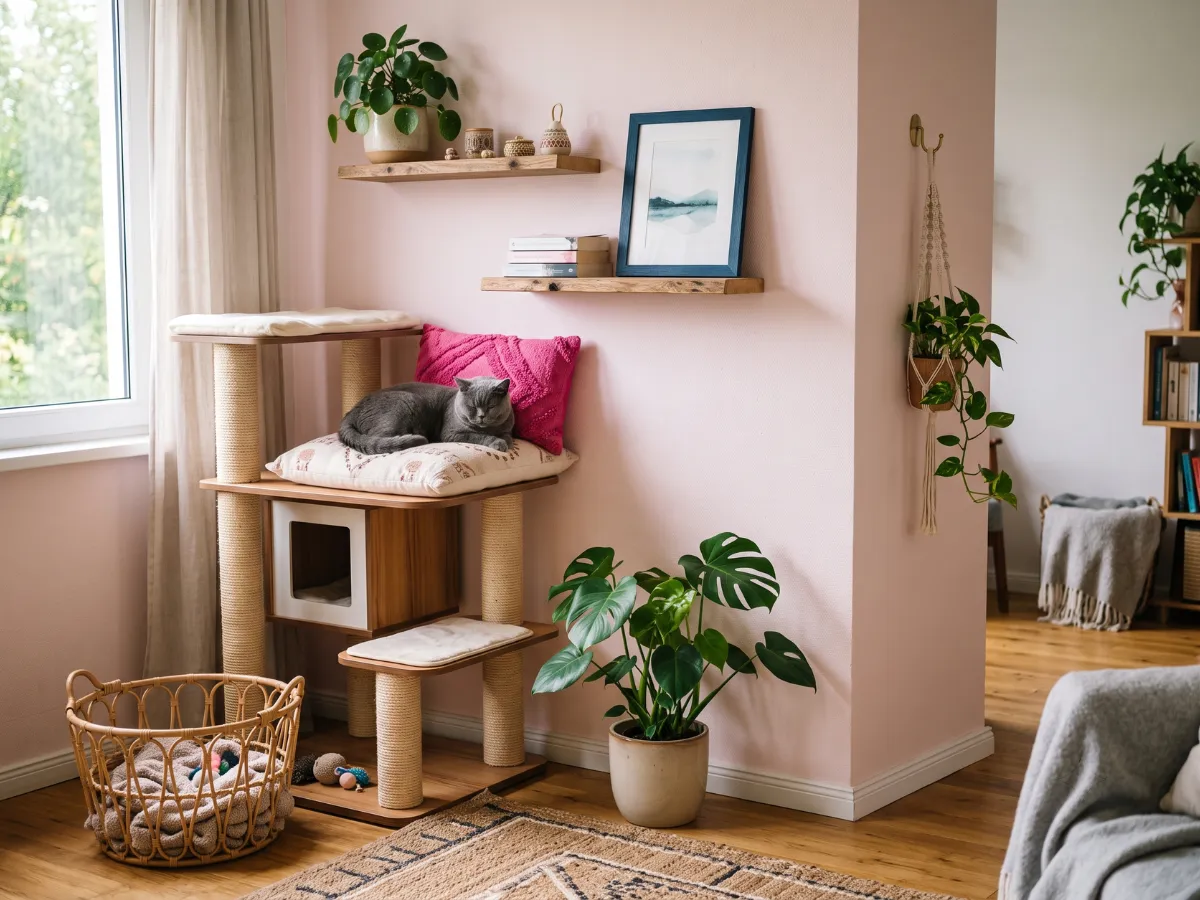
What we use
What we use for hidden litter setups
Cabinets, storage benches and washable rugs for small-space layouts: apartment picks in one list.
See what we use →As an Amazon Associate we earn from qualifying purchases.
Save these on Pinterest
Pin the layout matching your floor plan. The Cat Home collection holds the corner and castle guides.
Sources
The cleaning and placement rules on this page come from feline veterinary guidelines, not from our own head:
Apartments hide the box at home; the travel litter box planning page plans it away from home.