 PawStyle Daily
Budgie & Cockatiel Corner
7 Budgie Cage Setup Ideas for Small Spaces | Checklist
A tiny rental corner can still feel like a pastel storybook nook for your budgie girl: soft blush throw, renter-friendly hooks, morning light across the bars. This checklist keeps the look tidy and the routine simple. Check with an avian vet.
By PawStyle Daily · Updated 26 October 2026
Good to know: corner spot · pastel tray · Sunday reset.
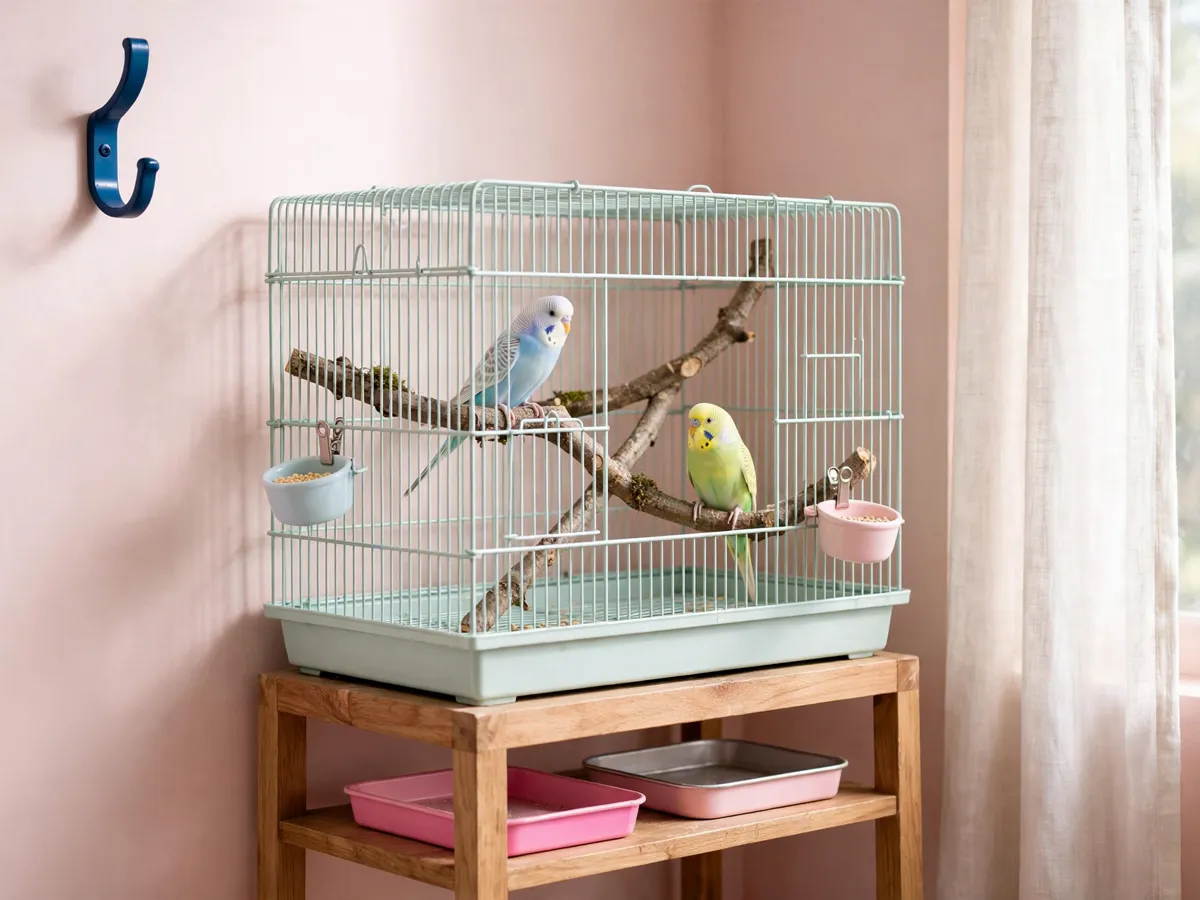
Cage pick for tiny rentals
Start with the rectangle silhouette against your blush wall: airy bars, pastel skirt outside, photo-ready from the doorway. For another small-apartment corner win, see our small apartment cat corner aesthetic guide.
A budgie’s cage should be big enough to turn around without striking anything, move from perch to perch, and stretch or flap its wings - the minimum guideline is 1 ft x 1 ft x 2 ft (30 cm x 30 cm x 60 cm), and bigger is better.
Place the cage in the room
Walk the room with the cage in your hands before the bowls and the branches go in. Check four things on that walk: the kitchen door, the front door, the window, and the spot where the family sits in the evening. What you want is a corner with a wall at the bird’s back, a view into the room, and no traffic sweeping past the bars all day.
Keep the cage out of the kitchen. Pans, steam and the coming and going of a stove are things a small bird cannot step away from, and a cage parked beside the hob is a cage you will move again in a week. The same goes for the space behind a door that swings: a cage there gets knocked every time someone carries the groceries in. One side against a wall gives the bird a back, and a bird with a back sits out on a branch instead of hanging on the bars.
Light comes next. A corner that takes soft morning light reads warm in a photo and gives the bird a bright start to the day. Direct afternoon sun through glass is a different thing: it heats the bars, fades the pastel tray, and leaves the bird with nowhere cool to sit. If the only free corner faces the afternoon sun, hang a light curtain and keep the cage back a step instead of moving it into a dim hallway.
Last, the family spot. A cage in the room where you drink your coffee and fold the laundry is a cage the bird can watch, and a bird that watches is a bird that talks back. Somewhere between the sofa and the window usually settles it: close enough for company, far enough that the television is not pointed straight at the bars.
Cage placement decision table
| Spot in the room | What works | What to watch |
|---|---|---|
| Window wall | Soft morning light, a bright corner for photos, a view of the street below | Direct afternoon sun through the glass, so keep the cage back a step or hang a light curtain |
| Quiet corner | Two walls at the bird's back and a calm edge to the room | A spare room the family never enters, where the bird stops chatting, so keep the corner on the way past |
| Living room | Company all evening, a view of the sofa, easy to talk to while you fold laundry | A television or a speaker pointed at the bars, so turn one side of the cage to the wall |
| Bedroom | Quiet at night, close to you, a soft corner in a small rental | Curtains that stay closed all day, and a bird that wakes with the first light through them |
| Hallway | A wall to sit against and a spot out of the sun | Coats, bags and shoes brushing the bars, doors that swing, and the busiest traffic in the home |
| Kitchen | Counter space that looks free for an afternoon | Pans, steam, hot plates and constant foot traffic, so pick another room even when the corner looks tidy |
Two homes can pick different rows and both birds do fine. Read the table as a set of choices, not a rulebook.
Set up the cage in order
There is a right sequence on setup day, and it exists so you can still reach the screws. Empty cages look finished in a photo, so the temptation is to put the bird in and decorate around it. Work in this order instead, and everything sits where you meant it.
- Stand first: set the cage on its stand, level, against the wall you picked, with the door facing the room. Wobble the base now while you can still fix it.
- Tray and skirt: slide the pastel tray in and hang the outside skirt before anything blocks the floor.
- Dishes on the sides: clip the food and water dishes to the cage sides, clear of the tray, then reach in and tug each one to check it holds.
- Perches: fit the perches next, with the high perch for sleeping placed before the low one, so a wing is not trapped mid-install.
- Toys last inside the cage, hung low enough that they swing clear of the food dish and the door.
- Fill the dishes, top the tray with fresh liner, then bring the bird in on the hand or in the travel cage.
- Close the door and check it twice before you turn your back on a bird in a new room.
Order matters because the dish clips and the perch brackets are both awkward with a bird already in the cage, and a hand reaching in twice is twice the risk of a nipped finger. Fit every bracket while the cage is empty and the door can be opened wide.
Perch layout
Aim for four perches in a budgie cage, each doing a different job. Set the sleeping perch high, at the top of the cage, where the bird can look down over the room. A second perch sits lower, beside the food and water dishes, so the bird steps off to eat without a long drop. Keep the sleeping perch out of the dish line: a bird that sleeps above its own bowls kicks the day’s liner onto the floor.
A natural branch adds the third perch. Look for a piece with a gentle curve and a few small twigs, bark still on, dried in the sun before it goes in. The curve gives the foot something to hold onto that a factory dowel cannot copy.
The fourth is a platform, flat and wide, where a bird that likes to sit out in the open can park with both feet down. Set it away from the sleeping perch so the top corner stays the sleeping corner.
Rotate the shapes over time rather than swapping the whole set at once. Pull one perch out, wipe it, leave the cage with its normal perches for a few days, then add the one you took out. A bird whose furniture shuffles weekly walks onto the new perch without being asked.
Perches plus dishes, tidy style
Think branch tones against blush: slim wood pieces, tiny pastel bowls clipped to the side, Sunday wipe-down in minutes. For the same cleaning-routine thinking on the cat side of the apartment, see our hidden litter box ideas for small apartments.
Offer perches in an assortment of diameters, shapes and textures with natural wood ideal, and never use sandpaper perches because they are too abrasive for a bird’s feet.
Attach sturdy, non-toxic food and water dishes to the cage sides rather than the bottom so droppings do not fall into them, and clean and disinfect them every day.
Weekly and daily cleaning rotation
A pastel corner stays pastel because of a rotation, not a spring clean. The dishes are the daily job and take ninety seconds at the sink. The floor and the perches are the Sunday job, and the cage bars are the one you do only when something has actually happened on them.
Weekly and daily cleaning rotation
| What you clean | How often | What to use |
|---|---|---|
| Food and water dishes | Every day | Warm water, a soft sponge, a dedicated cloth; rinse and dry before they go back on the clips |
| Cage floor and tray liner | Every day a fresh liner; a full rinse once a week | Fresh liner every morning, a rinse of the tray in the sink, a wipe along the corner the tray hides |
| Perches and the natural branch | Once a week | Warm water and a soft brush; dry in the sun and put them back after |
| Cage bars | When something has landed on them; corners by hand | A damp cloth, then a dry one; skip the corners that hold the clips and wipe those by hand |
| Toys and swings | Once a week | Warm water only; let them air dry before hanging them back |
| Food storage | Every time you top the bowl up | A dry scoop, the container closed tight, and the scoop kept out of the pellets |
Nothing in this table names a product: warm water and a dry cloth carry most of it.
The station is the small stretch of shelf beside the cage: a basket with the spare dishes, a roll of paper towels, the soft brush, the food scoop, and the cover folded on top. Keep the food bin off the floor and the scoop inside the bin rather than in the food, and the whole reset takes one reach instead of a hunt through the kitchen.
Keep the cleaning tools separate from the kitchen ones. One sponge for the bird corner, one for the dishes, and a cloth that lives in the cage cupboard. It is a small habit that keeps the sink arguments down.
The one thing that never waits is the food and water dishes: attach them to the cage sides rather than the bottom so droppings do not fall into them, and clean and disinfect them every day.
Everyday bowl base
Pastel bowls, same corner, same morning moment: a calm little ritual before your coffee.
Build the diet on pellets with produce - about 75-80 percent pellets with 15-20 percent fruits and vegetables - keep seeds and nuts strictly limited, and never starve a bird into pellets.
The cage spec on one page
Cage spec
| Item | What to look for | Note |
|---|---|---|
| Cage size | 30 x 30 x 60 cm minimum | Bigger is better |
| Perches | Natural wood, varied diameters | Never sandpaper |
| Food and water dishes | Attached to the cage sides | Cleaned daily |
| Diet | Pellets with produce | Seeds strictly limited |
Two sources behind every line: the VCA housing guide and the University of Florida care guide.
What to buy and what to skip
Budgie corners get overshopped faster than cat corners, because the bird section is full of small, cute, useless things. Six items carry almost the whole setup. Everything else is a want, and wants are how a corner stops being tidy.
Do the shopping in one pass and leave the accessories on the shelf. Buy the cage first and stand it where you plan to keep it before you buy anything to go inside it, so you can check the door opens on the side you can reach. Then buy the stand, the dishes and the perches, and buy the cover last: a cover that fits the wrong cage is a cover that never gets used.
Set up the cage in one afternoon with the bird still in its travel cage. Everything is easier when the bird is not watching: the stand goes together without a scramble, the clips go on squarely, and the tray slides in on the first try. Then open the travel cage, let the bird walk out on its own, and leave the room for twenty minutes.
What to buy and what to skip
| Item | What to look for | What to skip |
|---|---|---|
| Cage | A rectangle, horizontal bars, a door wide enough to reach the far perch, and room to turn, hop and stretch inside | Round cages, tall thin cages that force a bird to hop straight up, and cages that need a bolt through the wall |
| Stand | A stand at waist height with a solid base and a tray shelf underneath for the liner | Stands with a narrow base, and stands that wobble when you brush past |
| Dishes | Sturdy food and water dishes that clip to the cage sides, wide enough to lift out with one hand | Dishes that sit loose in the tray, and tiny bowls a bird can tip in one push |
| Perches | An assortment of diameters, shapes and textures, natural wood where you can find it | Sandpaper perches, and a cage filled with identical factory dowels |
| Cage cover | A light cover that hangs off the two hooks on top and leaves one side open | Heavy blackout fabric that traps the warm air, and covers taped or pinned on |
| Toys | Two or three toys with a job: a swing, a shreddable piece, a small ladder | A cage packed with plastic frippery, and anything with a thread a bird can untangle |
Skip the dome-top cage too. It looks like a palace, gives a bird less room at the top, and is a nightmare to hang a cover from.
Common setup problems and the fix
Every budgie corner has one of these problems in the first week. None of them need a new cage, and most of them are a perch in the wrong place.
What goes wrong and what to do
| Problem | Why it happens | Fix |
|---|---|---|
| The bird hangs on the bars | The bars are the most interesting thing in the cage, or the only perch is below the bird | Move a perch up to the top corner and put the food dish within one hop of it, so climbing beats hanging |
| Food is thrown out of the dish | The dish is clipped too high, or too shallow, or the bird has a favorite seed and picks around it | Drop the dish to perch height, swap to a deeper cup, and top the bowl up rather than filling it |
| The perch is too smooth | A factory dowel with the bark sanded off, or the wrong diameter | Add a natural branch and one other diameter, and rotate the shapes so the feet get variety |
| The cage wobbles | The stand is uneven, or the cage is not seated square on the stand | Level the stand, set the cage back on squarely, and check the tray is not sitting proud under one corner |
| The cover traps heat | A heavy cover pulled down over the whole cage on a warm evening | Hang a light cover, leave one side open, and pull the cage a step back from the afternoon sun |
| The dishes tip | A dish that clips to a bar the bird can land on, or a dish pushed against the door | Move the clip to a bar away from the door and from the top perch, and tug it to check it holds |
Fix one row at a time and watch the bird for a day before moving the next thing. Changing four things at once tells you nothing.
When to skip this look
Some corners should not be built at all, at least not yet. If one of these is you, skip the pastel version and keep the cage plain.
- A rescue bird that already knows its cage. If the bird has a cage it comes home with and it is settled, leave the cage it knows and add perches and dishes to that one. Aesthetic changes can come once the bird has stopped flinching.
- A bird that panics under a cover. If your bird thrashes when the cover goes down, the cover does not belong in your setup, and a dim corner or a light curtain will do the same job without the panic.
- A rental that forbids drilling the stand to the wall. If the landlord will not let you put a screw in the plaster, keep the cage on a free-standing stand with a solid base, and skip any shelf that needs fixing to the wall beside it.
- A bird recovering on a vet’s instruction. If your avian vet has told you to keep the cage simple, the setup stays bare until they say otherwise, and this page goes in the drawer for a month.
A plain cage with the right number of perches and dishes on the sides is always better than a styled corner a bird cannot use.
Travel and sitter routine
The corner has one more job, and it is the one people forget: it has to hand over to a stranger without falling apart. Write the routine on a card and tape it inside the cupboard door, so whoever feeds the bird on Saturday morning does not have to guess.
- Morning: fresh liner on the tray, both dishes washed and refilled, the bowl topped up rather than filled to the rim.
- Evening: the dish line checked, water swapped, and the cage door clicked shut twice.
- Vet days: the travel cage comes out of the cupboard, the loose dishes come off the cage, and the room stays quiet.
- Leave on the card: the avian vet’s number, where the pellet container lives, and the note that the door check comes before the evening cover.
For a long weekend, put the liner and the cloths in a labelled box beside the cage, so the sitter never opens your kitchen sponge drawer. A corner that hands itself over cleanly is a corner you can leave for a week.
Budgie Sunday checklist
- Cage with room to turn, hop and stretch
- Mixed natural-wood perches, dishes on the sides
- Dishes washed daily, seeds kept limited
- Pin this page to your Budgie board for Sunday-reset duty.
Questions we get about budgie cage setup
How big should a budgie cage be in a small apartment?
A budgie's cage should be big enough to turn around without striking anything, move from perch to perch, and stretch or flap its wings - the minimum guideline is 1 ft x 1 ft x 2 ft (30 cm x 30 cm x 60 cm), and bigger is better. Check with an avian vet.
What perches work best for a budgie?
Offer perches in an assortment of diameters, shapes and textures with natural wood ideal, and never use sandpaper perches because they are too abrasive for a bird's feet. Attach sturdy, non-toxic food and water dishes to the cage sides rather than the bottom so droppings do not fall into them, and clean and disinfect them every day.
Should a budgie eat seeds or pellets?
Build the diet on pellets with produce - about 75-80 percent pellets with 15-20 percent fruits and vegetables - keep seeds and nuts strictly limited, and never starve a bird into pellets. Check with an avian vet.
Where should I put the cage in a small apartment?
A corner with a wall at the bird's back, a view into the room, and soft light rather than direct afternoon sun. Keep the cage out of the kitchen, and away from a door that swings. The table in the placement section walks through window walls, quiet corners, the living room, the bedroom, the hallway and the kitchen, with what works and what to watch for each.
How many perches does a budgie need?
Aim for four perches, each with a different job: one high for sleeping, one lower beside the dishes, one natural branch, and one flat platform for a bird that likes to sit out in the open. Offer them in an assortment of diameters, shapes and textures with natural wood ideal, and never use sandpaper perches because they are too abrasive for a bird's feet.
Does my budgie need a cage cover?
A light cover suits a room that is busy or bright, and it hangs off the two hooks on top with one side left open. Skip heavy blackout fabric, because it holds the warm air against the bars. Some birds panic under a cover, and if yours thrashes or screams when it goes down, take the cover away for good and move the cage to a dimmer corner instead.
How do I move a cage without stressing my bird?
Move the cage once, in one direction, and never while the bird is mid-flight. Take the toys and the loose dishes out first, carry the cage with two hands and a slow step, then set it down and leave the bird alone for an hour before you put the perches and the dishes back. Travel cages are worth owning for this exact day, and for the vet.
How do I clean the cage without disturbing my bird?
Clean in a routine, on the same days, so nothing about it is a surprise. Wash the dishes while the bird is on the sleeping perch, work at one end of the cage and leave the far end for the next day, and do the deep clean on a quiet afternoon rather than the morning rush. Keep the cleaning cloths in the bird cupboard so the bird sees the same sponge every time.
What can I skip if I only have a weekend to set up?
Cage, stand, four perches, two dishes and a fresh liner. Everything else can wait, and a bird in a simple corner with four perches does better than a bird in a decorated corner with one. Buy toys in month two, once the bird has settled and you know what it actually plays with.
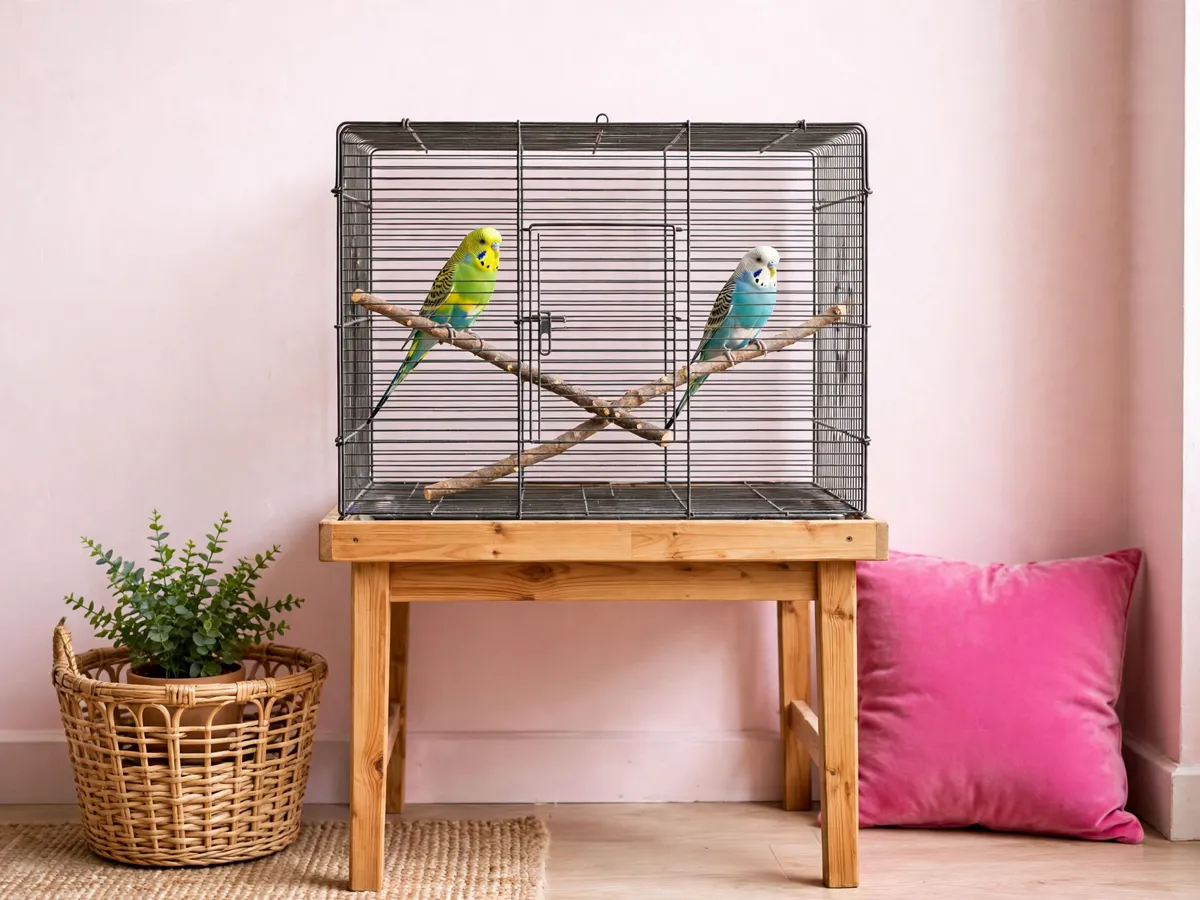
What we use
What we use for budgie corners
Cages, stands, dishes and cleaning picks in one list, and the things we left out.
See what we use →As an Amazon Associate we earn from qualifying purchases.
Save these on Pinterest
Pin the checklist for Sunday reset. The Budgie & Cockatiel Corner collection holds this starter page.
Sources
Every number on this page comes from a veterinary or veterinary publisher source, not from our own head: