 PawStyle Daily
Cat-Friendly Apartment Decor
Cat-Proofing a Small Apartment: Room-by-Room Checklist
Cat-proofing is the work you do once so you stop doing it every day. This checklist walks one small apartment room by room, in the order that matters: cords and batteries first, plants second, windows third, the kitchen last. It is built for renters, so nothing here needs a drill, and each fix takes minutes rather than a weekend. For informational purposes, consult your vet.
By PawStyle Daily · Updated 16 November 2026
Good to know: one afternoon · raceways, cleats and lidded drawers · no drill needed.

The order of the work
Most cat-proofing fails because it is done in the wrong order. The hazards a cat actually reaches in week one are the low ones, so the walk-through starts at floor level and works up: wires under the desk, the plant on the side table, the blind cord at sitting height, the screen a shoulder can lean on. High shelves and wall hooks come last, when the cat has already shown which room it lives in.
Give each resource its own spot and let the cat choose: a minimum of two resting areas, two feeding areas and two toileting areas. In a small apartment that sounds like a lot until you notice the resource count is the same in 600sqft as in 3000sqft: two nap spots, two bowl spots, two box spots. The apartment is small, but the cat still gets a choice between them.
One habit carries the whole page: spot-check after every delivery, every guest, and every re-arranged shelf. Cat-proofing is not a state, it is a drift back toward the floor.
Cords, batteries and the low wall
The low wall is the strip of floor and skirting a cat can reach without jumping. Keep electrical wires and batteries out of reach, because a wire can deliver a potentially lethal electrical shock. That single rule drives everything on the low wall.
- List every cord that lives below knee height: chargers, lamps, the router, the TV strip, the fan.
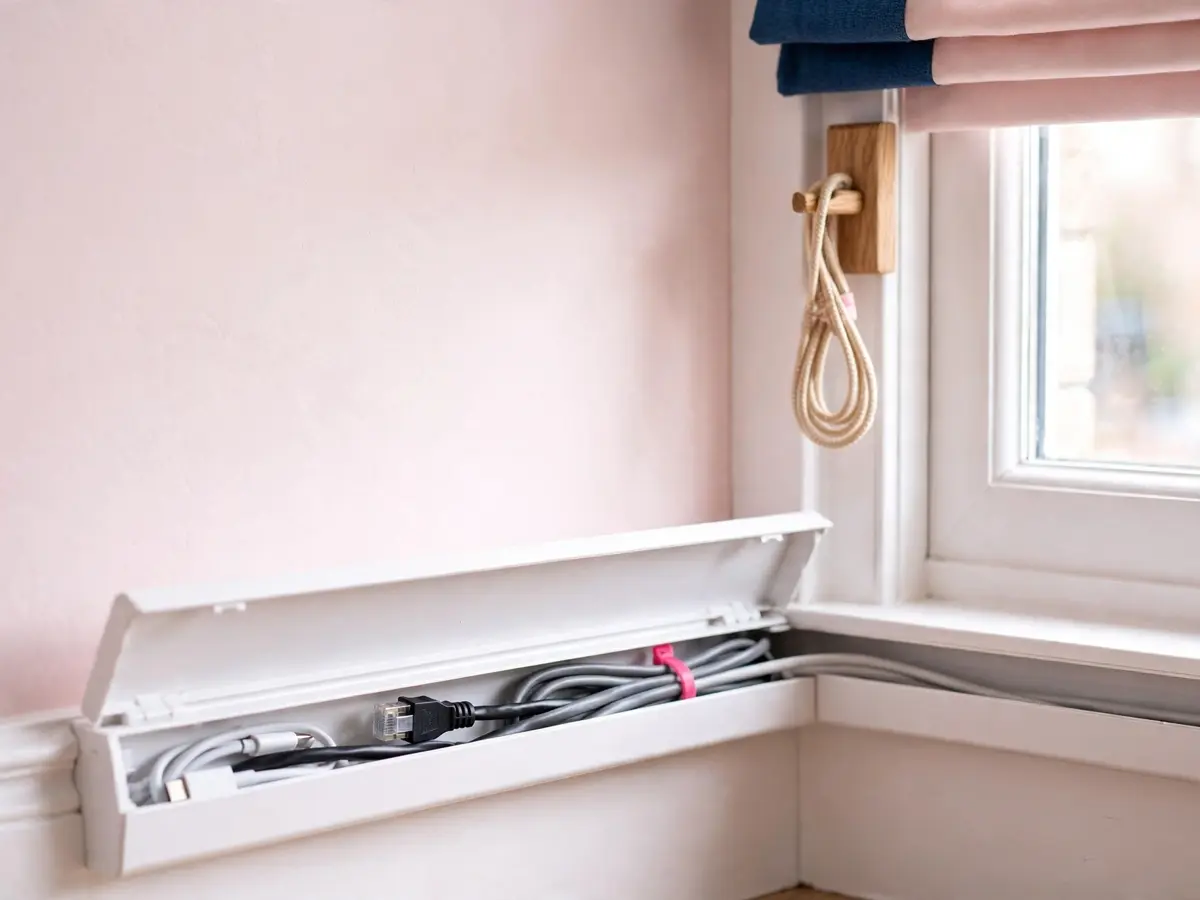
- Put each one in a raceway stuck to the baseboard, or run it over the back of the desk and into a drawer.
- Give blind cords a cleat inside the window frame, high enough that a sitting cat cannot reach the loop.
- Move spare batteries and battery lamps off open shelves into a lidded drawer.
- Unplug anything you do not use daily, so a chewed cord is a dead cord, not a live one.
A cat that has chewed a cord is a same-day vet call. Unplug it before you touch it, and do not wait to see how the cat seems tomorrow.
The plant shelf
A boho corner wants plants, and this is the one place to be slower than the nursery wants you to be. Lilies are especially toxic to cats and can cause life-threatening kidney failure even in tiny amounts, and poinsettias, mistletoe and holly are toxic as well.
The label rule does the rest of the work. Read the nursery label before the pot goes in the bag, find the botanical name rather than the cute common name, and a plant you cannot name stays at the shop. Cut bouquets shed petals, so the vase lives on the dining table or not at all.
Shelving is the second half of the fix: a plant the cat cannot reach belongs on a high closed shelf or in a hanging basket, and a plant the cat has already chewed needs a vet call, not a new shelf.
For the perch side of the same window, our no-drill window perch guide covers the builds that hang from the glass.
Windows and screens
Screens come first, decoration second. Push every screen with a flat hand the way a cat leaning on it would push, and any screen that pops, flexes or lifts out of its frame gets fixed or pinned before the cat moves in. A screen is not a guard, and it is never the anchor for a perch.
Indoor resting areas, such as a perch or a secluded surface, should include a spot where the cat can see outdoors. That is the point of the window, so cat-proofing the window is not about closing it off; it is about making the view safe to sit behind.
Window check
| What to check | What good looks like | If it fails |
|---|---|---|
| Screen fit | Push test with a flat hand, frame tight, no flex | Fix or pin the screen before anything hangs nearby |
| Screen frame | Screws seated, corners square, no daylight at the edges | Repair before moving day, not after the cat arrives |
| Blind cords | Looped on a cleat inside the frame, above sitting height | Move the cleat up or switch to a fixed wand |
| Sill clutter | Nothing breakable, nothing battery-powered left on the sill | Clear it, then decide what goes back |
| Window locks | Open stops or locked at a crack, not a cat-width gap | Add a stop or keep the pane shut in summer |
The push test is the whole inspection: a screen that holds a flat hand holds a leaning cat.
The kitchen and the counters
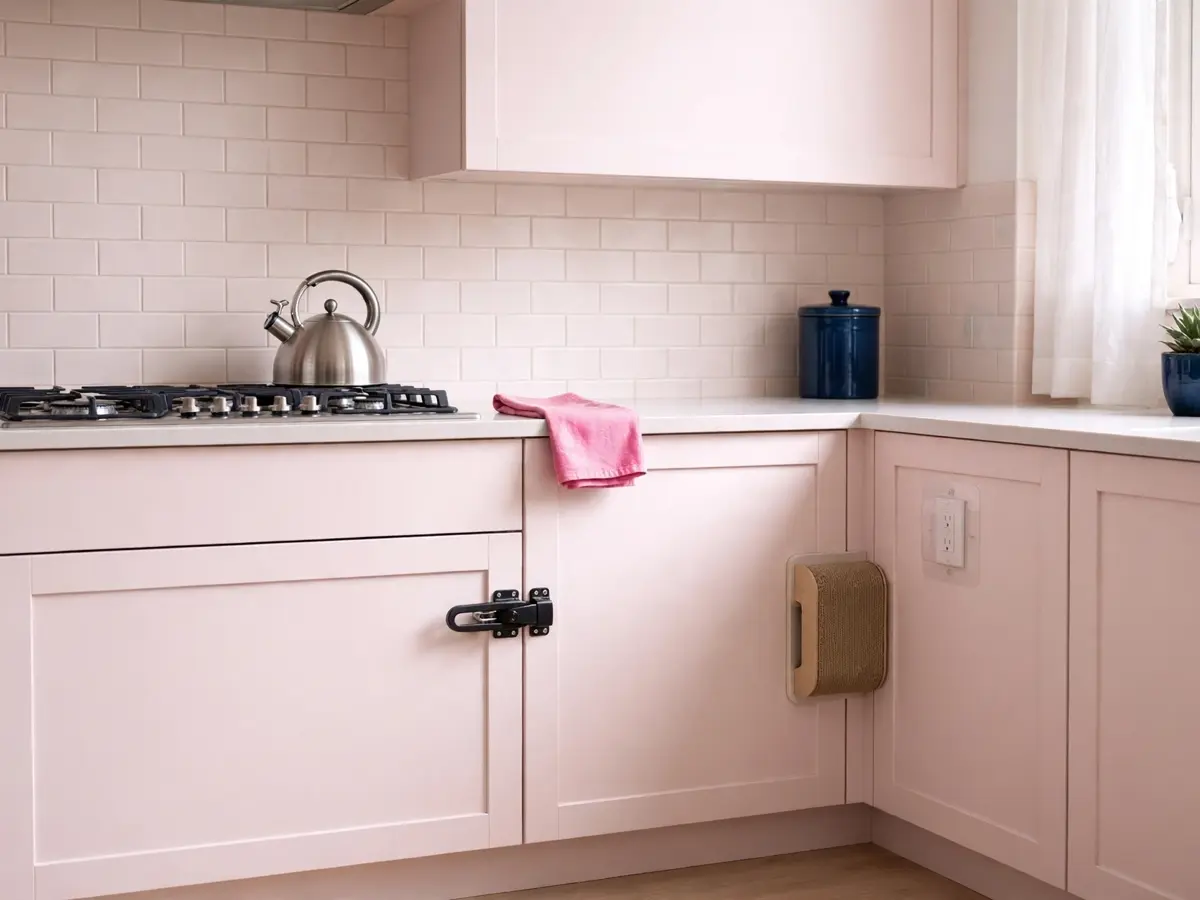
The kitchen is the one room where cat-proofing means doors, not habits. Pantry and lower-cabinet doors need latches or child locks, because a bag of food on the floor of a cabinet is a midnight project. The stove is the second boundary: nothing on the stovetop with a handle pointing out, and no cords from a kettle or an air fryer hanging over the counter edge.
Keep the litter box away from the food and water bowls, and give each resource its own spot so the cat has a choice. In a studio that rule usually puts the box in the bathroom or the entry nook and the bowls at the opposite end of the room, and the walk between them is the cat's daily commute.
Cats often find aromatic litter and litter deodorizers offensive, and no product removes the need to clean the box. So the cat-proofing version of the box corner is placement and routine: a quiet stretch, a washable rug, and a scoop that lives within reach, not a plug-in scent. For the box itself and the cleaning rhythm, see our hidden litter box guide.
The climbing map
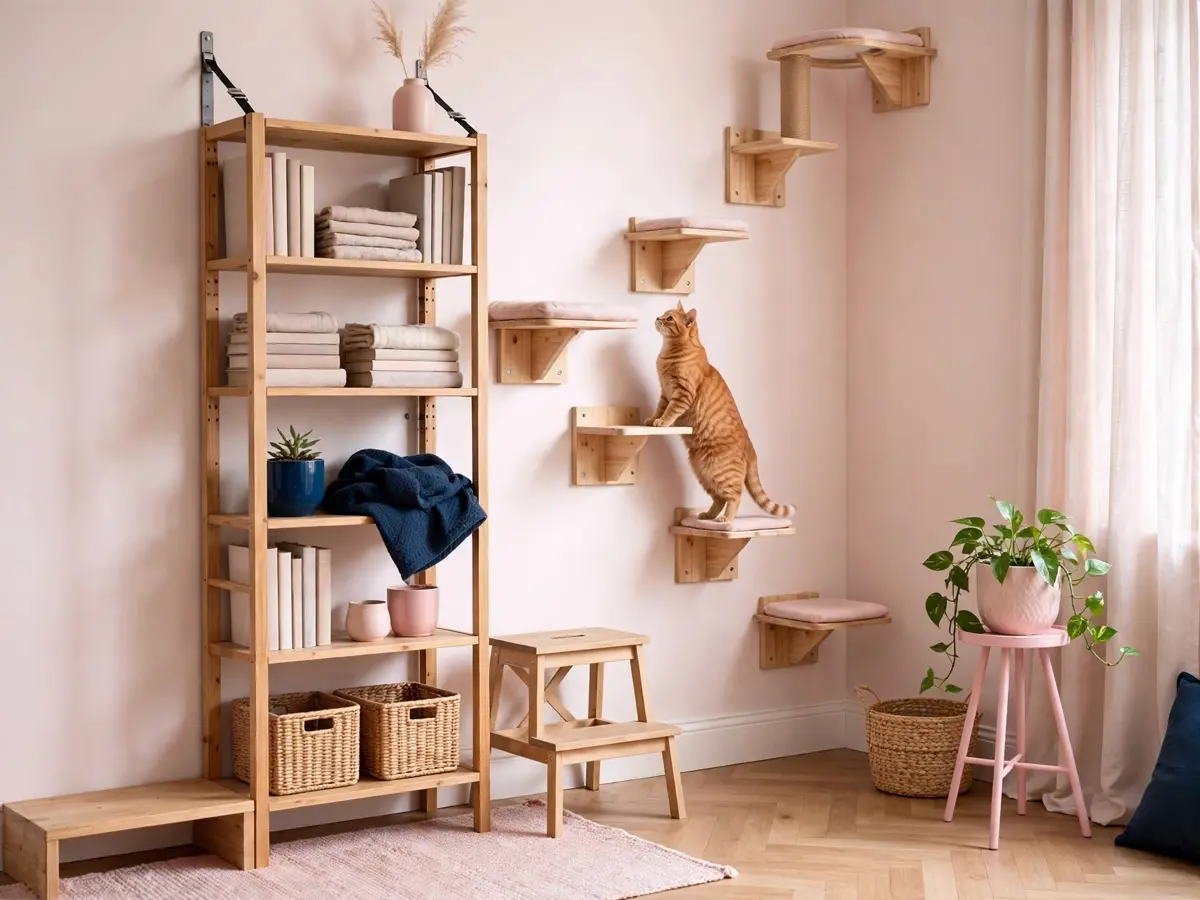
Every cat in a small apartment builds a route: floor to chair to shelf to bookcase top. Walk that route yourself before the cat does, and mark every piece of furniture that would tip under a launch. A tall bookcase gets strapped to the wall or emptied at the top, and a wobbly plant stand gets moved out of the route entirely.
For kittens and older cats with limited mobility, keep boxes, perches and shelves low or reachable by a ramp. The route is still the same idea; the steps are smaller and closer together.
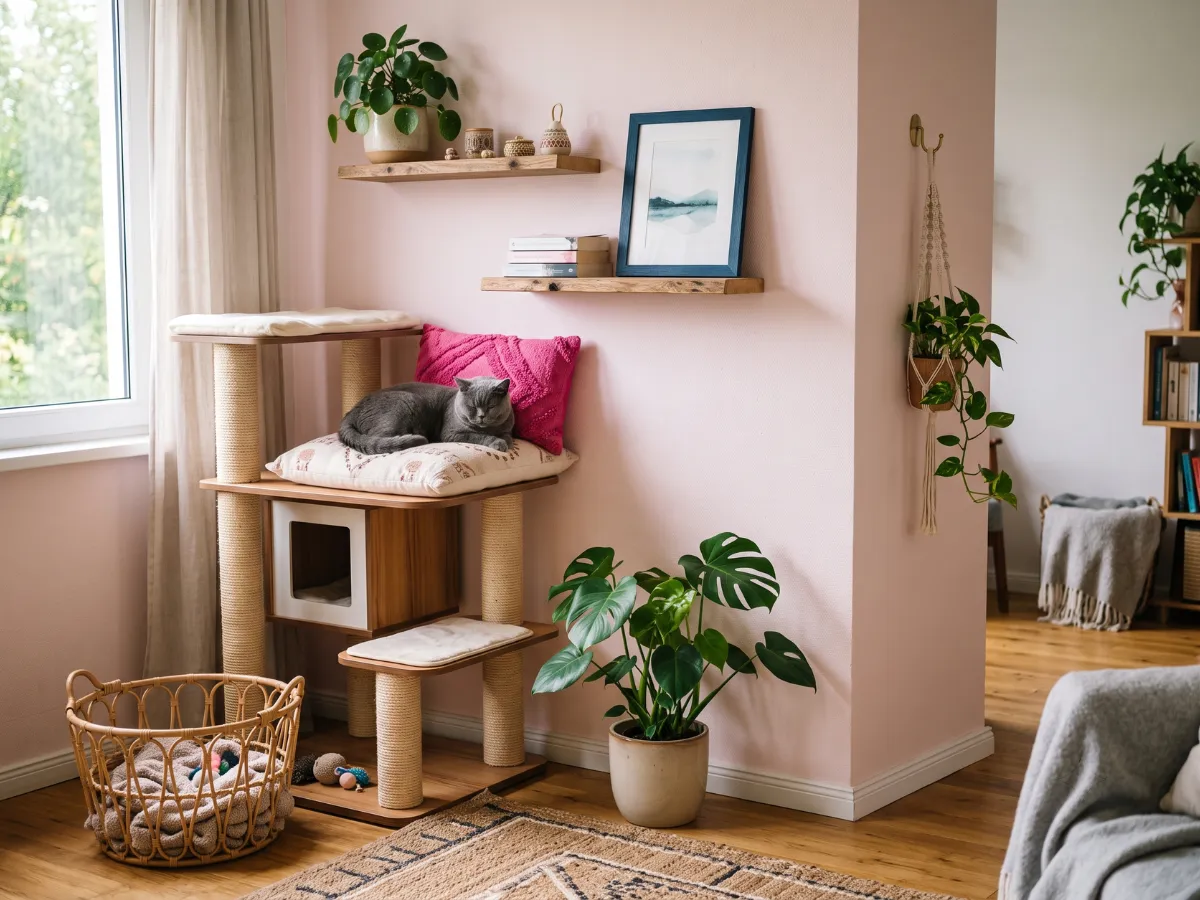
An ideal perch is elevated, with a padded cover, and an elevated area gives a cat vertical space to monitor its environment. The climbing map is how a small apartment supplies that without a wall of shelves: one route, two resting spots, and furniture that survives a landing.
The moving-day walk-through
Whether the cat is new or the apartment is new, the same walk-through happens before the cat walks in. It takes twenty minutes, and it goes in one direction around the home so nothing is skipped.
- Kneel at floor level in each room and look up: everything you can see from there is a cat-reach surface.
- Cords in raceways, blind cords on cleats, batteries in drawers.
- Plants named and shelved; anything unnamed goes out to the car or a closed room.
- Push test every screen; pin or fix the ones that move.
- Latch the kitchen cabinets; move the box and the bowls to their separate stretches.
- Close one safe room with food, water, a box and a hiding spot, and let the cat out of the carrier into that room only.
Then leave the cat alone in that room for a few hours. A cat that starts in one quiet room settles faster than a cat that starts in the whole apartment, and the rest of the checklist is already done when the doors open.
What still goes wrong
The checklist covers the permanent hazards; these are the recurring ones. Each fix is a habit, not a purchase.
Recurring hazards and the fix
| What goes wrong | Why | The fix |
|---|---|---|
| A charger reappears on the sofa arm | Guests and habits re-drift toward the floor | One basket for every loose cord in the apartment, and the basket lives in a drawer |
| A new plant arrives without a label | Gifts and market cuttings carry no botanical name | Name it before it sits down; anything unnamed stays in a closed room |
| A screen pops out in summer | Panels lift for cleaning and never re-seat fully | Run the push test again after every cleaning day |
| Food bags go into a low cabinet | Groceries land wherever the counter is full | A latched pantry shelf beats a cabinet floor |
| The box drifts next to the bowls | Floorspace pressure in a studio | Two stretches of the same walkway, box and bowls at opposite ends |
Every row is a drift, not a defect: the apartment keeps trying to become un-cat-proofed, and the walk-through is what pulls it back.
The whole checklist, one page
- Every cord below knee height in a raceway or a drawer
- Blind cords on cleats above sitting height
- Batteries in a lidded drawer, battery lamps off open shelves
- Plants named before they sit down; lilies out entirely
- Push test on every screen, pins on the loose ones
- Window open-stops set to a crack, not a cat-width gap
- Kitchen cabinets latched; stove handles turned in
- Tall furniture strapped or emptied at the top
- Box and bowls on separate stretches of the walkway
- One closed safe room for the first hours
Kitten level and senior level
The checklist is the same at any age; the heights change. A kitten reaches any gap a paw fits through and climbs anything with a weave, so the gap check goes wall to wall and the weave check covers curtains and baskets. Senior cats jump less and judge distance worse, so the low wall matters more, and the landing zones under the favorite jumps need to stay clear, not soft.
For kittens and older cats with limited mobility, keep boxes, perches and shelves low or reachable by a ramp. A folded blanket as a step does the job for most cats, and it moves when the route changes. For informational purposes, consult your vet.
Questions we get about cat-proofing
Where do I start cat-proofing a small apartment?
Start where the cat will actually spend its first week, not where the checklist looks neatest. Close one room, work the cords, plants and windows in that room until it is boring, then open the next door. Give each resource its own spot and let the cat choose: a minimum of two resting areas, two feeding areas and two toileting areas.
How do I keep my cat away from electrical cords?
Keep electrical wires and batteries out of reach, because a wire can deliver a potentially lethal electrical shock. In practice that means a raceway along the baseboard, a cleat for blind cords high on the frame, and spare batteries in a lidded drawer. A cat that has already chewed a cord is a same-day vet call, and the unplugging comes before the touching.
Which houseplants are the problem ones?
Lilies are especially toxic to cats and can cause life-threatening kidney failure even in tiny amounts, and poinsettias, mistletoe and holly are toxic as well. So a rental with no plant list starts by reading the nursery label, and a plant you cannot name stays at the shop. For informational purposes, consult your vet.
Do screens make a window cat-safe?
A screen is not a perch and it is not a guard. If the screen is the only thing between the cat and the drop, fix the window before you hang anything, and never hang a perch on the screen itself. A push test with a flat hand on every screen is part of the moving-day walk-through.
Where should the litter box and bowls go?
Keep the litter box away from the food and water bowls, and give each resource its own spot so the cat has a choice. In a one-bedroom that usually means the box on the quiet stretch of the walkway and the bowls on the opposite stretch, not both corners of the same room.
Can I cat-proof a rental without drilling?
Yes, most of this checklist is taping, clipping and moving furniture. A raceway sticks to the baseboard, a cleat goes inside a blind frame, corner guards clip on, and the window builds that hold weight hang from the glass. The one thing you cannot skip in any apartment is the walk-through: two rooms with the same furniture can hide different hazards.
What we use
What we use for cat-proofing
Raceways, cord cleats, cabinet latches and screen pins, in one renter-friendly list.
See what we use →As an Amazon Associate we earn from qualifying purchases.
Save these on Pinterest
Pin the checklist for moving day. The Cat Home collection holds the corner, castle and litter guides.
Sources
The hazard rules on this page come from veterinary and veterinary publisher sources, not from our own head:
- AAFP and ISFM: feline environmental needs guidelines
- ASPCA: holiday safety tips for cats
- Cornell Feline Health Center: common cat hazards
- AAFP and ISFM: house-soiling behavior in cats
The plant shelf rule covers every pot at once, and the money trees on the plant shelf page is the single most-asked species under it.