 PawStyle Daily
Puppy Training Tips
Border Collie Puppy Training: a Job for Each Day
A border collie pup does not need more exercise. It needs more purpose. The breed was built to think about sheep for a living, so a collie with nothing to think about will invent something, and the invention is usually your heels, the fence line, or a patch of lawn it has decided to herd. This page is about the herding craft specifically: one job per short session, scatter and scent games that put the brain to work indoors, the single item the pup is allowed to carry, and the redirect that turns a nipping mouth into a polite one. The plain obedience underneath all of it sits on the basic obedience at home page, and the walk itself is sized on the walk length by breed guide. What lives here is the part those pages do not cover: how a herding brain spends its day.
By PawStyle Daily · Updated 20 November 2026
Good to know: one job per session, not five | scatter and scent before a long walk | a carried item has rules | the nipping mouth gets redirected, never chased.
The breed problem, stated plainly
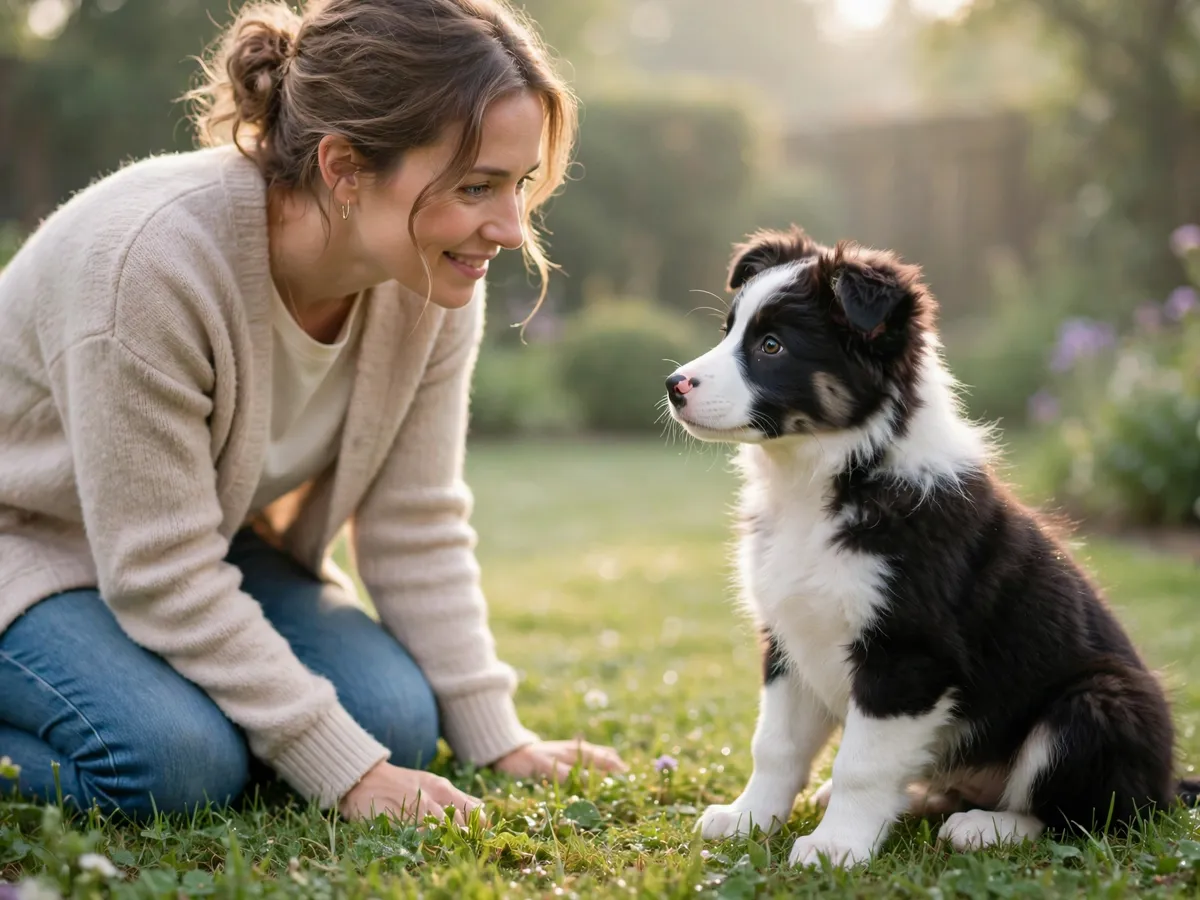
Most puppy training advice assumes a dog that would rather be comfortable than busy. A collie is the exception. Give it a choice between a soft bed and a job, and a well-bred pup picks the job, then refuses the bed until the job is done. That is not a discipline problem to be broken. It is the engine the breed was built with, and a household that fights the engine gets a war. A household that points the engine at something gets a dog that works, then rests, then works again.
The trouble is that a collie does not need a difficult job. It needs a job. This is the most useful sentence in herding training, because households hear "busy dog" and reach for a longer walk, a bigger yard, a harder trick. What the pup actually wants is something with a beginning and an end, repeated until it is boring. A scent game under a chair is a job. Carrying one rope toy from the sofa to your hand is a job. None of these are impressive. All of them are the difference between a collie that naps and a collie that herds the laundry basket across the room.
A job per session, not a list of commands
Structure the day as a handful of short sessions, and give each session exactly one job. One job means one thing the pup is being asked to do, from a start to a finish, and the household watches for the moment it is done rather than counting reps on fingers. Three commands in a row is not three jobs; it is one confused session where the pup never learns which part was the point. A collie trained in lists gets a dog that waits for the next cue instead of finishing the current one, and that dog will spend its life looking at you with a busy head and nothing to do with it.
End the session while the pup is still winning. This is the rule that separates a collie that loves training from a collie that tolerates it, and it is the hardest rule to follow, because the winning rep is the one that feels like stopping too soon. Take the easy version of the job, the one the pup did perfectly yesterday, ask for it once more, pay it well, and walk away. The pup goes to its bed remembering the last thing it did was correct, and the next session starts with a dog that already wants to play. A session that ends on a failure teaches the pup that training ends badly, and a collie that expects it to end badly will start dodging the start.
Keep the sessions shorter than feels reasonable. A herding pup learns faster than it can switch off, which is the exact reason the nipping and the staring and the fence-line running happen: the brain is still switched on after the body is done. Five short jobs spread across the day will beat one long block, and the long block is the one that ends with a pup that has learned to guess rather than to think. The plain commands that go inside each job, the sit and the stay and the come, are taught on the basic obedience at home page. This page only decides what job the day asks of the dog.
Scatter, scent, and the item to carry
The first herding game is the cheapest one. Instead of feeding the pup from a bowl in one spot, toss its dinner into a patch of grass or scatter it across a hallway floor and let the pup go find it. The pup eats the same meal, and it eats it with its nose working, which is the part a bowl never asks for. Scatter feeding is not a trick and not a slower way to feed; it is the closest thing a household without sheep can offer a dog that was bred to search. Start it indoors on a mat or a quiet corner, where the pup can win, and move outdoors once the searching is confident. A pup that scolds you for losing its bowl has learned the game is a lottery, so keep the first scattered meals small and easy to finish.
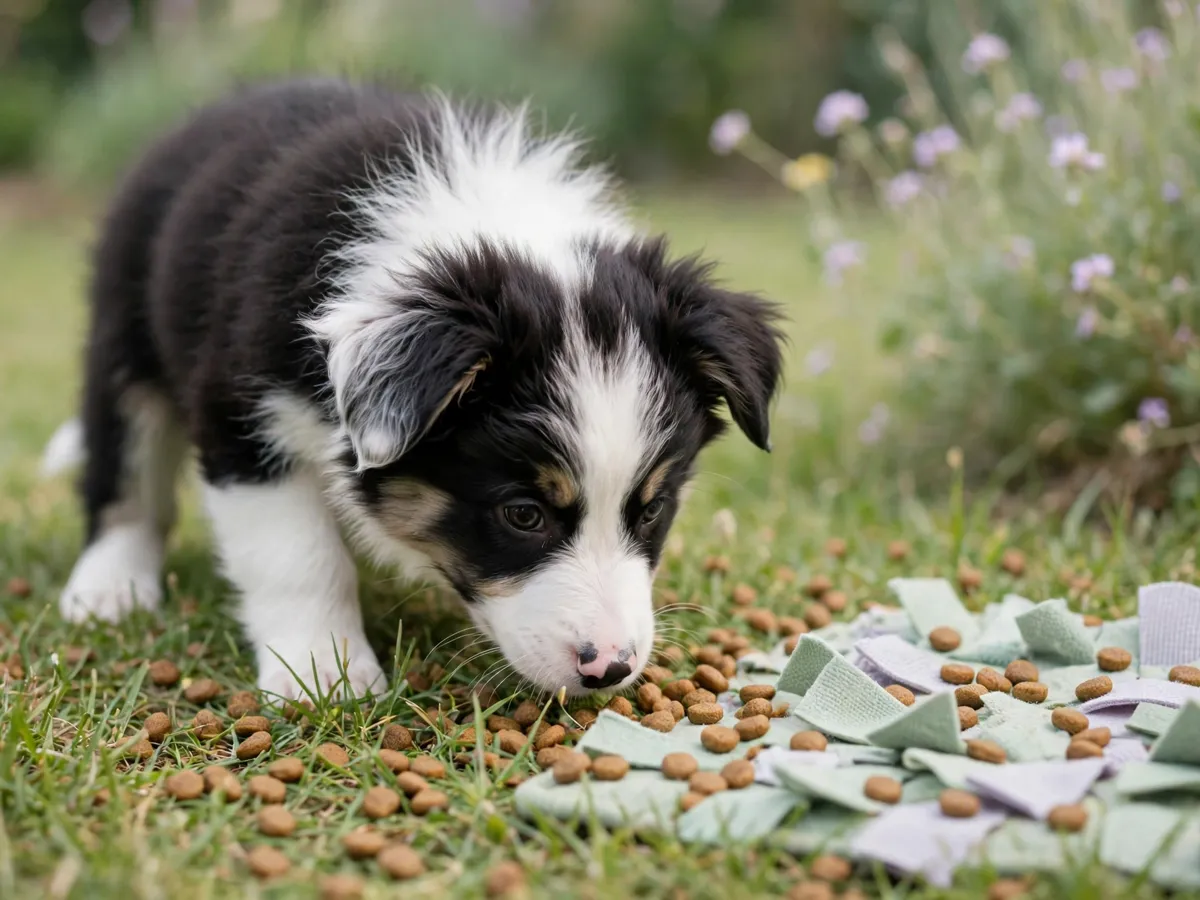
Scent work is the second game, and it tires a collie faster than a long walk. Hide a piece of the meal under a towel, then a cup, then behind a chair leg, and let the pup hunt it down. The nose does the work the legs would have done, and a pup that has hunted for a stretch will lie down and stay down without being asked. Scent is also the quiet game, the one a household can run on a rainy afternoon or in a small apartment with no yard at all, which makes it the most reliable tool for a collie that lives in a city. Nothing about it requires equipment beyond a few treats and a handful of cups.
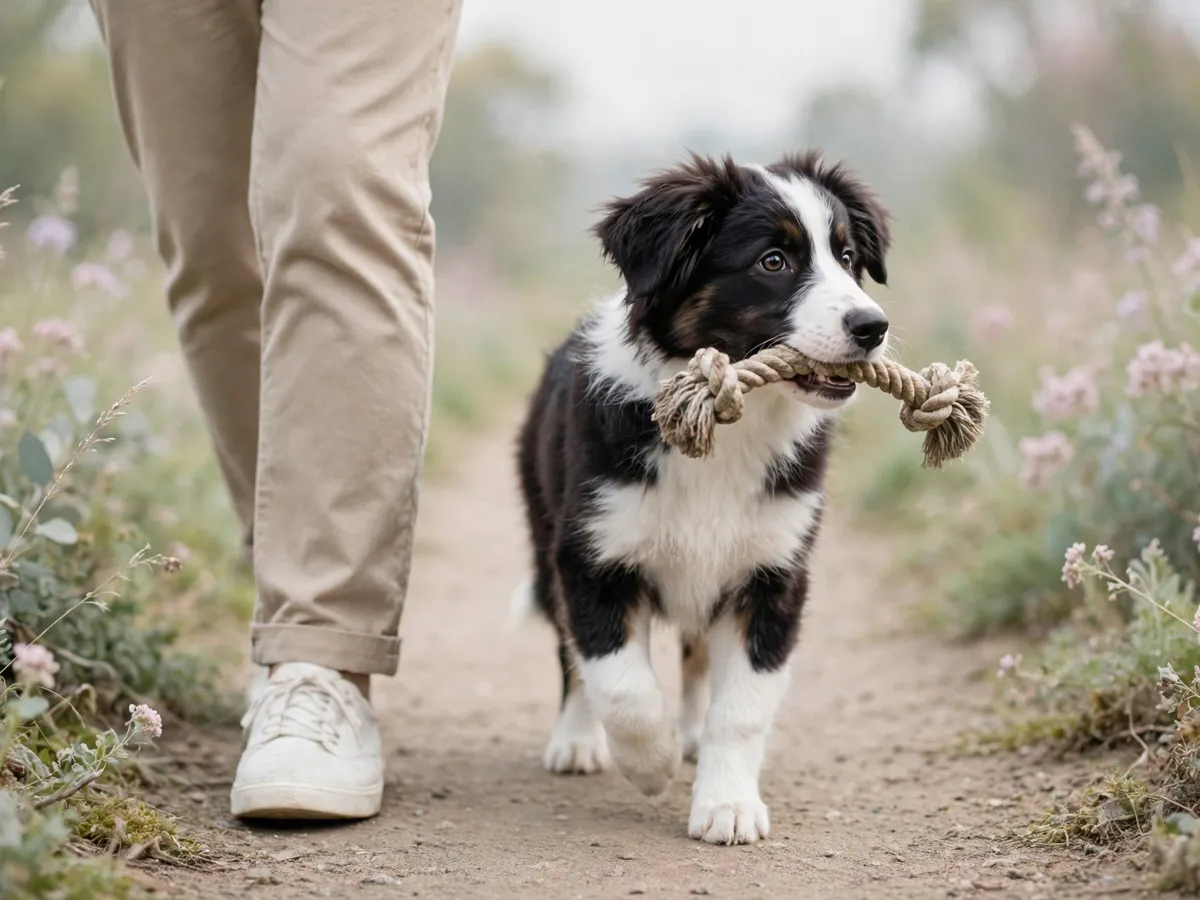
The third game is the carried item, and it is the one that solves the collie's famous mouth. Give the pup one rope toy, and the rule is that the toy lives on the floor between the two of you and goes nowhere near the ankles. The pup carries it from the sofa to your hand, drops it on cue, and picks it up again. A herding mouth wants something to herd, and a rope toy that has a start and a finish is an honest substitute for a flock. The mistake is three toys and no rule, which gives the pup a mouth that grabs whatever is closest, usually a heel. One item, one rule, one job.
Redirecting the nipping mouth
The nipping is not spite and it is not a dominance question. It is the herding mouth aimed at anything that moves, and the moving thing in a house is usually a person. A collie pup that has been bred to gather with its teeth will test the ankles of the household the same way it would test the legs of a flock, because the household is the only thing in the room that walks. Knowing this changes the fix. You are not punishing a bad dog. You are showing a working dog where the work actually is.
The redirect has three moves and they all happen at once. Keep the hands still, because a waving hand is a more interesting target than a sleeve. Move the game indoors to the tug toy, so the mouth lands on the item that has a rule instead of the ankle that does not. End the session the moment teeth touch skin, because the lesson a pup learns from a nipped person who then runs away is that nipping works. A pup that gets a runaround learns to chase, and a household that chases a nipping pup has just invented a new game the pup will play for years.
The boring version is the answer. A nipping pup does not want a reaction; it wants a target. Be still, be a piece of furniture that does not move, and the pup will look for something else to herd, which is exactly when the rope toy appears. Repeat this and the pup learns the lesson a city herding dog most needs: the moving things in this house are not the job.
The off switch is taught elsewhere, and you want it
Everything on this page assumes the pup can also do nothing. A collie that cannot settle will turn every job into a argument, and the household will spend the day managing a dog that never clocks off. The settle command itself, the mat that holds while dinner cooks, is taught on the basic obedience at home page, which owns the kitchen anchor as one of its five commands. This page does not teach the mat. It only asks you to put the mat in the day somewhere, between the jobs, so the pup learns that a herding brain is allowed to be off.
The practical version is a rhythm, not a trick. A job, then a settle, then a rest, then another job. A collie raised on that rhythm grows into a dog that can lie under a restaurant table or beside a desk without inventing a flock of its own. The walk that fills the rest of the day is sized on the walk length by breed guide, which handles the miles so this page can stay on the thinking.
Border collie puppy questions
What should a border collie puppy session look like?
Short, a few commands deep, and ended while the puppy is still winning. A herding pup learns faster than it can switch off, so the last rep should be the easiest one.
Is a long walk enough for a collie pup?
On its own, no. A collie wants a job rather than only miles: a scent game, one item to carry, a place to lie down and watch the room. A tired body with a bored head still invents work.
Why does my collie puppy nip at heels?
Herding mouth, aimed at anything that moves. Keep hands still, move the game indoors to a tug toy, and end the session when teeth land on skin; a pup that gets a runaround learns to chase.
Save the herding day-plan
Pin this before the pup arrives and keep it where the treat pouch hangs. The day is a handful of short jobs, a scatter meal, a scent hunt, one carried item, and a mat to clock off on. The plain commands live on the basic obedience at home page, and the walk is sized on the walk length by breed guide.
For informational purposes, consult your vet.