 PawStyle Daily
Pet Loss Memorial & Rainbow Bridge
How to Tell a Child a Pet Has Died
There is no sentence that makes this easy. There are sentences that make it honest, and honest is what a child can hold. This page is a quiet walk through the moment itself — choosing it, naming what happened, keeping the first explanation short — and through the weeks that follow, when a small grief behaves nothing like an adult's. Take what fits your family and leave the rest.
By PawStyle Daily · Updated 17 November 2026
This page is for informational purposes · written for comfort, not as grief therapy · if your family is struggling, a school counselor or family therapist is a real and reasonable next step.
Choosing the moment
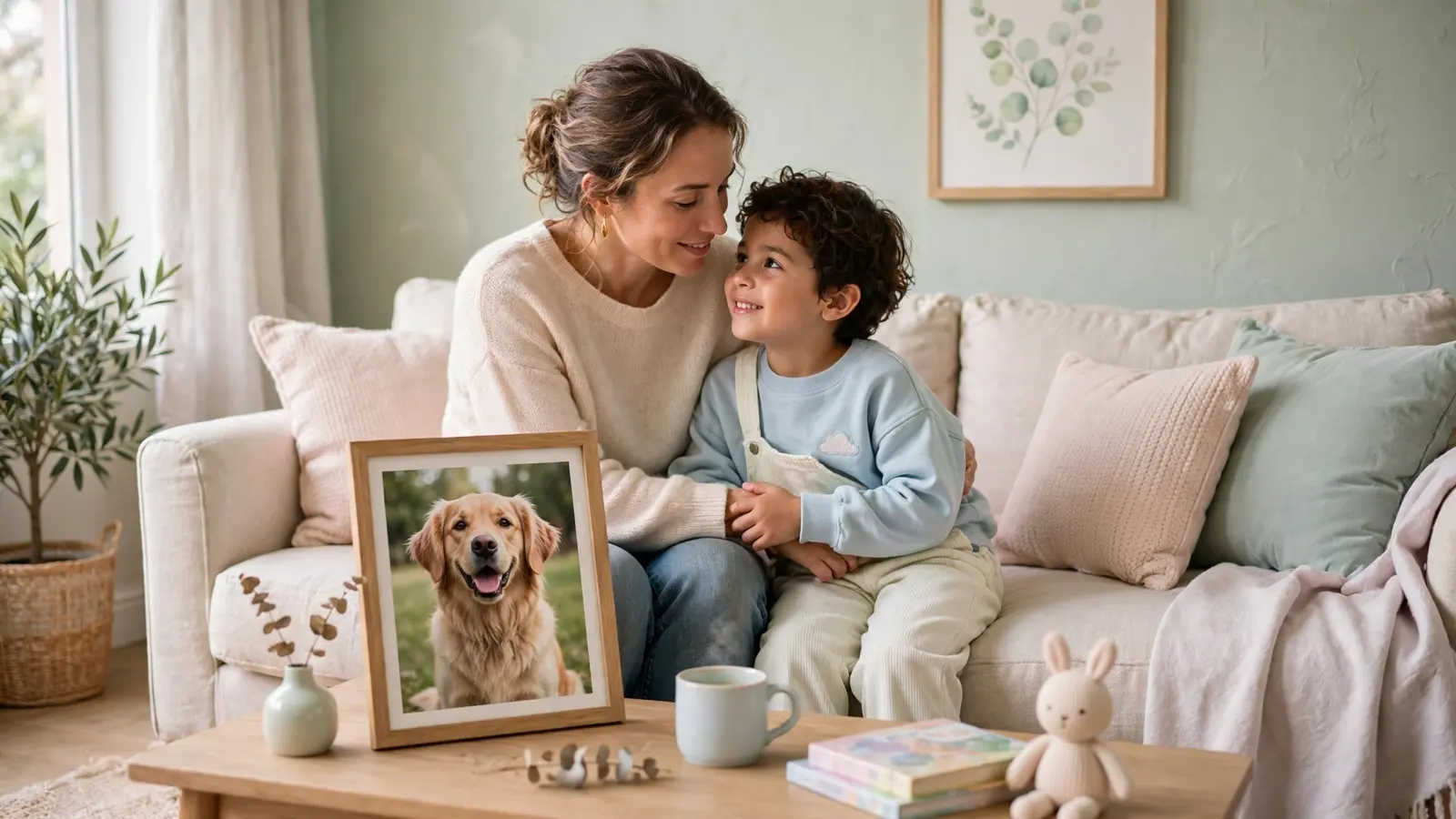
Tell them soon, in a calm place, when nothing else is scheduled right after. The sofa after school, the kitchen in the early evening, a quiet bedroom — somewhere the child already feels at home, with time on the other side of the sentence for whatever comes. A child told in a doorway on the way to somewhere has nowhere to put the feeling.
Hard avoidances, from parents who have been through this: the school gate in the morning, the car on the way to a birthday, or the last minute before a trip. If you must tell at a bad time, say only the fact and promise the full conversation for tonight. One adult, ideally the one the child runs to first, and no rehearsed speech. You will say it badly. Children remember that they were told the truth, not how the sentence scanned.
When the death is expected rather than sudden, choose the moment twice — a short conversation beforehand that the pet is very ill and will probably die, and the real one afterward. The second conversation is easier for everyone because the first one already carried the word.
Using the real words
Say died. Say dead. Every soft substitute — went to sleep, went away, ran off, is in a better place, we lost him — trades a slightly easier sentence now for a harder problem later. Children are literal, and a pet that went to sleep invites a fear of bedtime. A pet that went away invites a search. A pet that was lost invites the question of whether it can be found.
One honest sentence does the whole job, and it can be plain: “Biscuit was very old, and she died this morning. We are all very sad.” Age-banded honesty lives in how much you add around that sentence, never in replacing the word itself. If your family holds a belief about what happens after death, that belongs in the conversation too — as an addition to “died”, not as a substitute for it.
The euphemism that is genuinely fine is the one the child makes up. When a child says “Leo is in the sky now”, you have been given the family's new language, and you can use it back with a clear conscience, because the child built it on top of the real word.
One short explanation, then the questions
The first explanation should be three or four sentences, and then it is the child's turn. What happened, that the pet has died, that the family is sad, that it is okay to ask anything at any time. Then stop talking. Silence feels neglectful to an adult and spacious to a child — it is the room the child needs to decide what to do with what they just heard.
Children ask the same question for days, and the repetition is not doubt — it is a small person checking that the world still says the same thing. Answer the same way each time, in the same plain words, without frustration. Some children never ask and instead start playing, which is also processing. Sit nearby and let the game run; the questions arrive in the bath, at bedtime, in the car a week later, and they deserve the same plain answer.
- Answer only what was asked. The question about whether the pet was scared does not want the veterinary history attached.
- “I don't know” is a fair answer, and a better one than a guess a child will remember word for word.
- Correct gently if a child blames themselves — for the illness, for a quarrel with the pet last week, for not noticing sooner — because blame sticks when nobody names it.
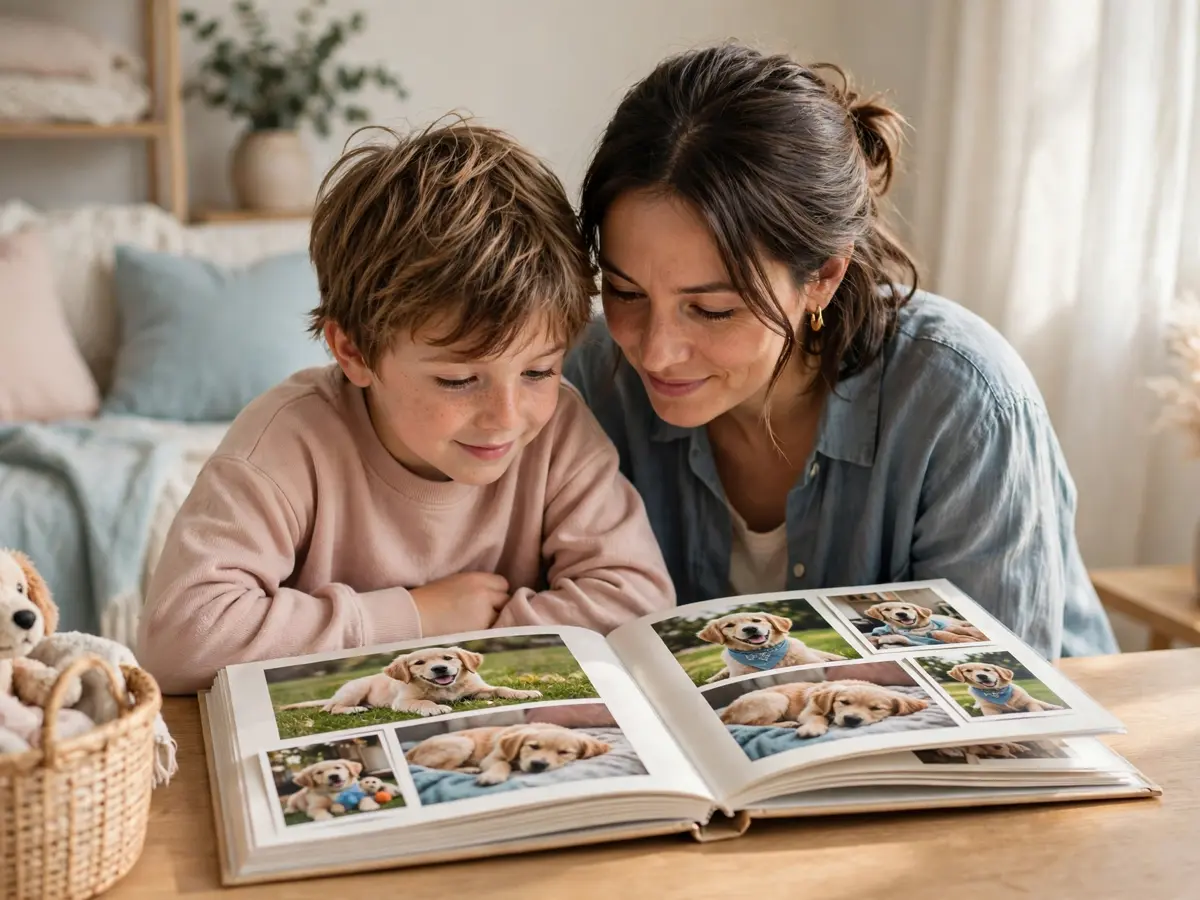
- Keep offering openings for weeks: “I was thinking about Biscuit today — do you want to look at her pictures?”
Letting the child see the ritual
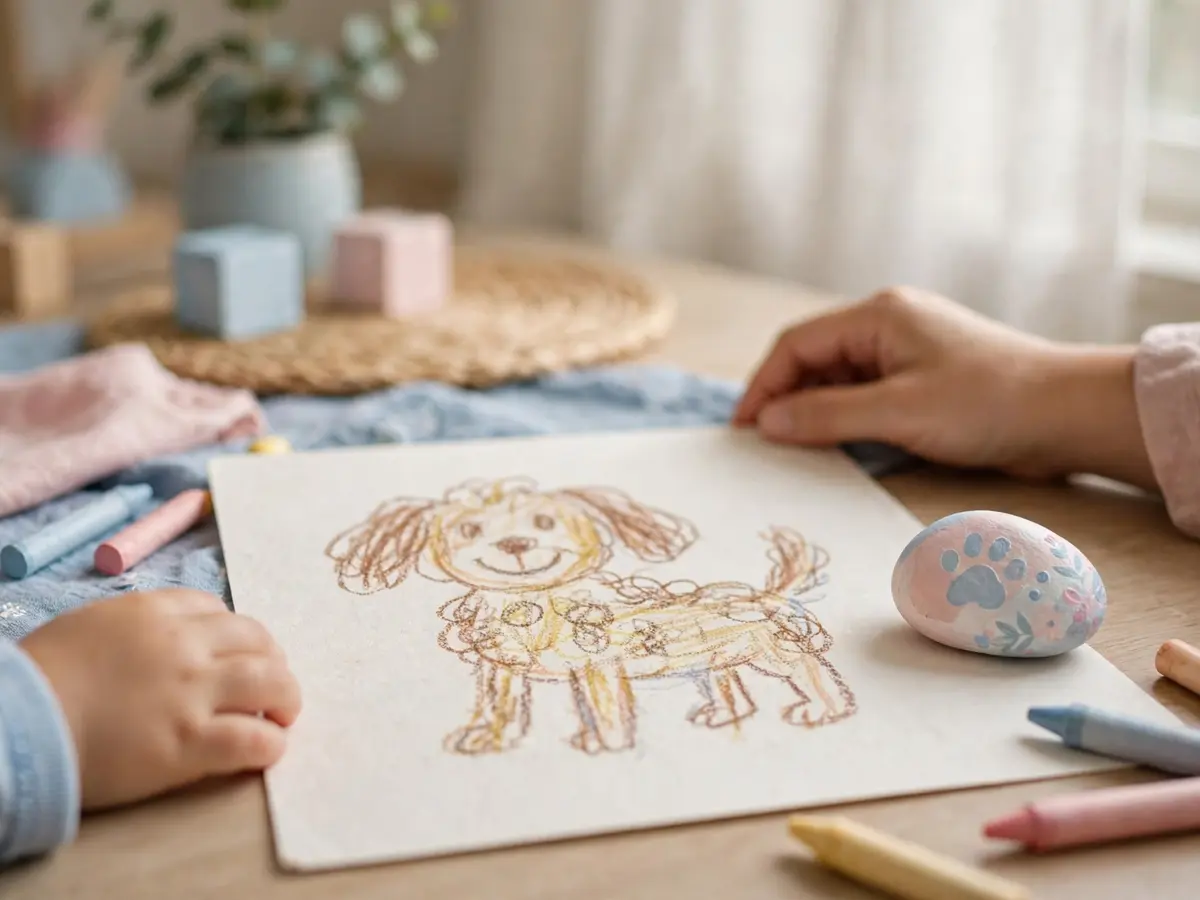
A goodbye the child can see or touch does work that words cannot: it makes the death a real event rather than an announcement. The shape depends on your family and what is actually possible — a painted stone for the garden, a candle at dinner, a drawing for the memory box, a small spot in the yard, a photo by the bed.
The child should get to choose their part of it rather than being handed one, and their part should be something a child can actually do: picking the photo, drawing the picture, choosing the spot, saying one word at the burial. Watching you grieve at the same ritual teaches the other half — that sadness is allowed in this family and that it does not swallow anyone.
Some children skip the ritual entirely, run off to play, and return to it a month later. That is also a healthy goodbye at child speed. The ritual stays available; the child sets the clock.
What the following weeks look like, by age
A child's grief is real and it is shaped by the age carrying it. None of what follows is a schedule a child must keep — it is the range families actually report, so you know that what you are seeing has been seen before.
- Preschool: death is not yet permanent in a small child's world, so the pet may “come back for dinner” in conversation and in play. Answer the same way every time, and expect the same question many more times than feels reasonable.
- Early school: questions turn practical and blunt — what happens to the body, is the pet cold, is it dark where the pet is. Some children feel guilt over ordinary last days; a plain sentence that nothing they did caused this goes a long way.
- Around eight to ten: permanence lands, which is when grief gets loud. Anger, stomach aches, tears at unexpected hours — sometimes aimed at you, sometimes at the pet for leaving.
- Eleven and up: many children grieve privately, on a phone, in a notebook, at night. Offer a place to talk that does not force one, and keep an eye on sleep, school and appetite as the quieter signals.
Across every age, grief arrives in waves, and the wave is often triggered by a routine rather than a thought: the empty bowl, the walk that now goes the other way, the word “walk” said by accident. Changing the routine too fast can hurt as much as leaving it. Let the family find its own pace with the bowls and the beds.
When to bring in a school counselor or family therapist
Most children carry a pet's death with their family and nothing more. The signs that a professional deserves a call are the ones that reach beyond grief and stay put: sleep that stays broken for weeks, schoolwork or friendships that fall away, play that is stuck replaying the death over and over, a fear of sleep that outlasts the first few nights, or a child who says they want to die too.
A school counselor is a gentle first step and usually the fastest one — they see the child weekly, they know the classroom, and a child can visit without the event becoming a family episode. A family therapist is the next step when the grief sits inside something bigger, or when the adults are struggling too much to hold the child's questions.
Asking for that support early is a parenting move, not a failure of one. A child who watches a parent say “this is too big for just us” learns that asking is allowed, which is a lesson that outlasts this one loss.
The conversation at a glance, by age
| Age | What they usually understand | What tends to land well |
|---|---|---|
| Under five | Death is reversible in their world; the pet may 'come back' | The same plain words every time, and repeated patience with the same questions |
| Five to seven | Death is permanent but not universal; blame is common | A gentle, direct line that nothing they did caused it |
| Eight to ten | Permanence lands, and grief gets loud and physical | A real part in the goodbye, room for anger, answers without hurry |
| Eleven and up | Full adult understanding, often carried privately | An offer to talk that does not force it, and an eye on sleep and school |
Ages are ranges, not rules — some eight-year-olds are private and some thirteen-year-olds ask out loud. Read the child, not the number.
Telling a child about a pet's death
Should I say the pet 'went to sleep' instead of died?
Euphemisms land softer in the moment and heavier later. A child who hears that a pet went to sleep and did not wake up can become afraid of bedtime, surgery, or their own naps. 'Died' is one short, honest word, and a child who understands it can trust everything else you say about the pet.
How much detail does a child need?
One short explanation, then the questions do the steering. Say what happened, that the pet has died, that the family is sad, and that questions are welcome at any time — then answer only what is asked. A child who wants to know whether the pet was scared asks; one who wants to know about the burial asks about that instead.
What if I cry in front of my child?
Let it happen. A child who sees a parent cry and keep going learns that grief is survivable, which is the lesson under every other word on this page. Say it out loud — 'I am crying because I miss her, and I am okay' — and the moment becomes a model rather than a scare.
Should the child be there for the goodbye?
Most children do better with a real goodbye than a vanished pet, so offer it rather than deciding for them. Some children want to sit with the family, some want to say goodnight and leave, and both are goodbyes. Forcing attendance or forbidding it both take the choice away from the person it belongs to.
How long does a child's grief last?
Longer than most adults expect, and it comes in waves rather than stages. A child can weep over the dog on Monday and play football on Tuesday, then collapse again on Friday — that is how a small person carries a big feeling. 'Waves over weeks, sometimes months' is the realistic picture; a grief that never lifts or blocks school, sleep and play is the point at which a counselor is worth a call.
When should we get another pet?
When the family genuinely wants one, not when the house has been quiet for a set number of weeks. A new pet never replaces the one who died, and saying that out loud keeps the child's trust intact and spares the new animal an impossible job. Some children ask for a new pet the same week, some say 'never' for a year — follow the child rather than the calendar.
Save these on Pinterest
Save this page for the day a family needs it, gently, and pair it with the rainbow bridge keepsake journal and the memorial keepsakes guide for the months after. If a friend's family is going through this, our words for a friend who lost a pet may be useful when you show up for them.
This page is for informational purposes. Grief is heavy — a school counselor or family therapist is a real and reasonable next step when it stays too big, and there is no shame in making that call early.