 PawStyle Daily
Pet Loss Memorial & Rainbow Bridge
What to Say When a Friend Loses a Pet
Your friend's dog is gone, and the message you keep drafting keeps erasing itself. That hesitation is normal — pet loss is a grief the world under-acknowledges, and nobody hands us the script. This page is the script's gentle skeleton: sentences to reach for, sentences to leave unsaid, and the small gestures that carry a friendship through the first weeks. No perfect sentence exists. Presence does.
By PawStyle Daily · Updated 17 November 2026
For comfort only, not grief-therapy advice · soft, slow and personal beats polished and formal.

The silence problem
Here is the paradox: the friends who love us most often say the least when a pet dies, because the loss feels “too small” to burden someone with — not a parent, not a sibling, “just a cat.” So the grieving person ends up consoling the well-wisher: “it's okay, she lived a long life.”
The truth is the friendship suffers more from the silence than from any clumsy sentence. A pet is a daily companion — the first face in the morning, the reason the schedule bends, the listener who never interrupted a bad day. A grief that size deserves acknowledgment, not a workaround.
So the first move is the smallest one: say something, today, even if it is only two words and a name.
Words that reach a friend
These are starting points, not scripts — swap in the pet's real name and one true detail and any of them becomes yours.
- “I'm so sorry. Miso was so loved.” Names the loss, states the obvious truth that needs saying, asks for nothing.
- “Tell me about her, if you feel like it.” Opens the door without pushing through it. Many grieving people want to talk and nobody asks.
- “I still remember the day she [stole the whole sandwich / learned the stairs / sang at the vacuum].” One shared memory says “she was real to me too” better than a paragraph.
- “You gave her a really good life.” Reframes the guilt that follows every loss, gently, without arguing with it.
- “No reply needed. Just thinking of you both.” Removes the burden of responding — the kindest clause in this whole list.
- “I'm bringing coffee Thursday, and I'm leaving it on the porch if you'd rather be alone.” A concrete offer with a built-in exit beats “let me know if you need anything.”
- “I don't know what to say, and I'm here anyway.” The honest one. Honesty about being lost is its own comfort.
Words to skip
Each of these comes from a kind place. Each still lands wrong. The pattern underneath all of them: they minimize the loss, rush the timeline, or hand the griever a job.
What to leave unsaid, and why
| Instead of | It lands like | The underlying problem |
|---|---|---|
| "At least she lived a long life." | "The loss is smaller than it feels." | "At least" ranks grief instead of honoring it |
| "You can always get another one." | "Pets are replaceable." | A companion is not a slot to refill |
| "Are you over it yet?" (even joking) | "Your timeline is too long." | Grief has no schedule to report to |
| "She was just a cat." | "Your love was oversized." | The daily bond was real, whatever the species |
| "Everything happens for a reason." | "Look for the silver lining." | Some losses don't need a why |
| "Let me know if you need anything." | An offer that hands them the work | The grieving person won't ask; offer something concrete instead |
The rule behind the table: never shorten their grief to make the conversation easier for you.
Small gestures that say the same thing
When the words run out — and they will — the gestures keep speaking. Small, quiet, no announcement.
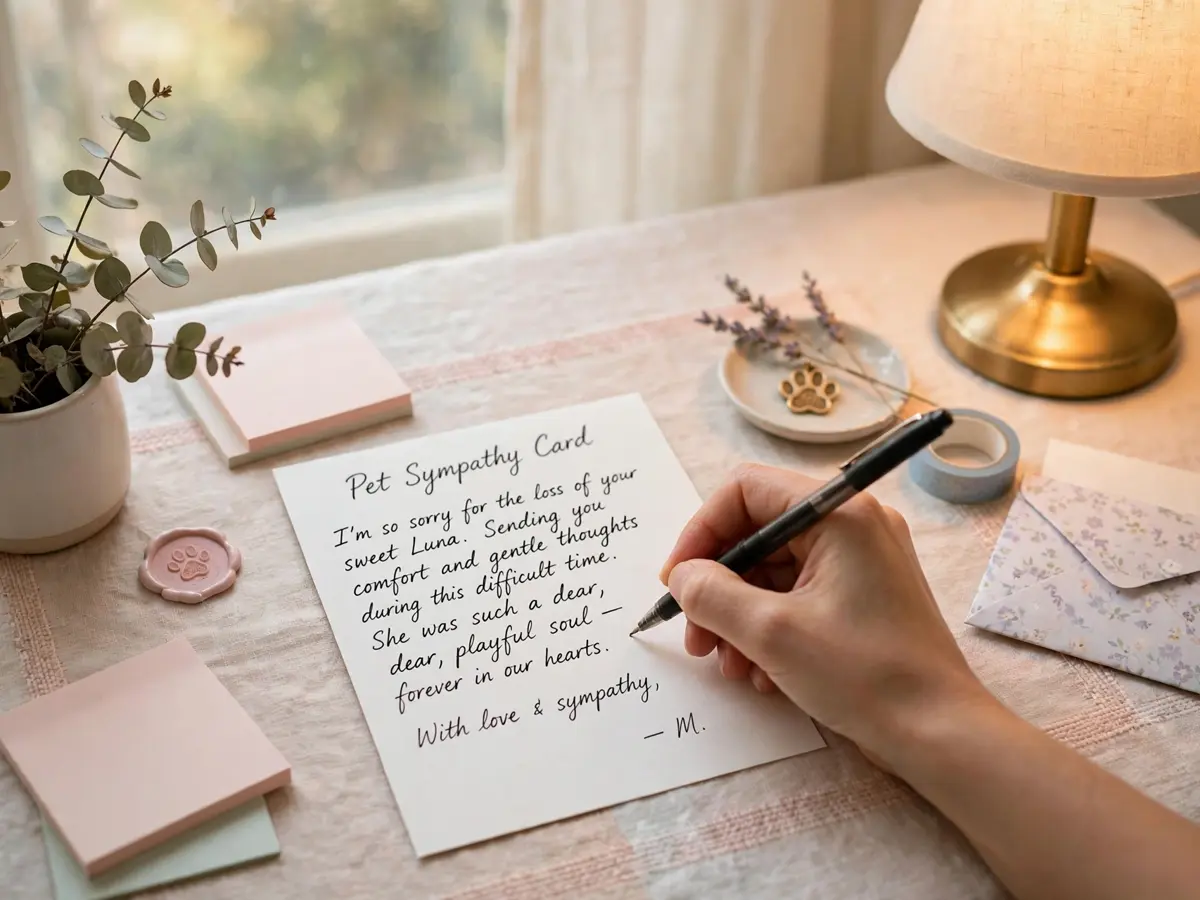
- A card: handwritten, in an envelope, with the pet's name and one memory. It arrives when the friend can bear it and keeps in a drawer forever.
- A photo text: one picture of their pet you happen to have — from a walk, a party, a visit. “Found this of her” is a complete message.
- Food on the porch: the casseroles stop after week one. A soup in week three is remembered for years.
- The walk they always took together: ask if they want company on the route they walked with the dog. Some days the answer is yes; some days it is enough to have been asked.
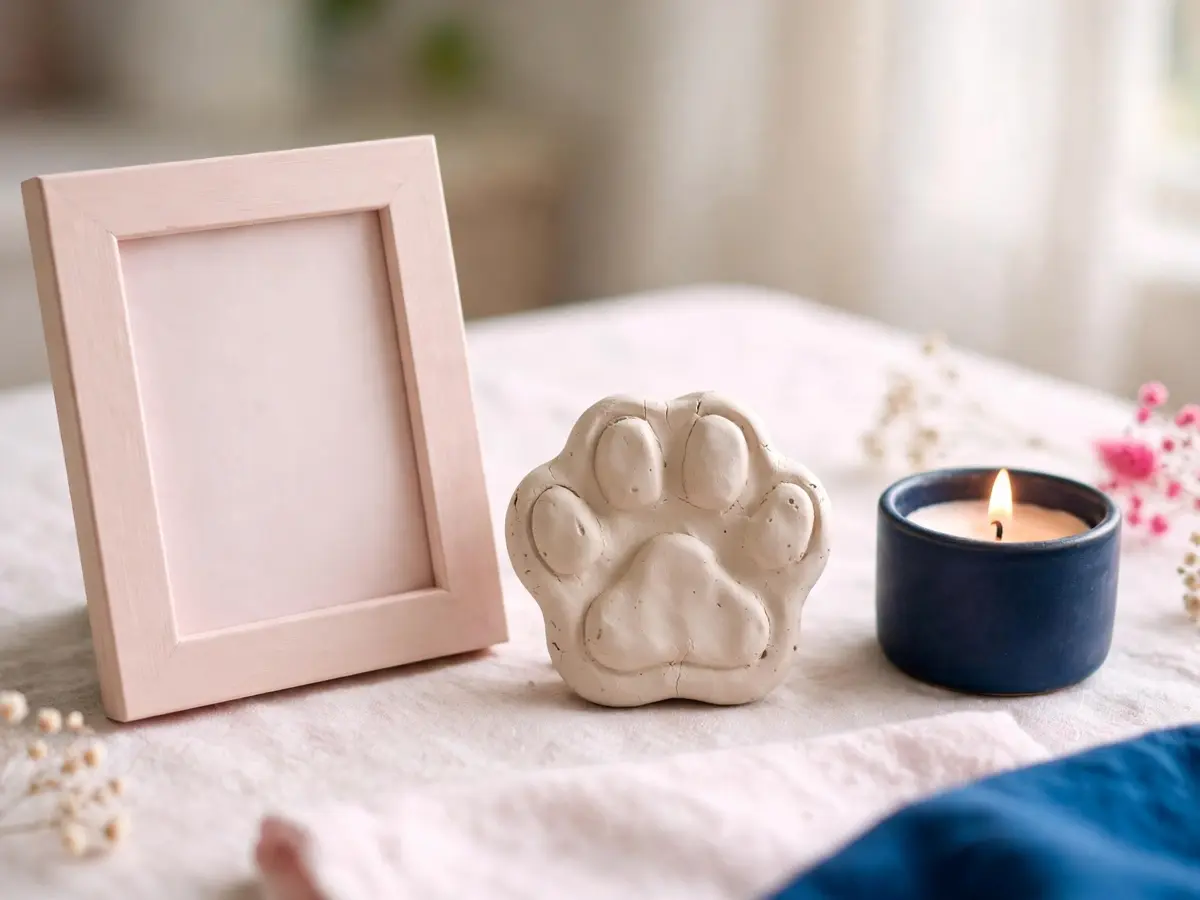
- A keepsake offered gently: a frame, a small journal, a planted bulb. The memorial keepsakes page covers what works and the timing to offer it — offer, never arrive with it unannounced.
When the friend's kids are grieving too
For a family, the pet is often the child's first loss, and the parent is grieving while also parenting through it. The friend-support version of that: keep your messages to the adult, but ask one gentle question about how the kids are doing, and let the parent talk about the kids for as long as they want — parenting grief out loud is how many parents process their own.
A small gesture lands well here too: a coloring page or a printable the kids can use to remember the pet. Our printable coloring pages are one quiet option, and the rainbow bridge journal was built for exactly this kind of remembering — a free printable, gentle enough for a child to share.
When the grief is heavier than a friend can hold
Some pet losses sit on top of other losses, and some weeks are darker than a check-in can reach. It is okay — and kind — to say so plainly: “I think this one is bigger than me. Can I sit with you while you look for someone who knows this terrain?”
Many vet clinics know pet-loss support lines and grief counselors who work with this exact loss, and a friend who offers to sit with the search is a friend doing their part. Asking for that kind of support is a strength, not a failure of the friendship.
The first weeks, in order
- Day one: a short message with the pet's name. No reply needed.
- Days two to seven: one concrete offer — food, a walk, company on the sofa. Quiet presence over plans.
- Week two: a photo or a card. The messages have thinned out by now; yours stands out.
- Weeks three and four: the check-in nobody else sends. One line is enough.
- Anniversaries and firsts: the adoption-day date, the first holiday without them — remembering on those days is the deepest form of “I knew they mattered to you.”
Presence over eloquence, at every step. The friend will not remember your exact words; they will remember that you showed up.
Pet-loss support questions
What if I say the wrong thing?
The fear of saying it wrong is what makes people say nothing, and nothing is the only real mistake. A short, warm message that names the loss beats silence. If a line lands badly, a follow-up of "I'm sorry, I said that clumsily — I'm here" repairs it in one sentence.
Is it okay to send a text instead of calling?
Yes, especially in the first days. A text arrives when the friend can bear it, asks for nothing in return, and can be reread at 2 a.m. Follow their lead after that: if they call, call back; if they text, text.
What about photos of the pet?
Sending one is usually a gift, with one careful rule: send, never post. A photo of their dog in their DMs says "I remember him too." The same photo on your public feed makes their grief a broadcast — ask first, always.
How long does the support last?
Longer than the casseroles. The first week is full of messages; the quiet month after is when a check-in lands hardest. A "thinking of you and Miso today" text in week three or four means more than a paragraph in week one.
Should I mention getting a new pet?
Not unless they raise it first. Bringing a new animal into the conversation too soon can read as "replace the loss," and even a well-meant version lands heavy. When they bring it up, be glad with them — that is the moment it becomes your business.
Save this for the day it's needed
Pin this page quietly — it is the one you open at 11 p.m. when the message needs sending. If the friend could use a gentle keepsake, the free rainbow bridge journal and the memorial gift ideas are the two pages most often sent alongside a card. For lighter days ahead, the memorial collection holds the whole series. A gentle gift if you need one.
This page is for informational purposes: comfort and friendship only, not grief-therapy or medical advice.