 PawStyle Daily
Pet Loss Memorial & Rainbow Bridge
Rainbow Bridge Memorial Keepsakes (Free Journal)
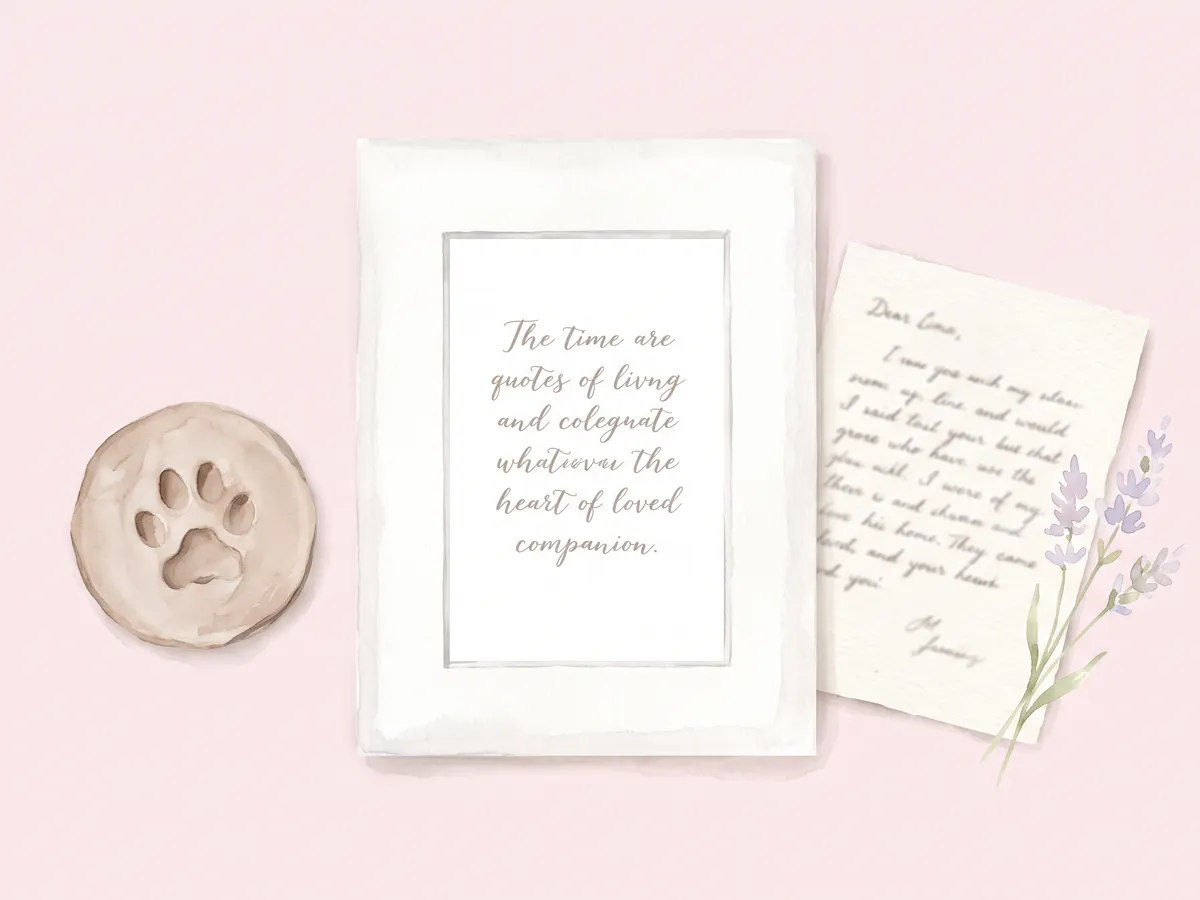
Grief needs space, not shopping carts. This page holds gentle keepsake ideas: a quote frame, a paw-print page, a letter you never send. There is a free 5-page printable journal too, and a quiet order of work for the days you feel like making something. No prices, no urgency. A gentle gift if you need it.
By PawStyle Daily · Updated 6 October 2026
For comfort only, not medical or grief-therapy advice · Soft watercolor art, made gently · Free journal, no purchase needed.

3 keepsakes: frame, print, letter
The frame
Print one favorite photo in soft white mat with a single quote line.
Print at 8 by 10 inches for a standard 11 by 14 frame, or 5 by 7 inches for a small desk frame. A mat that opens about one inch wider than the photo gives the print air to breathe and hides a crooked edge. Hang the finished frame where the light stays soft, away from a sunny window, at the height of your eyes when you are standing.
The paw print
Press a paw print in air-dry clay on a quiet afternoon.
Press the clay onto a sheet of wax paper, hold it flat and still, and let it dry overnight before you lift it. Write their name, the year and the date you made it in small letters under the print. If you are not ready to frame it, keep the disk in a small box beside their collar or their tags until you are.
The letter
Write the letter you never send: what they taught you, in your own words.
Say the ordinary things first, the walks, the greetings at the door, the sound the house made when they were in it. A letter can run one paragraph or ten pages; there is no length it has to reach. Keep it folded inside the journal, tuck it into the keepsake box, or leave it somewhere the two of you used to go.
Three small rituals, done in any order, kept or gifted only when ready.
If a portrait belongs in your keepsake plan, the custom pet portrait guide has a soft watercolor path for memorial pieces.
Soft pastel art with room for your quote · No prices, no pressure: just quiet keepsakes.
What is inside the five pages
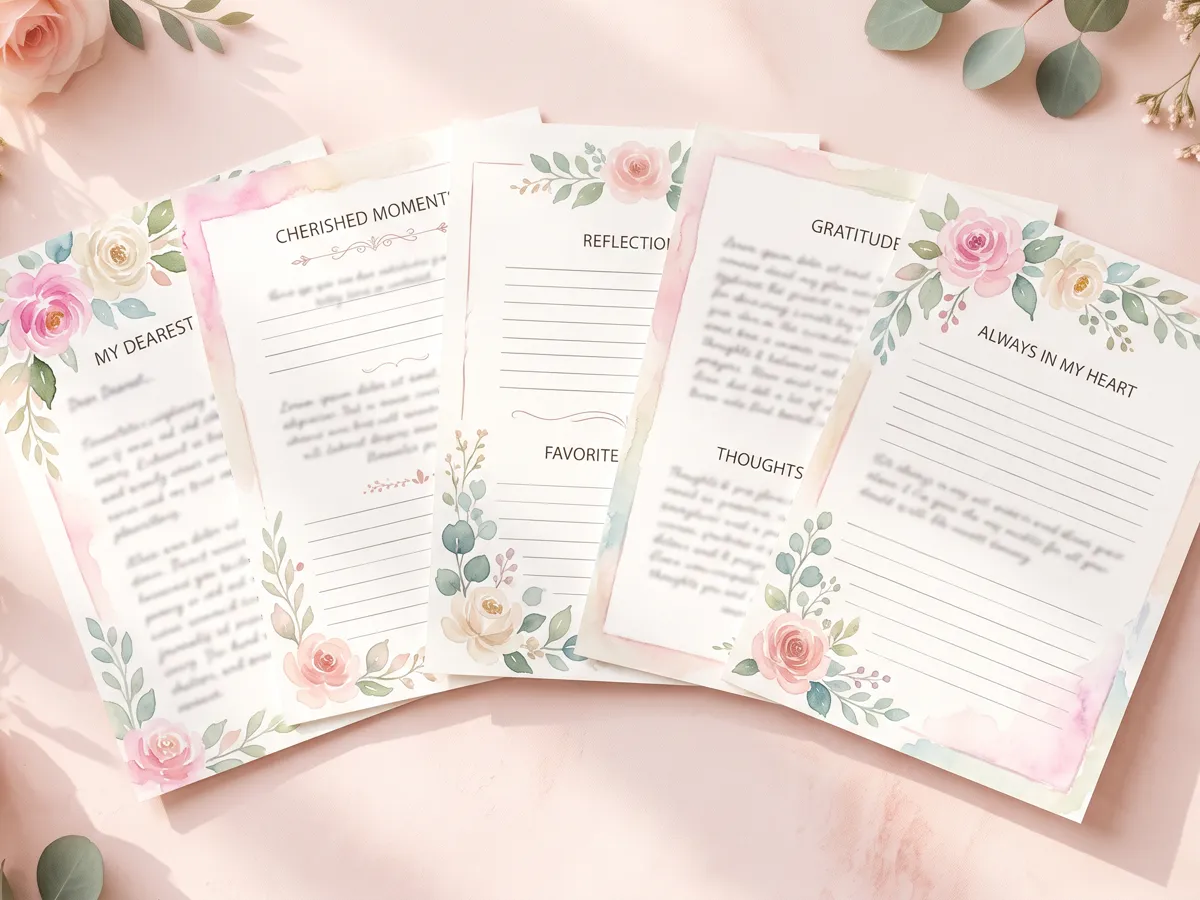
Each page of the journal has one small job, and none of them asks for a long entry. Here is what sits on each page and the kind of line that fits it.
Page one, the first hello
The day you met. Write where they came from, how old they were, and the first thing they did that made you smile. This is the page you read when you want to remember the beginning.
Page two, the everyday
The ordinary days. The time of the walk, the spot on the rug they always chose, the sound of their nails on the floor. The small things are the ones you will be glad you wrote down.
Page three, the funny bits
The moments that made you laugh. The stolen sock, the time they barked at their own shadow. A few words are enough, and this page can be filled in with a friend over coffee.
Page four, the hard day
The day you said goodbye. Write what you want to remember and what you want to leave behind. This page can wait, and some people leave it blank for a long time, which is fine.
Page five, the goodbye
The last page holds a quiet line to them and one gentle plan for tomorrow. It is the page you write when you are ready to close the journal, not before.
The five pages at a glance
| Page | What goes there | How much to write | Fine to skip |
|---|---|---|---|
| Page one, the first hello | The day you met, their age, the first thing they did | Three or four lines | If the early years are a blur, write the day you brought them home |
| Page two, the everyday | The walk, the bowl, the cushion, the routine | A list of small things | Rarely skipped: the routine is the easy part to write |
| Page three, the funny bits | The stolen sock, the doorbell noise, the odd habit | One line per memory | Skip it on a heavy day and come back when it lifts |
| Page four, the hard day | What you want to remember, what you want to leave | One sentence is enough | Skip it for as long as you need to |
| Page five, the goodbye | A last line to them and one gentle plan | A short note, unfinished is fine | Leave it blank until the journal feels ready to close |
Every page has a prompt line at the top, so a page can be answered with a few words instead of an entry.
How to fill it in
There is no right order, and the pages do not have to be finished in sequence. Start on the page that feels easiest today.
- Write in short lines. One memory per line is plenty, and a list fills a page faster than a paragraph.
- Use their name. Say it out loud as you write it, and let the journal hold it the way the house used to.
- Leave the hard pages for later. Page four can sit empty until you know what belongs there.
- Write the date beside each entry, so the page remembers which month it came from.
- Keep the pen with the journal. A page gets written when the pen is already there, not when you have to go looking.
- Leave the blank lines blank. A half-filled page is still a page that holds them.
A first sitting, in four steps
- Choose the page you can answer without thinking. The everyday page is the usual starting point, and the funny bits run a close second.
- Put the pen beside the journal the night before, so the first line costs nothing when you sit down.
- Set a small limit. Ten minutes, one page or one line, then stop when the limit is done.
- Read the page once and close the journal. Leave the editing for another month, if you edit at all.
Write by hand if you can, and type it later if you want a copy that is easy to search. A handwritten page keeps the slant of the day, the place where the pen pressed too hard, and the wobble in the letters at the end of a line.
If you spoke to them in another language, write in that one. The journal does not need translating, and a page in two languages sounds more like your house than a page in one.
One page a week, one line a day, or five pages in one evening: the pace is yours to set and yours to break.
Free 5-page journal: what's inside
- Page 1: favorite memory.
- Page 2: what I miss today.
- Page 3: a photo and three words.
- Page 4: letter to them.
- Page 5: one gentle plan for tomorrow.
Print once, fill slowly. Email signup only if you want the PDF kept for you.
Free journal first; keepsake gift ideas only if you ask for them.
If a quiet gift is on your mind for a dog mom you know, browse the dog mom gifts under $25 edit , no pressure, no rush.
Print it at home or at a shop
The journal and the frame print look best on paper with a little weight. Both routes work, and a print shop is the safer choice for anything you plan to frame.
- Paper choice. At home, pick matte photo paper or heavy card stock in soft white; the blush tone of the border stays truer on matte than on glossy.
- Borderless or bordered. Print borderless if you are matting the piece yourself, and bordered if the white edge is part of the frame.
- Keep the file at full size. Open the PDF at 100 percent, not "fit to page", so the proportions stay as they were drawn.
- When a print comes out cropped, send the original file to the shop and ask for the whole page, with the white border kept in. A home printer that trims the edge usually has a borderless setting switched off.
- Print one test page first. Check the matte finish and the white of the border before you print the rest.
Frame the print only after it is completely dry, and lay it flat in the frame so the paper does not curl against the glass.
First lines that fit on one line
When the page feels wide and the pen feels heavy, these small openings fit in a single line. Use the one that sounds like that morning, and let it stand on its own.
- The morning sounded like...
- The one who always waited by...
- The favorite corner was...
- The funny one was when...
- I miss the small sound of...
- If I could say one line today...
- Today the house feels...
- The photo I keep coming back to shows...
- One thing the morning walks taught me...
- What I want to keep is...
- The last good day looked like...
- For tomorrow, just one small step...
One opening per sitting. The rest of the line belongs to them.
Printing choices side by side
| Choice | Best for | How to ask for it | Watch for |
|---|---|---|---|
| Home printer, matte | The five journal pages and a test print of the quote card | Print at 100 percent on matte photo paper, no scaling | A borderless setting that trims the pastel edge |
| Home printer, card stock | A small 5 by 7 keepsake for a desk frame | Heavy matte card, one sheet at a time | Roller marks on thick paper; feed a single sheet |
| Print shop, framed size | The 8 by 10 quote print and a second copy to keep | Ask for the full page with the white border kept in | A crop that cuts the border off the design |
| Print shop, matte finish | The frame print that hangs in soft daylight | Matte paper, no gloss, cut to the frame opening | Glossy paper that reflects daylight on the wall |
| Clay paw print, unframed | A keepsake you keep in a box until you are ready | Air-dry overnight, then write the date on the back | Lifting it off the wax paper before it has dried |
Sizes above are the common US frame openings; any frame you already own can be matched to the print you make.
Gift it gently
A memorial keepsake is a gift that arrives with no strings on it. How you offer it matters more than what is inside.
- Offer it, do not present it. Say you made something for them and ask whether they would like it, then let the answer be no without a reason.
- Write a short card. A line such as "I thought of you and them today" is enough. The card does not need to name the loss or explain the gift.
- Send it in a flat envelope, so nothing arrives folded or bent, and leave the journal pages unbound so they can be filled in at any pace.
- Choose your timing. A quiet week is often better than a birthday, and the first month is usually not the moment.
- Skip the follow-up. Never ask whether they have filled it in, and never set a date by which it should be done.
- Skip the suggestion that the keepsake will make anything easier. It is a small object, and that is all it is.
Hand it over in person, leave it in the mail, or put it in their hands the next time you see them.
Keep it for a year
A keepsake is a slow thing. This is one way to hold it for a year without turning it into a task.
- One box. Keep the journal, the clay disk, the spare prints and the collar tags in a single box on a shelf you can reach.
- One date. Write the date you started on the inside cover, in pencil, so it can be changed without being wrong.
- One page a month. Twelve pages over a year is a slow fill, and it leaves the hard pages for the months when you can face them.
- The journal does not need finishing. Some pages stay blank for years, and the box still holds what you put in it.
On the anniversary, open the box and read what you wrote. Then close it and put it back, until the next time you want to.
When to skip the keepsake
Some days are not the days for clay, ink and glue. Skipping it is a choice, not a failure.
- A day when looking at photos hurts too much. Leave the album closed and the file unopened; the journal will wait for you.
- A house where a partner or a child is not ready. Keepsakes made for one person can land hard on another, so make yours privately or not at all for now.
- A moment when the kindest thing is to close the tab. The page will still be here, and so will the free journal.
- A week when the printing, the framing and the waiting are too much to hold. One page, or one line, is a complete visit.
Memorial keepsake questions
What do I write when the words will not come?
Start with objects instead of feelings: the bowl, the lead, the blanket, the window they watched. A list of nouns is a page, and sentences tend to follow once the list is on paper. You can also copy the prompt line at the top of the page and answer it in three words.
Can I print the journal at home?
Yes. Print one test page on plain paper, check the border, then run the set on matte photo paper or heavy card stock. Choose 100 percent in the print dialog rather than fit to page, and keep the PDF at full size in case you want a second copy later.
Is a digital copy enough?
For some people it is. Name the file with their name so you can find it again, and keep it in a folder you actually open. A screen is a fine place to read a page you are not ready to print, and the file can go to a shop whenever you change your mind.
How do I gift the journal to someone?
Ask before you send it. A short message, a plain card and a flat envelope make the offer easy to accept or leave. Never attach a date to it, and never ask later whether they have filled it in.
Should I fill it in all at once?
No. One page in a sitting is plenty, and one line counts as a sitting. The pages do not expire, the file prints again if a page is spoiled, and a journal filled across a year reads differently from one filled in an evening.
What do I do with the journal when it is finished?
Keep it in the same box as the clay paw print and the spare prints, or slide it behind the quote print in the frame. Some people photograph the filled pages and put the paper in a drawer. There is no ceremony the journal asks for.
Can I use a photo that is not perfect?
Often the imperfect photo carries more. A phone shot with a soft focus, a blurry one from a walk, a picture where they are half out of frame: print it small and let the softness sit on the page as it is.
What if I want to write to them again later?
Print a second copy and start a fresh set. The first journal stays as it was, and the second one records a different month, not a correction of the first.
Do I have to share the keepsake with anyone?
That is yours to decide. Some people leave the frame on a shelf, some keep the journal in a drawer, and some read one page aloud to family. Sharing is optional at every stage.
Gentle notes
- Keep one ritual if it feels right, and skip the rest
- Soft watercolor art only; no real sick photos
- Share only when ready; private grief is valid
- Support lines in your country beat any keepsake
- For comfort only, not therapy advice
Save for tender days
Pin this for when you need it, or send it to a friend quietly. The Stories collection holds the funny Corgi series for lighter days.