 PawStyle Daily
Best Pet Supplies & Gift Guide
Harness Training: A First-Week Plan for a Dog That Freezes
The straps go on, the room goes quiet, and the dog stands there like a coat rack. That freeze is the most common first harness moment, and it is not stubbornness — it is a dog that has never been asked to walk wearing one. This page is the week that answers it, step by step, indoors first.
By PawStyle Daily · Updated 18 November 2026
Good to know: one step per day · indoor wears before the door · for informational purposes, consult your vet.
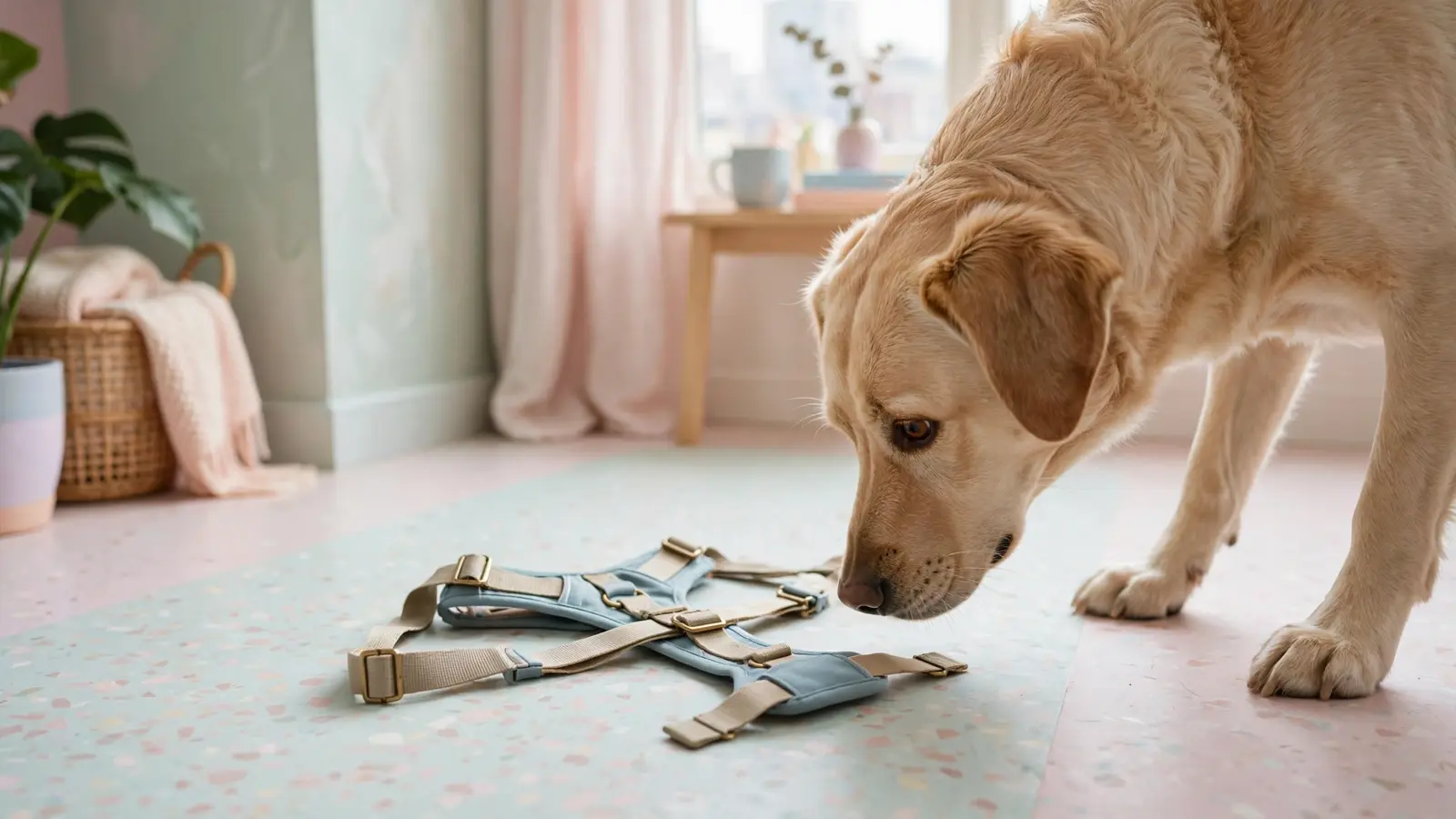
A harness is a strange object: it arrives folded, it smells of the factory, and it goes over the head and around the chest in one move. A dog that has never worn one has no idea what the next step is, so the first week is spent making each of those moves ordinary before anyone touches the door handle.
Why a dog freezes in a harness
The freeze usually has three parts stacked on top of each other. There is the object itself, which the dog has not met. There is the feeling of pressure around the chest, which is unlike a collar. And there is the door, which arrives two seconds later and carries everything the dog already knows about walks.
The fix is to separate them. Give the harness a week of boring indoor appearances, and the first real walk meets a dog that already knows what the straps feel like.
Fit it before the first session
Harness sizing uses two measurements: the circumference at the base of the neck where it meets the shoulders, and the widest part of the chest, typically behind the front legs.
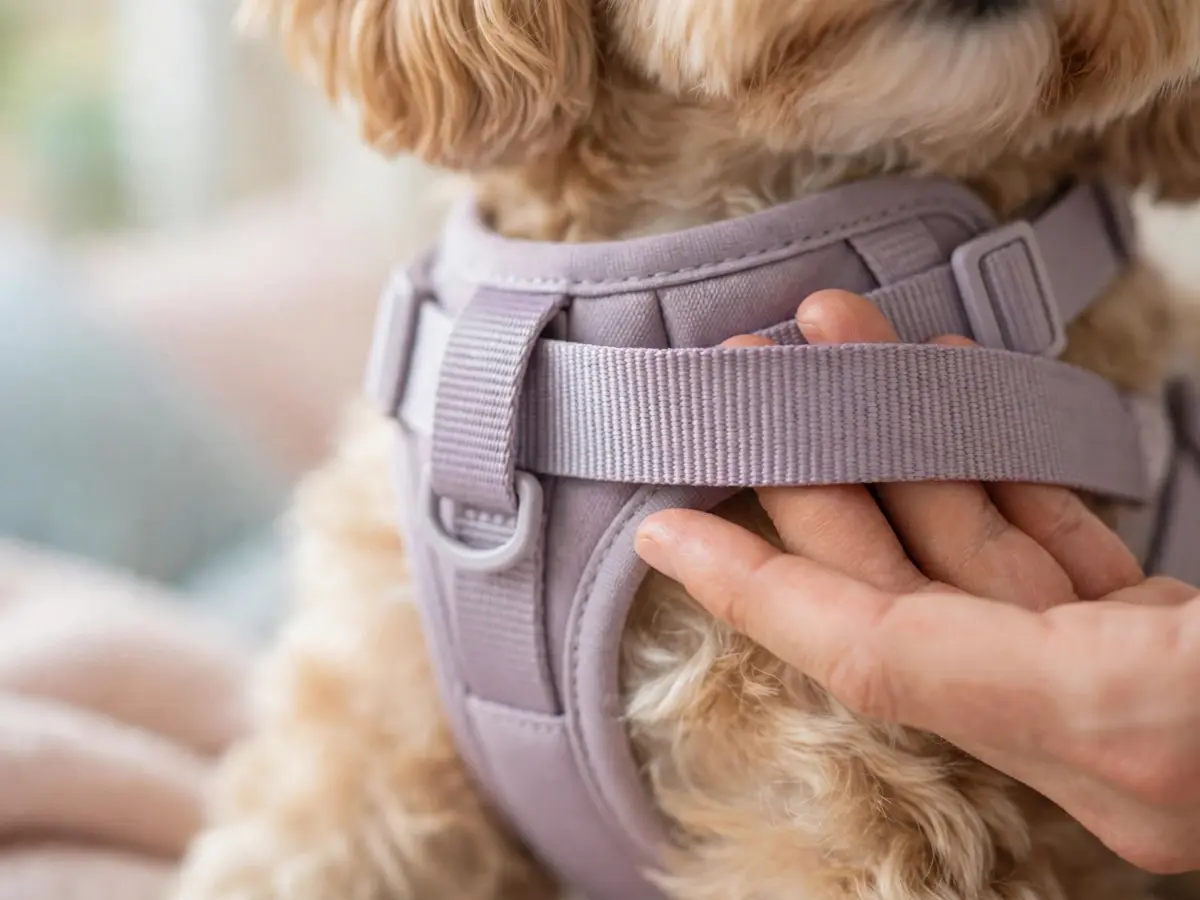
A harness should fit snugly but not uncomfortably: you should have to squeeze two fingers underneath a strap.
Two fingers that slide in freely mean the strap is loose, and a loose strap is the one a dog backs out of. Check both the neck loop and the chest girth, then check them again after the dog has walked in it for a few minutes, because the coat settles.
Sizes do not travel between brands
Two dogs can be the same height or weight and still need different harness sizes, because a harness fits the ribcage.
One brand's fitting rule: measure the chest girth at the widest point of the ribcage, add 5% for comfort, then read that adjusted number against that brand's size chart.
That margin is one brand's rule, not an industry one, and the chart printed on the box you are holding is the chart that wins. Measure the dog again for every new harness rather than trusting the size from last year, and re-check a growing puppy's fit every few weeks.
What picks a harness size
| Input | Does it pick the size? | Why |
|---|---|---|
| Neck circumference | Yes, one of the two | The loop has to go over the head and sit at the shoulder base |
| Chest girth behind the front legs | Yes, the main one | The girth is where the harness actually fits |
| Body weight | No | Weight says nothing about the shape of a ribcage |
| Height at the shoulder | No | Two same-height dogs carry different ribcages |
| The old harness's size | No | Sizes differ brand to brand |
| The chart on the box in your hand | Yes | It is the only chart built for that shape |
Measure the dog, read the chart for that harness, then confirm with the two-finger check on both straps.
The first week, day by day
Seven sessions, each one short, each one ending while the dog is still willing. Repeat a day as many times as it takes before moving on.
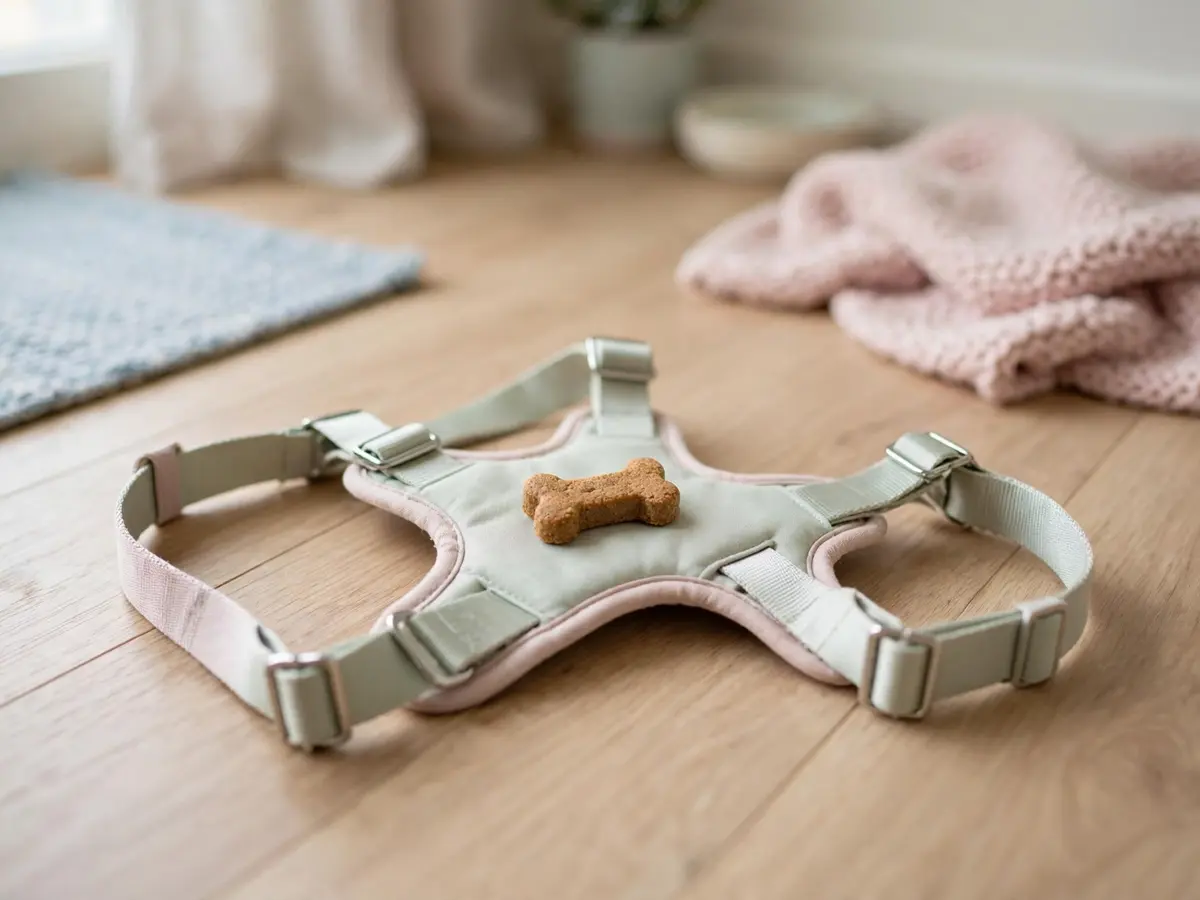
- Day one — the harness on the floor. Folded, flat, unclasped, in the middle of the room where the dog already eats. Put a piece of food on it. Let the dog investigate it or ignore it. No hands on the straps today.
- Day two — nose through the opening. Hold the loop open, place a treat behind it, and let the dog reach through with its nose only. Do not pull the harness up over the head yet. Three reaches, then put it away.
- Day three — over the head, straight off. Nose through, lift the body panel over the head, click or say yes, then take it back off immediately and feed. The dog learns that the harness ends, which is most of what a freeze is about.
- Day four — straps closed, a few seconds. Fasten it, stand still, feed three pieces, unfasten it. Stay in the room the dog knows. Do not reach for the leash.
- Day five — short indoor wears. Five minutes at a time, twice, while the dog eats breakfast in it or plays a tug game. Walk around the apartment yourself so the dog moves with you rather than alone.
- Day six — leash on, indoors. Clip the leash to the harness inside and let the dog drag it around the room while you hold the slack. Two minutes, then off. The leash stops being a door signal.
- Day seven — the first short walk. Open the door, step out, walk a short lap, and come home. The first walk is the length of the hallway, not the length of the park.
First week at a glance
| Day | The move | How long | What ends it |
|---|---|---|---|
| One | Harness on the floor, treat on top | A few minutes | The dog walks away |
| Two | Nose through the opening only | Three reaches | The third reach |
| Three | Over the head, then straight off | One rep, twice | Every rep |
| Four | Straps closed for a few seconds | Three treats | The third treat |
| Five | Indoor wears while eating or playing | Five minutes, twice | The five minutes |
| Six | Leash clipped on, indoors | Two minutes | The two minutes |
| Seven | First short walk outside | One short lap | Coming home |
Repeat any day that ends badly. The week is a sequence, not a calendar.
Front clip or back clip
On a front-clip harness the leash attaches near the chest and helps redirect a dog that pulls, while a back-clip harness attaches between the shoulder blades.
A back clip is the simpler shape and it reads more naturally on a dog that is still learning what a harness is, so the first week usually runs on one. A front clip is the choice once pulling shows up as a habit rather than a first-day excitement, and it is worth sizing again when you switch, because the two shapes sit differently on the ribcage.
The two shapes side by side, with the escape and comfort trade-offs, are on our front clip versus back clip guide.
When the week stalls
A stall is information, not failure. Read the table, drop back one day, and run the easier step twice more before trying again.
First week stalls and the fix
| What you see | What it usually means | The move |
|---|---|---|
| Dog freezes with straps closed | Too much, too fast | Back to day three, shorter reps |
| Dog scratches at the chest strap | Fit too tight, or a new sensation | Two-finger check on both straps |
| Harness backs out over the head | Chest girth too loose | Smaller size or a different shape |
| Dog lies down the moment the door opens | Door still carries the whole walk | Open the door, no leash, feed, close it |
| First walk is a standstill | Outside is a new room | Shorten the lap to the doorstep |
Every fix is a step back, not a step forward. The week takes as long as it takes.
After the first week
From day eight, the harness is equipment and the walk is the training. Keep the sessions short for another week, reward the dog for checking in with you on the lap, and let the distance grow on its own. If the freeze returns after a week of good walks, that is a conversation for the vet rather than a harness problem.
For the fit side, the harness sizing and fit guide covers measuring in detail, and the dachshund harness pick is the long-backed shape done right. Both sit inside the supplies and gift guide.
Harness training questions
My dog stands still the moment the harness goes on. Is that normal?
Very. A dog that freezes has not been trained to walk in a harness yet; it has been dressed in something strange. The freeze is the dog thinking, not a refusal, and it breaks with a few indoor wears before anyone reaches for the door.
How long should the whole first week take?
Seven short sessions is the plan, and a dog that needs ten is not behind. Move to the next step only when the current one ends calmly, and the leash goes outside on the last day rather than the first.
Do I clip the leash on indoors during the week?
Yes, for the last two indoor sessions, and let the dog drag it around the room under your supervision. A leash that first exists outside is a leash that arrives with the door, and the door is already a lot.
Front clip or back clip for the first walk?
On a front-clip harness the leash attaches near the chest and helps redirect a dog that pulls, while a back-clip harness attaches between the shoulder blades. A dog that has not walked in a harness yet usually starts on the back clip and earns the front clip later.
Can I use my old harness's size as a guide for a new brand?
No, and this is where most fit mistakes come from. Two dogs can be the same height or weight and still need different harness sizes, because a harness fits the ribcage. Measure the chest again on the new dog and read the new brand's own chart.
What if the harness slips over the head when the dog pulls back?
That is a fit problem, not a training problem. Re-check the two-finger rule on every strap and measure the chest girth again at the widest point of the ribcage. A harness that backs out needs a smaller size or a different shape.
Save these on Pinterest
Pin the day-by-day table so the week is on your phone when the harness arrives, and keep the fit rules next to it. Pair it with the sizing and fit guide and the clip comparison, then keep the set on the pet supplies collection.
Training steps only, no brand picks. For informational purposes, consult your vet about your dog.