 PawStyle Daily
Cat-Friendly Apartment Decor
White Cat Tree: Choosing One That Survives a Bright Room
A white cat tree in front of a blush wall photographs beautifully for about a month, and then it starts reporting on the room: every hair, every shadow, every hour of sun it stood in. The trouble is almost never the color itself. It is the shade of white, the surface the white sits on, and the light the piece wakes up in. This page owns those three decisions. Which white agrees with which wall, which fabric holds fur instead of releasing it, which wrap turns near a window, and where to stand the whole thing so it still looks white next season. Height, posts and stability belong to the cat tree buying guide on this site, and the brown and walnut lane belongs to the mid-century cat tree page. This one is about finish only.
By PawStyle Daily · Updated 20 November 2026
Good to know: cream and ivory for warm light | a plush or felted surface over a smooth one | the wrap kept out of the direct beam | the sample held to the wall, not to the swatch card.
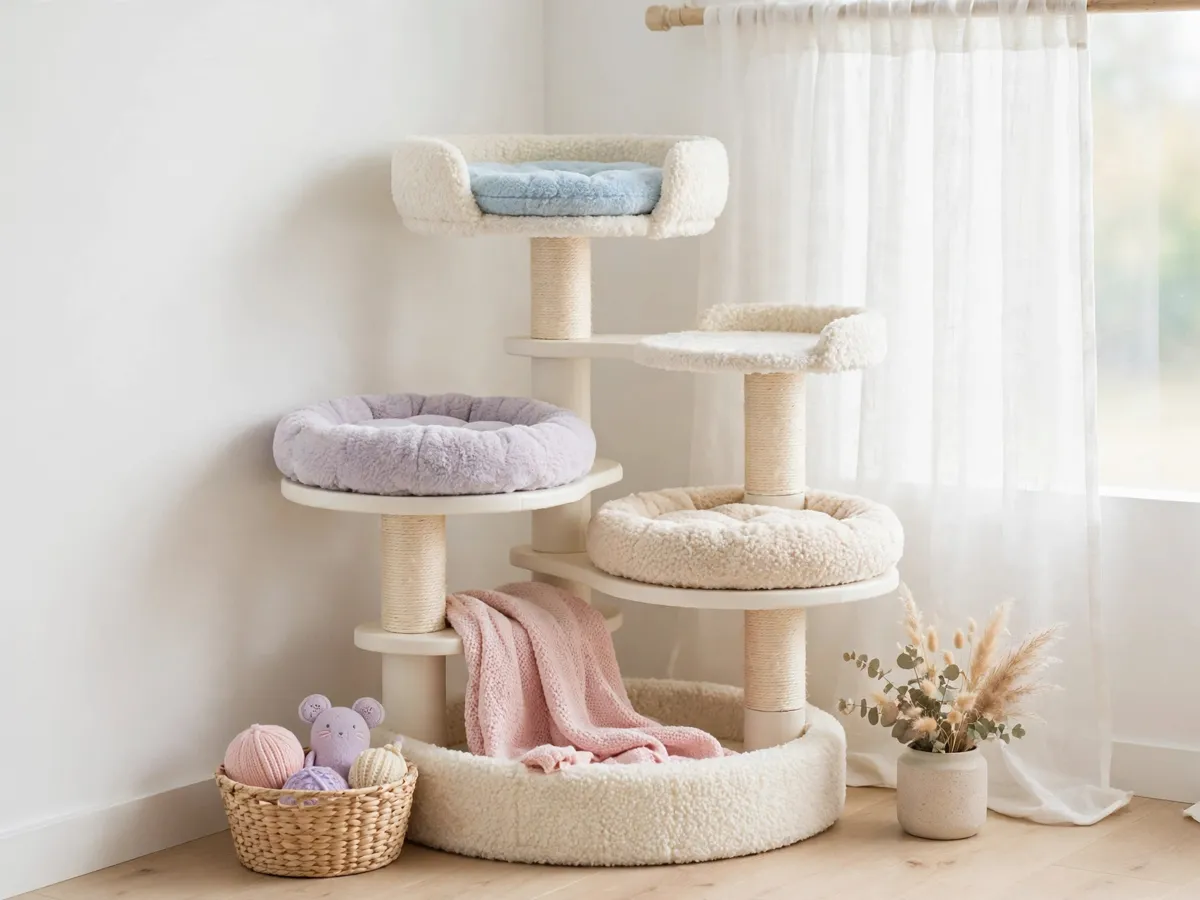
What a white tree has to survive
White is the loudest finish a room contains, and the only one that reports on everything it touches. A walnut tree hides a week of fur; a gray tree hides a season of sun; a white tree hides nothing and shows it back at you from across the room. That is exactly why it is worth buying deliberately instead of hopefully. Chosen well, it is the piece that makes a small apartment look finished - it lifts the corner, it photographs like furniture, and it disappears into a pale wall instead of arguing with it.
Chosen on a listing photo, it fails in three predictable ways. The shade is wrong for the wall, so the tree reads blue while the wall reads warm. The surface is smooth, so shed hair sits on top of it and travels onto the floor with every jump. The wrap stands in a window line, so a year later the platform that looked ivory has gone the color of weak tea. None of those is a defect, and none is a reason to give up on white. They are three decisions, all made before the box arrives.
A white tree is a finish question, not a quality question. A modest tree in the right white, on the right surface, out of the beam, will outlive an expensive one placed badly. The order below runs shade, then surface, then wrap, then light - the four things you can choose from a description, a sample, and a look at your own room at the hour you use it.
Cream, ivory, or cool white
There is no single white, and a listing that says white is telling you nothing. Cream carries yellow in it and reads warm; it is the shade that looks like fabric rather than paint, and it forgives a room lit by lamps. Ivory sits a step behind cream - still warm, but with enough gray in the undertone to look intentional rather than vintage. Cool white has blue in it, and it is the shade that makes a blush wall look pink by comparison, which is how a clean piece ends up looking gray, then dingy, then unwanted.
Against a blush wall the rule is short: match the temperature, not the name. A blush wall is warm, so a warm white beside it disappears into the room and a cool white beside it stands out as an object. If you want the tree to read as furniture, go cream or ivory. If you want it read as a statement - the sculptural piece in the corner - then a cool white against a truly neutral wall is a legitimate pick, and the room it wants is one with gray or limestone walls rather than pink ones.
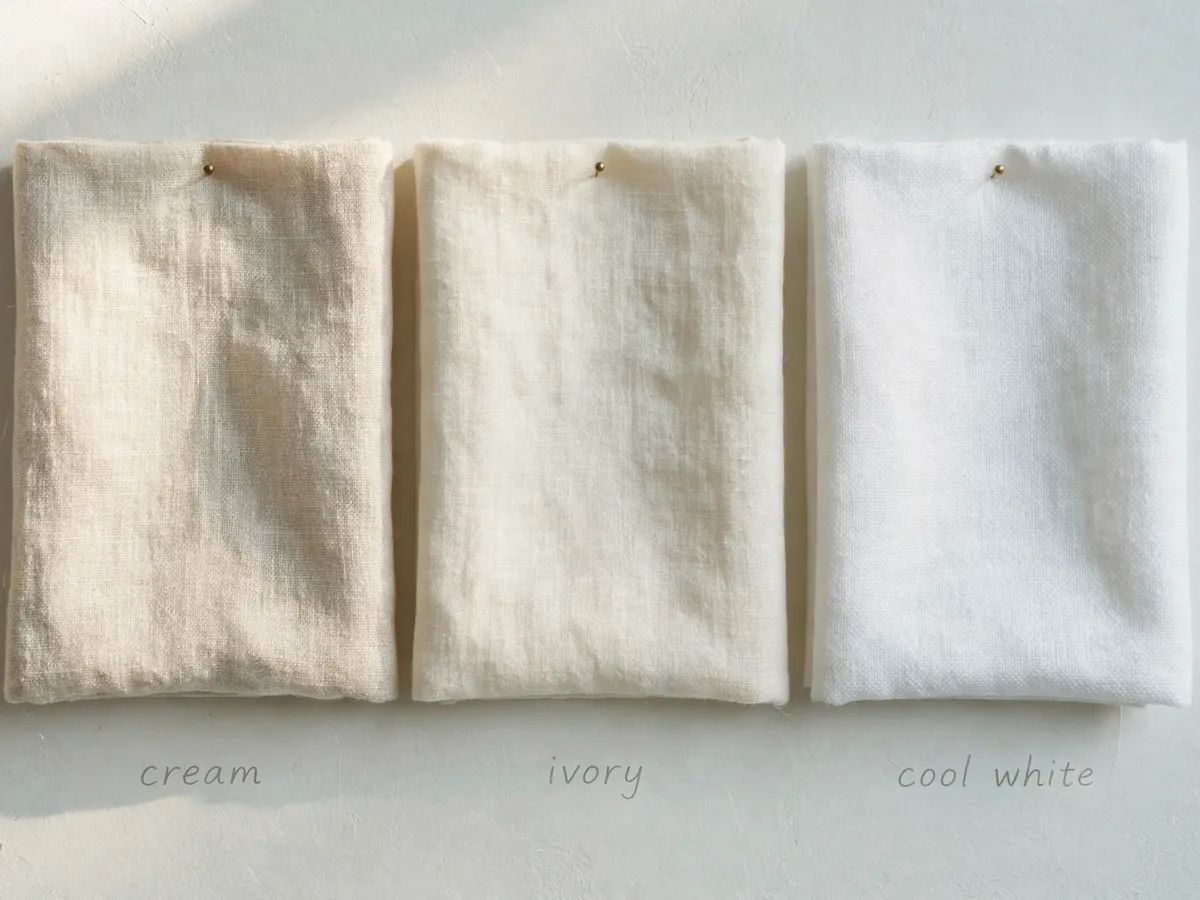
The test is physical and takes one evening. Hold the sample, a printed sleeve photo, or the seller’s swatch against the wall itself, at the hour you actually use the room, and step back three paces. Then photograph it on your phone with no filter and look at the photo rather than the wall. A camera flattens undertones in a way the eye does not, and the tree will live in your photos as much as in the room. If the swatch looks blue in that photo, so will the tree.
Which white shows the fur
Here is the part nobody wants to hear: a white tree does not create more fur, it reports the fur that is already there. A dark tower carries the same shed and simply declines to show it, which is why the black tree in the corner looks tidy for a month. So the question is not whether white shows hair - it does - but which surface holds the hair in place long enough for you to deal with it on your own schedule instead of every time the cat jumps down.
Texture decides that. A plush with real pile, or a felted surface with a short matted nap, grips hair at the base, and a roller lifts it off in one pass. A smooth fabric - the tight canvas, the low-sheen velvet, the printed poly panel - gives hair nothing to hold onto, so it slides onto the floor and the hem of your trousers every time the cat stretches. Same color, same cat, a different morning.
Two practical moves carry the rest. A folded throw in a room tone over the favorite platform takes the shed where the cat actually lies, and it goes in the wash on laundry day; the throw is the layer you refresh, not the tree. A lint roller kept beside the piece, not in a drawer across the room, is the difference between a pass while the kettle boils and a Sunday project. For a dark cat in a pale room, a gray or oatmeal throw over white is the compromise that reads styled rather than apologetic.
The wrap that yellows in a window line
Sun is the one thing a white tree cannot be talked out of. Natural sisal, left in a beam, goes amber on its own - normal, and most people stop noticing. A pale fabric wrap does the same thing more visibly: it yellows with age, the color deepens a shade each summer, and a platform that read ivory at delivery reads cream by the second year and butter by the third. The change is gradual enough that the usual conclusion is the wrong one - that the tree was cheap - when the cause is where it stands.
Foam covered in fabric turns faster than woven fabric, because the dye sits on a soft surface rather than down a fiber. Vinyl and faux-leather wraps go a different way: they stiffen, then take on a warm cast at the edge where the light is strongest. None of this is a reason to avoid pale wraps. It is a reason to treat the window as part of the purchase.
The fix is a curtain, not a cleaner. A sheer drawn across the window in the hours the sun rakes the wall takes the hard beam off the wrap while leaving the room bright, and it costs less than the shipping on the tree. Rotate the piece a quarter turn when you rotate the sofa covers, so any change arrives on all sides at once instead of on one face. When a wrap has turned, the platform or the post is a replaceable part - the same logic the repair pages on this site apply to a worn sisal column.
Where the light falls
A bright room and a bright beam are not the same thing, and the whole page comes back to that sentence. The room you want a white tree in is a light room - pale walls, sheer curtains, sunlight bouncing off the floor so the piece reads as air rather than bulk. The beam you do not want is the one that lands on the wrap for hours every day, because that is the sun doing the turning described above. Morning light and late-afternoon light are the two to check for, and the map is drawn by watching the room, not by reading the listing.
Walk the room twice, once in the morning and once at the end of the day, and note where the bright patch sits on the wall each time. The spot that stays put - lit but never raked - is where a pale finish belongs. It is usually inside a corner, beside a door, or on the wall sheltered by the window’s own reveal. A white tree flat against a sunlit wall is the same purchase made in the wrong room, and moving it costs nothing while a new wrap costs the price of the piece.
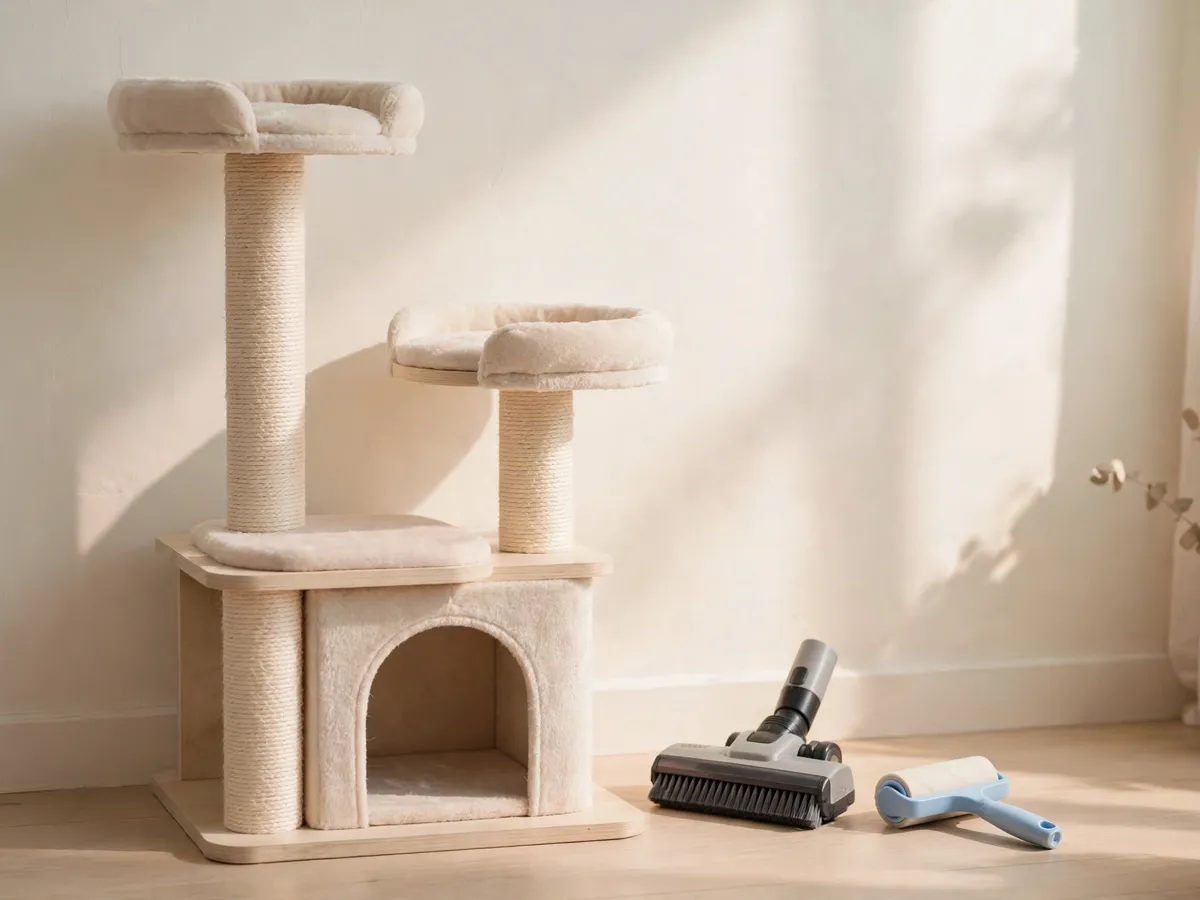
Everything above the finish - the sightline, the jump route, the distance from the sofa and the litter station - is mapped on the cat tree placement page, and the two are read together rather than twice. The short version for a white piece: place it for the cat first, then check the light you have chosen against the light the wrap can take, and shift inside that one wall rather than abandoning the corner. A pale tree in a warm, indirectly lit corner is the version that still looks new in its third year, and it makes a small apartment read larger than it is.
Questions about a white cat tree
Which white is easiest to live with?
Cream or ivory, in a room with warm light. A cool white reads gray against a blush wall and shows every shadow, so hold the sample to the wall itself before deciding.
Does a white tree show more fur?
It shows fur that a dark tree also carries. Choose a white with a textured plush or a felted surface rather than a smooth one, because the pile holds the hair where a flat weave lets it travel.
Where should a white tree stand?
Out of the direct window line. Sun is what turns a white wrap over time, so a bright room is fine and a bright beam is not, and the same rule applies to any pale finish.
Save these on Pinterest
Pin the shade test before the next order, or send the window-line rule to a friend whose ivory tower has gone tea-colored on one side. The Cat-Friendly Apartment Decor collection holds the buying guide, the walnut and mid-century lane, the placement walkthrough, and the repair notes that keep a pale piece looking finished instead of tired.
Cream for warm walls, ivory when you want the piece read as furniture, plush or felted so the fur stays on the tree, and every pale wrap out of the direct beam.
For informational purposes only.