 PawStyle Daily
Budgie & Cockatiel Corner
Budgie Pellet Diet: Gentle 4-Week Switch
A budgie that has eaten seed since its first day in the cage does not change its mind because a bag says so. The switch works the other way around: the pellet dish appears beside the seed dish, stays there without drama, and the two swap places slowly over four weeks. No skipped meals, no empty bowl mornings, no hunger as a teaching tool. Check with an avian vet before the first week starts.
This page is the slow lane: two bowls, one small change each week, a weigh-in on the kitchen scale, and a dish routine that keeps the whole plan honest. If the bird stalls, the page tells you where to pause rather than push.
By PawStyle Daily · Updated 16 November 2026
Good to know: two bowls · one change a week · a weekly weigh-in · never starve a bird into pellets.
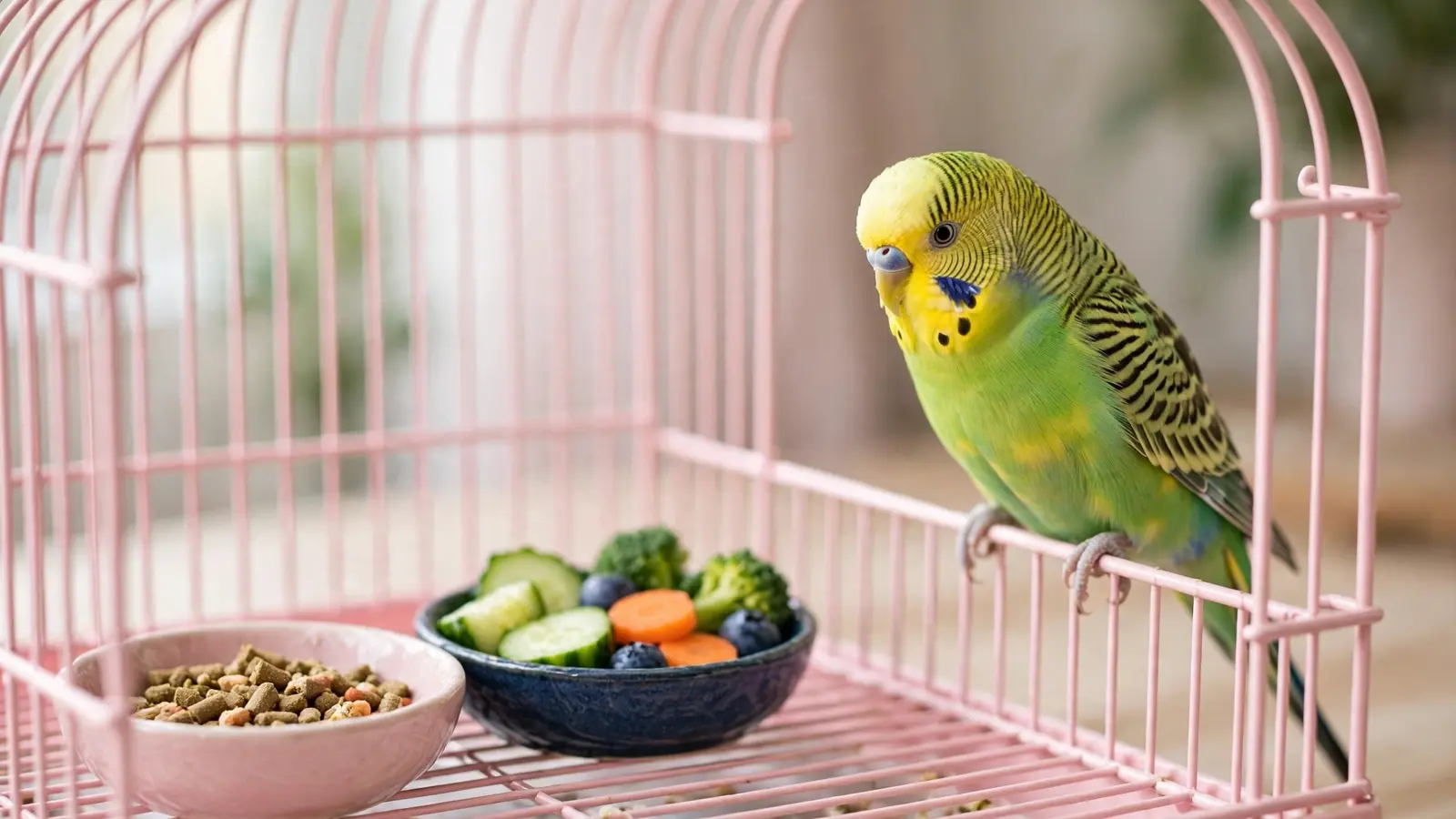
The guideline this page follows
Everything below hangs on one sentence from the care guidance, so it goes here in full rather than folded into the middle of a paragraph:
Build the diet on pellets with produce - about 75-80 percent pellets with 15-20 percent fruits and vegetables - keep seeds and nuts strictly limited, and never starve a bird into pellets.
Read it as three habits rather than one rule. The pellet bowl is the base, so it stays in the cage all day. The produce share is a separate small dish, refreshed before it sits warm. Seeds and nuts keep their place, but a small one, and the last clause is the one that governs the pace: a hungry bird is never part of the method.
Pellet base · produce share · seeds limited · no hunger games.
Check the cage before the bowls
A bird that is being asked to try something new wants the rest of the cage to be boring. That means a stable standing spot, a dish it can reach without climbing the bars, and no furniture moving mid-switch.
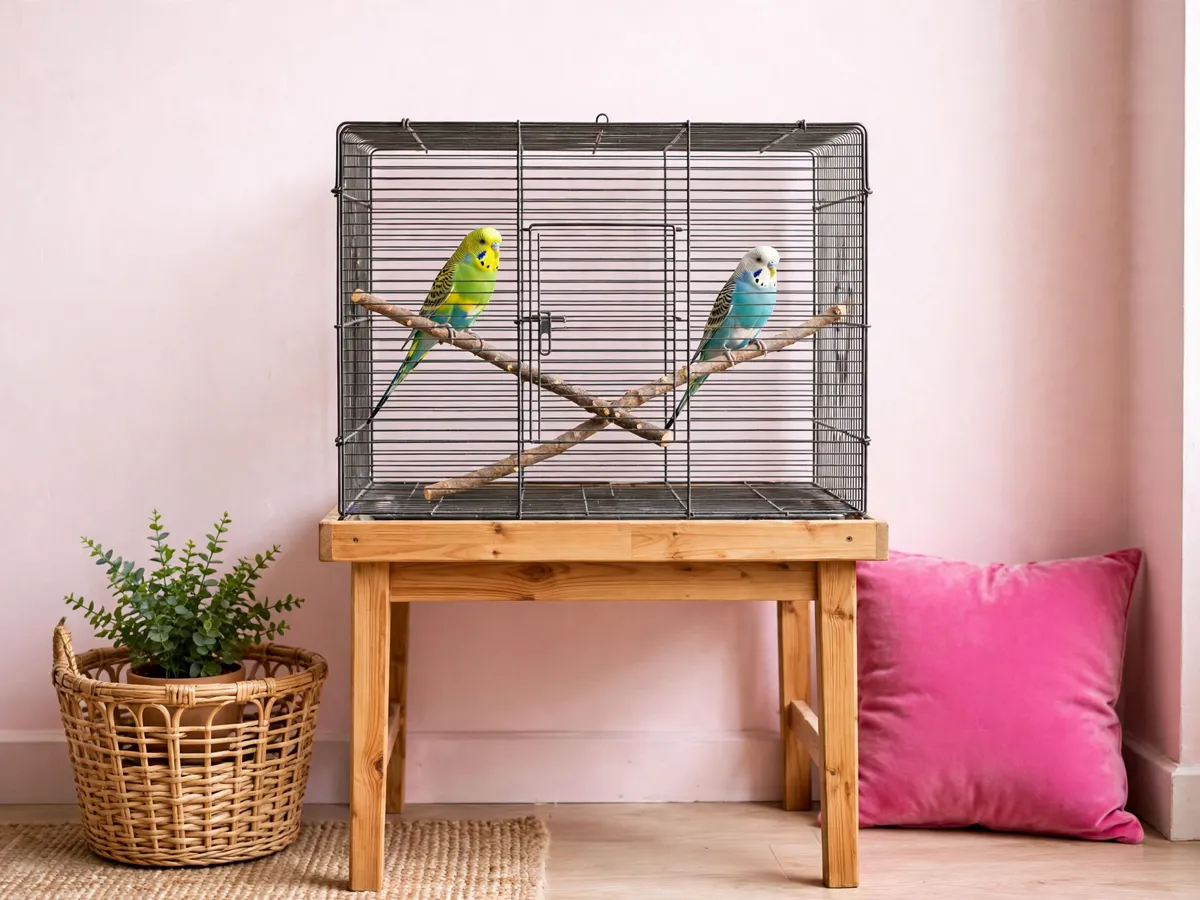
A budgie’s cage should be big enough to turn around without striking anything, move from perch to perch, and stretch or flap its wings - the minimum guideline is 1 ft x 1 ft x 2 ft (30 cm x 30 cm x 60 cm), and bigger is better. Space matters here because the switch adds a dish: two bowls plus a produce dish need a cage where none of them sits in the flight line.
Offer perches in an assortment of diameters, shapes and textures with natural wood ideal, and never use sandpaper perches because they are too abrasive for a bird’s feet. A bird that eats standing on a comfortable branch is a bird that stays at the dish long enough to try the new thing in it.
Attach sturdy, non-toxic food and water dishes to the cage sides rather than the bottom so droppings do not fall into them, and clean and disinfect them every day. During a switch the daily wash matters twice over, because a dish that smells of yesterday is the first reason a budgie refuses today’s food.
If the corner around the cage needs a rethink, the budgie cage setup checklist walks through perch layout and dish placement, and it is worth settling both before week one rather than during week three.
The switch, one week at a time
Each week changes one thing and leaves everything else alone. The bird sets the pace inside that: a week can stretch, but a week never gets skipped.
The four-week switch at a glance
| Week | What changes | What stays exactly the same |
|---|---|---|
| Week one | A small shallow dish of pellets appears beside the seed dish, with a few pellets scattered on top of the seed so the shape and the crunch turn up where the bird already eats | The seed mix, the dish positions and the feeding times - nothing is removed |
| Week two | The pellet dish goes in first thing in the morning, when the cage is hungriest, and the seed follows a little later in the same spot | The total amount in the two dishes and the daily dish wash |
| Week three | The seed portion shrinks to a smaller scoop, the pellets stay available all day, and a few pellets move onto the foraging toy | The morning order, the produce dish and the weigh-in card |
| Week four | The pellet dish becomes the base of the day, the produce share gets its own small dish, and the seed portion turns into the training pouch | The weekly weigh-in, and the rule that a hungry bird is never the plan |
If a bird stalls for more than a few days on any row, repeat that row rather than moving down the table. Check with an avian vet if it stops eating altogether.
The pattern behind the table is simple: pellets arrive where the bird already is, then arrive first, then arrive alone at the base of the bowl, with seeds reduced to the role of a reward. Nothing is ever taken away without the replacement already on the shelf beside it.
The two bowls, and what each one is for
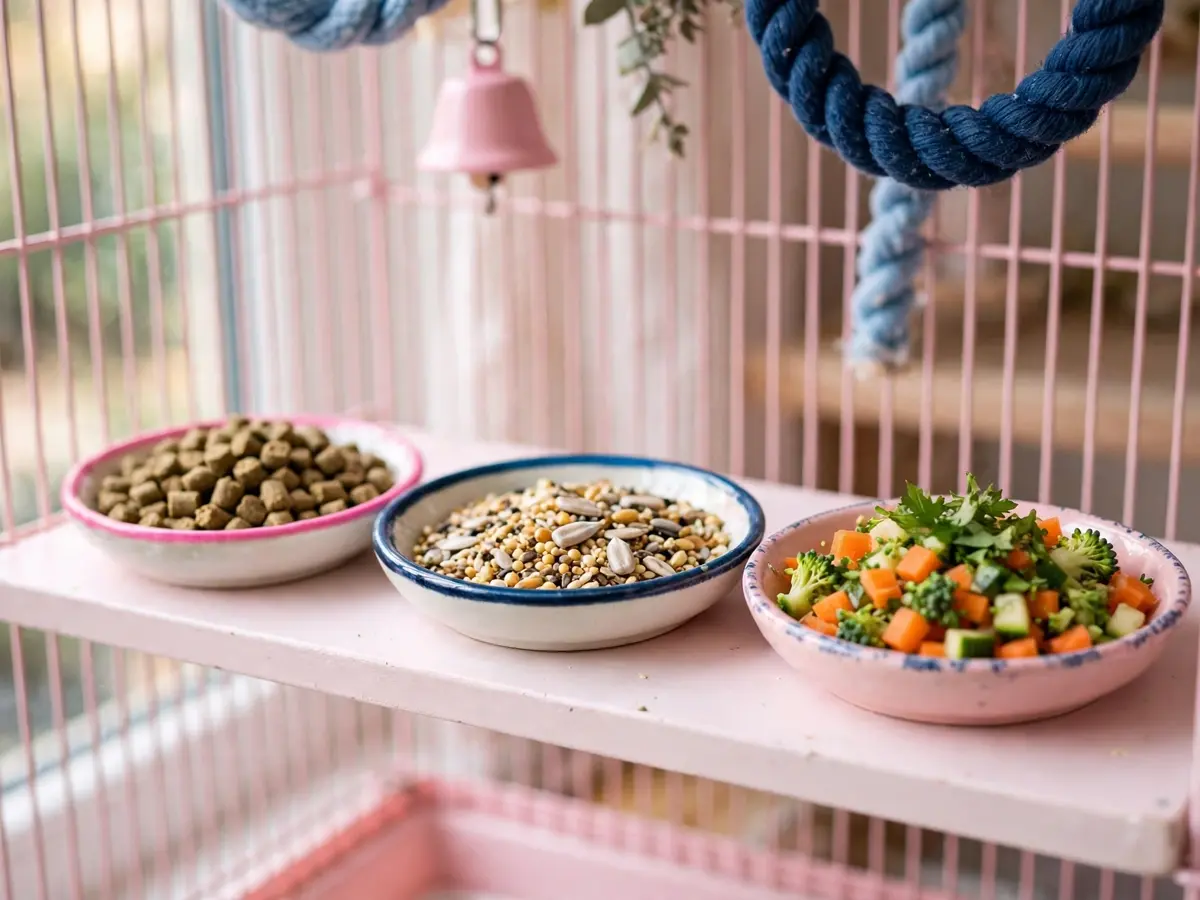
A switch runs on three dishes: the pellet dish, the seed dish and a small produce dish. Keep them in the same three spots every day, because a budgie navigates its cage by memory, and a dish that moves overnight reads as a missing dish in the morning.
The pellet dish stays clipped to the side, shallow enough that the bird sees the food without dipping its head past the rim. Top it up rather than filling it, so the dish always looks like it was just visited. The seed dish sits a comfortable hop away rather than beside the pellet dish, because two dishes touching each other invite the bird to pick the favourite out of the pair all day.
The produce dish is the smallest of the three: a few pieces, cut small, swapped before they sit warm. The produce share is part of the guideline, not a garnish, and a bird that meets produce in a dish of its own is far more likely to treat it as food than a bird that finds a leaf on top of its pellets.
Seeds, demoted to a training treat
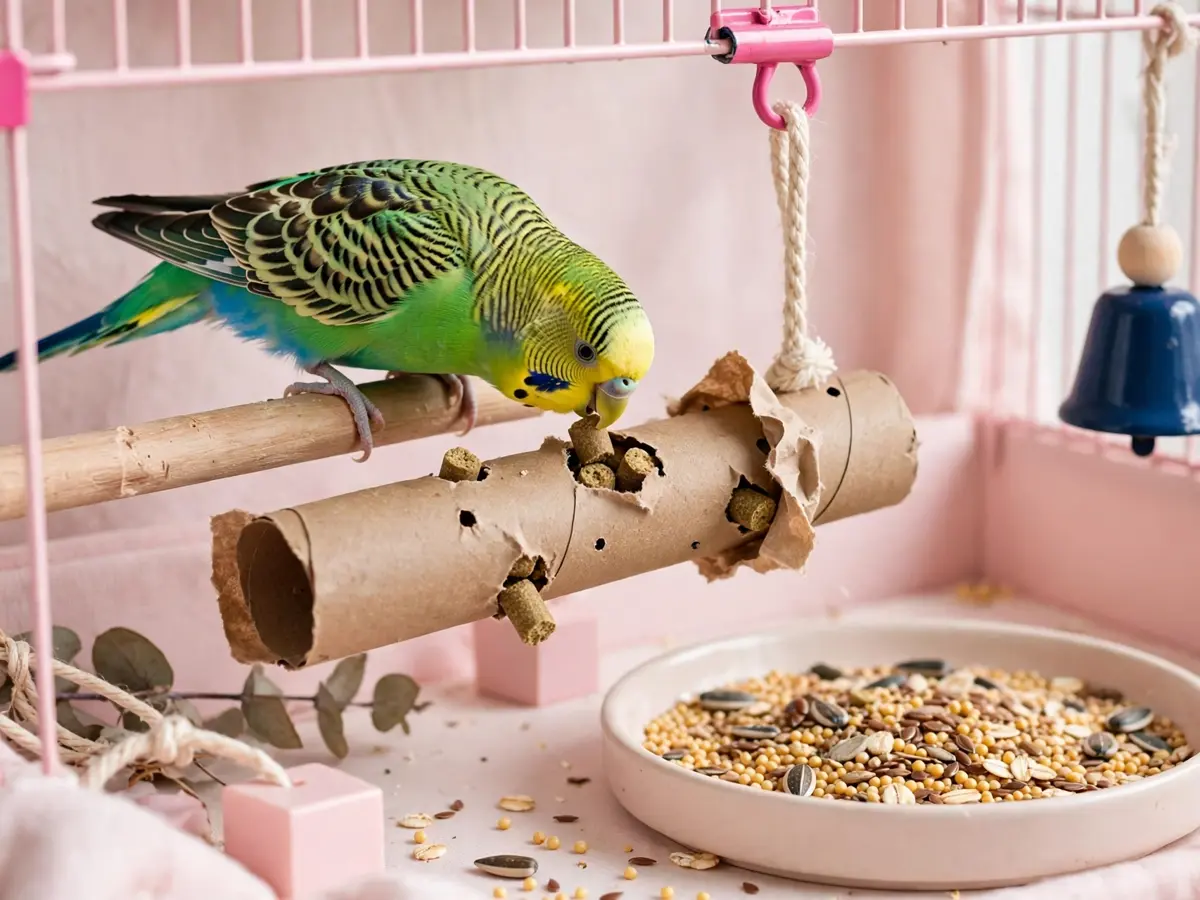
The seed portion does not vanish, it changes jobs. By week four the small dish becomes a pouch, and the seeds inside it are the reward for a step up, a target touch or a hand landed on. A budgie that works for a seed is a budgie that still gets seeds, and the relationship with the food stays intact.
The foraging toy is the second home for that reward. Tuck a few pellets and the odd seed into a paper roll, and the same bird that would ignore a bowl spends twenty minutes taking the roll apart. The DIY foraging toy builds for budgies have five that take an evening each, and every one of them turns a pellet into a puzzle.
Keep nuts in the same limited corner as the seeds. The guideline pairs them for a reason, and the treat pouch and the foraging roll are the only two places either one turns up after week four.
The weigh-in habit
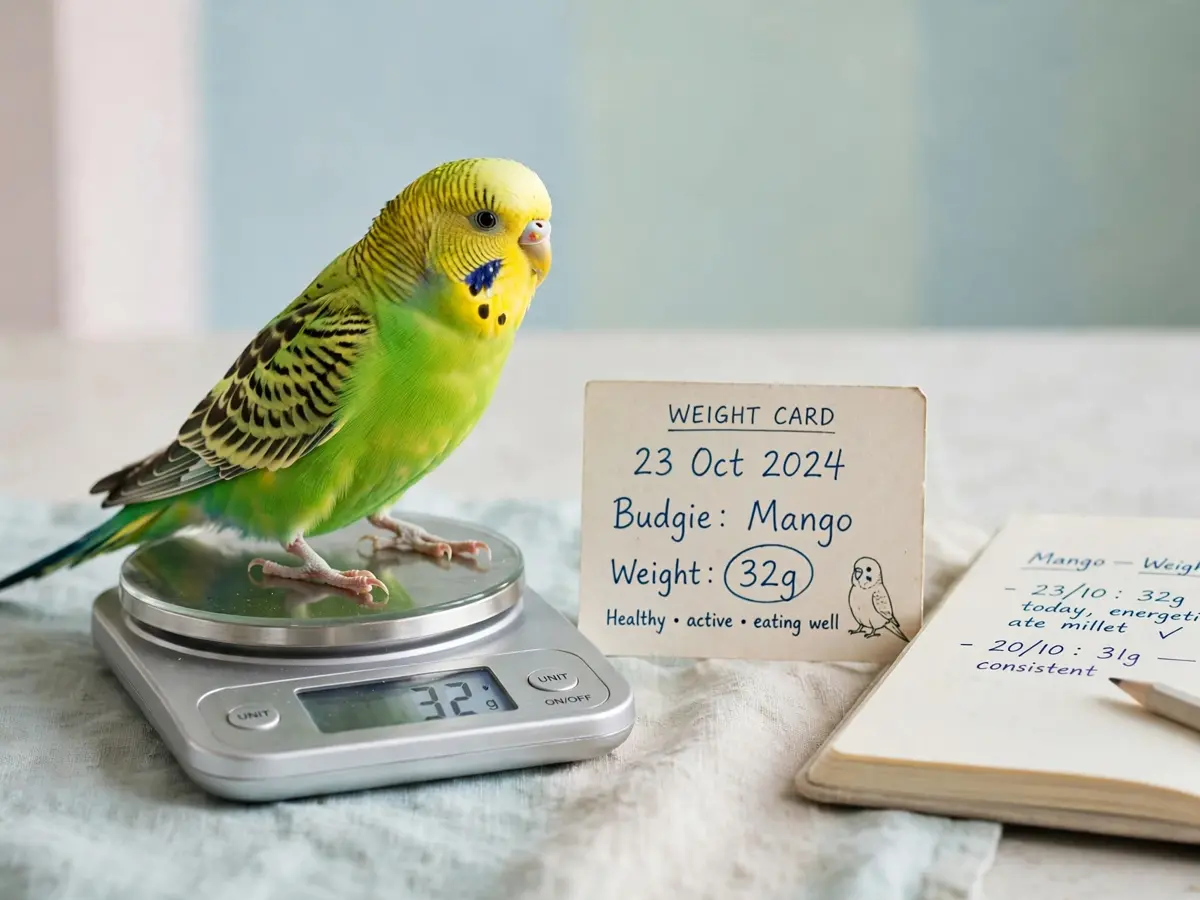
A kitchen scale and a card taped inside the cupboard door carry the whole safety net. Weigh the bird once a week, at the same time of day, ideally after the overnight dish has been emptied and before the morning top-up. Write the number in grams on the card with the date beside it.
The card is not there to prove progress. It is there to catch a bird that has quietly stopped eating, because a budgie that feels fine but is losing weight will still chirp at you from the perch and still look like itself in the mirror. A number that slides down across two weeks is the point at which the switch pauses and the avian vet gets a call, not the point at which the plan doubles down.
Weighing takes a minute and it needs no handling beyond stepping on and off. If your bird is not used to it, cover the scale with a small towel so the surface is not slippery, set it on the counter beside the cage, and let the bird walk on for a seed before you ever ask it to stand still.
The daily dish routine
The switch runs on clean dishes, so the wash goes on the same rhythm as everything else in the cage. Pull the pellet dish and the produce dish together each morning, wash both with warm water and a dedicated sponge, dry them fully, and refill them before they go back on the clips.
What gets washed during the switch
| What | When | How |
|---|---|---|
| Pellet dish | Every morning | Warm water and a soft sponge, dried fully, then topped up rather than filled |
| Produce dish | Every morning and again before the evening swap | Warm water, no soap needed on a dish that only held fruit and vegetables, dried fully |
| Seed dish | Every morning | Warm water, dried fully, topped up with the smaller scoop from week three onward |
| Water dish | Every day, and any time the water looks cloudy | Fresh water, dish washed and rinsed, back on the clip the same way every time |
| Scale and weigh-in card | Every week | A dry cloth on the platform, the date and the number in grams written beside the last one |
Dishes go back on the same clips, in the same order, every day. A budgie reads the cage by position, and a fixed routine is half the switch.
Where the switch stalls, and what to do
Six stalls cover almost every switch, and none of them needs a new plan. The answer is nearly always a slower week, a flatter dish or a smaller scoop.
Stalls and the fix
| What happens | Why | What to do |
|---|---|---|
| The bird throws pellets out of the dish | A deep dish hides the food, so the bird treats the dish itself as the toy | Switch to a shallow dish, put in a small handful at a time, and let the floor catch the mistakes |
| The bird eats around the pellets and waits for seed | Week two arrived before week one had settled | Go back one week, keep the morning order, and give the pellet dish more time at the bird's favourite end of the cage |
| The seed dish is empty by lunch while the pellet dish is full | The seed scoop is still the old size | Step the scoop down to the smaller one and split the seed across the morning and the training pouch |
| The bird screams at the usual feeding time | The routine changed faster than the food did | Keep the hour, change only the contents, and answer the scream with the produce dish rather than extra seed |
| The bird ignores the produce dish | Produce is unfamiliar and a bowl of it is too much at once | Put one small piece on the flat shelf beside the dish, and add a second only when the first one disappears |
| The number on the scale slips | The switch is running faster than the bird | Pause the plan, go back to the bowl the bird was eating from, and call the avian vet |
A stall is information, not failure. Slowing down costs a week; pushing through costs a bird that stops eating.
Pellet switch checklist
- Pellet, seed and produce dishes in fixed spots before week one
- One change a week, and the change is written on the card
- Scale out, card dated, the same weigh-in hour every week
- Dishes washed and dried daily, water swapped daily
- Build the diet on pellets with produce - about 75-80 percent pellets with 15-20 percent fruits and vegetables - keep seeds and nuts strictly limited, and never starve a bird into pellets.
- Foraging roll and treat pouch as the only homes for seeds after week four
- Avian vet called if the bird stops eating or the number slips
Questions we get about pellet switches
How long does a pellet switch take for a budgie?
Four weeks is the pace on this page, and it is a pace rather than a deadline. A bird that ignores the new dish for a while simply stays on the week it is on, because the calendar exists to slow a person down, not to pressure a bird. Check with an avian vet.
Can I just take the seed dish away one morning?
No. Build the diet on pellets with produce - about 75-80 percent pellets with 15-20 percent fruits and vegetables - keep seeds and nuts strictly limited, and never starve a bird into pellets. A bird that stops eating because the bowl it knows disappeared is the exact outcome the slow version avoids.
Which pellets should I buy?
Buy a plain pellet the bird will actually pick up, and let your avian vet steer the choice for your bird. This page never names a brand: pellet lines change their formulas, and a recommend from a stranger on the internet ages badly. What matters for the switch is the shape and the crunch, because those are what the bird meets first.
What is the produce share, and where does it go?
The guideline splits the bowl into a pellet base and a produce share, so produce gets its own small dish rather than being buried in the pellets. Keep the pieces small enough for a budgie to hold in one foot, and swap them before they sit warm all afternoon. Check with an avian vet before new produce joins the rotation.
My budgie throws the pellets out of the dish. Now what?
That is normal in week one, and it is usually excitement rather than rejection. Use a shallow dish so the bird can see the pellets without dipping its head, put in a small handful at a time, and let the floor catch the mistakes. A dish that gets topped up through the day stays interesting; a dish filled to the rim gets treated as a toy.
Do I need a new cage for the switch?
No. The switch happens in the bowls, and the cage around them stays the same. What is worth checking once is the dish clips and the perch line, because a bird that is thinking about a new food wants a steady place to stand while it decides.
What we use
What we use for the switch
Shallow dishes, dish clips, a kitchen scale and foraging paper for the four weeks, in one list.
See what we use →As an Amazon Associate we earn from qualifying purchases.
Save these on Pinterest
Pin the four-week table for the week you start. The Budgie & Cockatiel Corner collection holds the cage setup checklist and the foraging builds beside it.
Sources
The diet and housing rules on this page come from veterinary sources, not from our own head: