 PawStyle Daily
Pet Loss Memorial & Rainbow Bridge
Pet Loss Sympathy Cards & Messages
An animal sympathy card does one job: it says the loss was real and the pet was seen. This page holds short pet loss messages for every distance of friendship — the close friend, the coworker, the child, the caption that rides along with flowers — plus a quiet list of words that land and words to skip. Swap in the pet's name, keep the rest as written, and for informational purposes only: comfort here, not grief-therapy advice.
By PawStyle Daily · Updated 17 November 2026
Short messages, pastel-warm, no religion · Swap in the name · For comfort only, not therapy advice.
Why sending a card matters
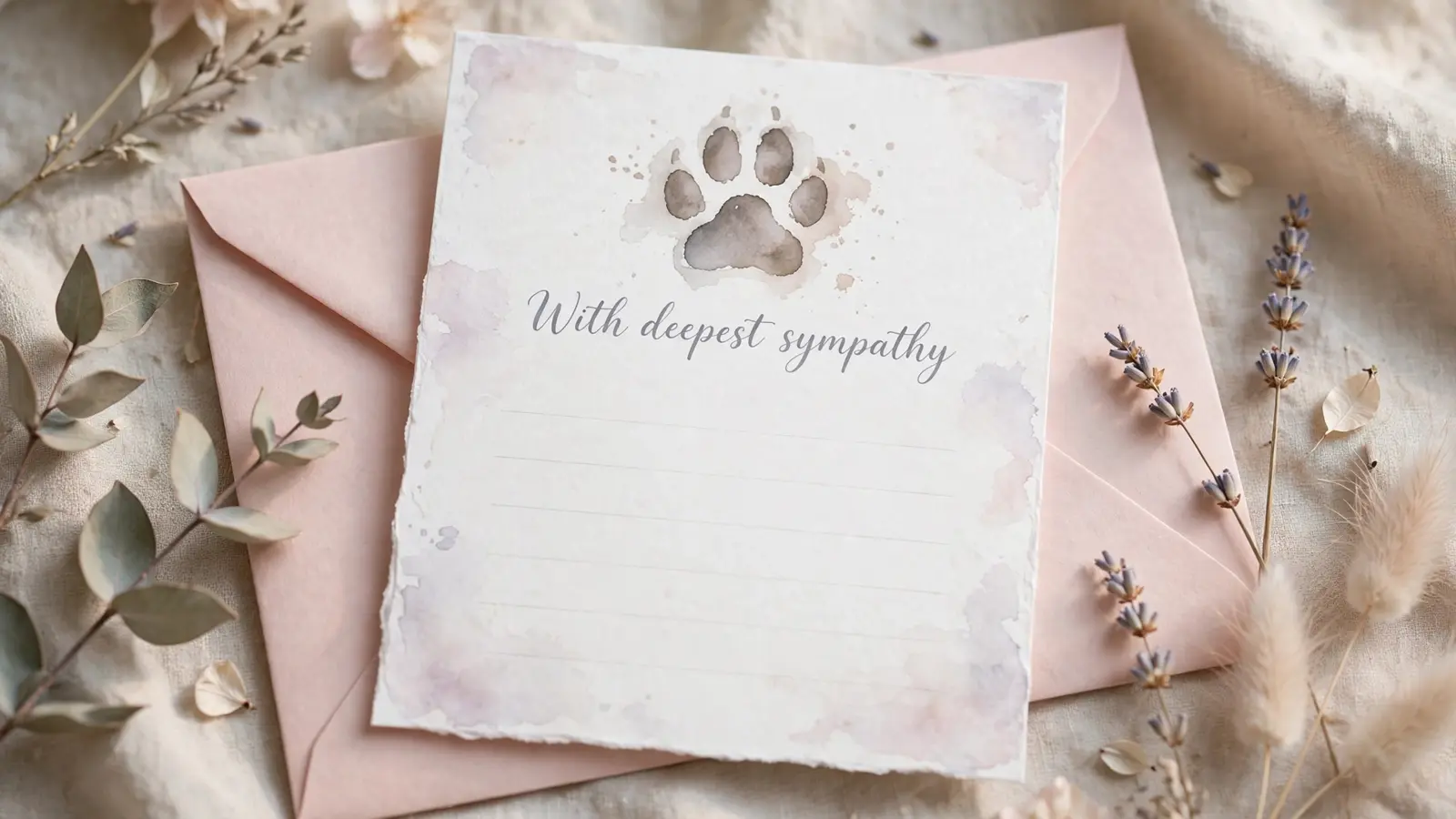
It can help to memorialize a pet in a way that includes others who cared about them, and friends and family can form a support network. A sympathy card is often the smallest, easiest brick in that wall: it tells the grieving person their pet was real to more people than just them, and it says so at the exact moment the house has gone quiet.
You are not being asked to fix the grief. A card is acknowledgment, not a solution — presence in an envelope.
For a close friend
The close-friend card can carry the most warmth and the most specifics. Pick the one that sounds like your friendship, swap in the name, and send it before it feels polished:
- “I am so sorry about [name]. She was so loved, and it showed in everything you shared.”
- “No reply needed. Just sitting with you and [name]’s memory today.”
- “I keep thinking of [name] in the sun. He was one of the great ones.”
- “The house must feel so different tonight. I am here for every version of this week.”
- “You gave [name] such a good life. That counts, forever.”
- “Sending the softest corner of today your way. Coffee Thursday, porch drop-off, no talking required.”
A concrete offer with a built-in exit beats any “let me know if you need anything.”
For a coworker or acquaintance
Shorter, warmer, and nothing they must answer. One or two lines is the whole message:
- “So sorry about [name]. Thinking of you this week.”
- “Heard about [name] — so sorry for your loss. No reply needed.”
- “The photo you shared of [name] was wonderful. So sorry.”
- “Take the time you need. Wishing you a gentle week.”
Acknowledgment is the job; depth belongs to the friendships that have it.
Messages a child can receive
A card for a child names the loss honestly and leaves the door open. Write it to the child, not about them, and keep it to a sentence or two:
- “[Name] was a very good dog, and you were a wonderful friend to him.”
- “I am sorry [name] died. It is okay to feel sad and to feel better at the very same time.”
- “It is okay to miss [name] for a long time. Love does not have a deadline.”
- “[Name] knew how much you loved him. That part never goes away.”
The card opens the conversation; the family carries it. The guide to telling a child walks through the words, the timing and the goodbye by age.
Captions for flowers and small gift baskets
Flowers or a basket need the shortest caption of all — the gesture is doing half the talking. One line, no signature poem:
- “For [name], with love.”
- “In memory of a very good girl.”
- “Something soft for a hard week.”
- “Thinking of you and missing [name] too.”
- “With sympathy, and a photo of [name] in the sun.”
If you have a photo of their pet, printing it small and tucking it into the card is the single most-kept gesture on this page.
Words that land, words to skip
Most people who say the awkward thing are trying, and nobody needs a judge at a funeral. This is not a rulebook for policing others — it is a menu for your own card, so the kind intention lands as kindness:
Words for the card, words to leave out
| Lands well | Better left unsent | Why |
|---|---|---|
| '[Name] was so loved.' | 'At least he had a long life.' | 'At least' argues with the grief instead of joining it |
| 'No reply needed.' | 'Let me know if you need anything.' | A concrete no-pressure offer beats an open chore |
| 'Tell me about her, if you feel like it.' | 'She is in a better place.' | Unless that is your own belief, borrowed comfort can jar; skip theology entirely |
| 'You gave her such a good life.' | 'When are you getting another one?' | A new pet is their question to raise, never yours |
| 'I remember when he stole the sandwich.' | 'I know exactly how you feel.' | A shared memory includes them; a claimed feeling centers you |
If you have said one of the sting column lines before — nearly everyone has — a warm follow-up repairs it completely.
The pattern under it all: name the pet, keep the sentence short, and ask nothing back.
Small gestures that ride along
- Print one photo of their pet, small, and tuck it into the card
- Send the card a month later, when the first-week messages have thinned
- Drop coffee on the porch with a text: no visit required, no talking needed
- Gift the memory jar or the keepsake you made, offered with no strings
- Check in again on the anniversary — the second card outperforms the first
For the words to write inside a keepsake gift, the pet memorial quotes page has short lines and letter prompts; for how to offer a made keepsake gently, the memorial gifts guide covers the no-strings approach.
Pet sympathy card questions
Is a pet loss card really necessary?
Necessary is the wrong measuring stick, but it does land. Most grieving pet owners hear nothing at all, so a card that names the loss says 'this was real, and I saw it.' One warm sentence outperforms a perfect paragraph that never got sent.
Text, card, or flowers?
All three work, and they do different jobs. A text arrives fast and can be reread at a heavy hour. A card sits on the shelf as a physical thing they can keep. Flowers and a small basket decorate the hardest week. Match the depth of the friendship, not a rulebook.
How long after the loss can I still send a card?
Longer than you think. The first week is loud with messages; the quiet month after is when a card lands hardest, and an anniversary card lands harder still. There is no expiry date on 'I was thinking of you and Miso today.'
Should I mention the pet by name?
Yes, whenever you know it. A name turns a form letter into a memory: it says the pet was real to you too, not just an event that happened to them. If you never met the pet, borrow a detail from the sender — 'the photo you shared of her in the sun' works.
What if I already said the wrong thing?
Say so once, briefly, and move on: 'I am sorry, that came out clumsy — I am here.' The repair works better than the original sentence would have. Nobody remembers a clumsy card as long as they remember silence.
Can I send a pet loss card for a coworker's pet?
Yes, and shorter is kinder. A coworker card is one or two lines: name the loss, offer nothing they must answer. Leave the deeper conversation for a teammate who knew the pet — your job is acknowledgment, not therapy.
Do I send anything for a fish, hamster or bird?
Follow their lead, not the species. If they loved that animal loudly, a short line honors it; if the loss was quiet, silence plus a warm check-in later may fit better. The size of the animal never sets the size of the card.
Gentle notes
- Name the pet; a name turns a card into a memory
- Short and sent beats perfect and drafted
- Nothing in the card should require a reply
- A month later is not too late — it is often the best week
- For comfort and informational purposes only; deeper grief deserves real support
Save for the next hard card
Pin this for the next sympathy card you need to write, or send it to a friend stuck mid-draft. The Stories collection holds the lighter pages too.