 PawStyle Daily
Pet Holiday Costumes & Party
5 Crochet Ghost Costumes for Corgis (No-Sew Options)
A crochet ghost is the softest Halloween costume a Corgi can wear: breathable yarn, no stiff edges, stretches with that long loaf body. Each version below gives a crochet path plus a no-sew backup for busy weeks: same ghost look, felt instead of yarn, finished in an evening either way. The cape ends at mid-back every time, so the ears, the eyes and the shoulders stay free. For informational purposes, consult your vet.
By PawStyle Daily · Updated 5 October 2026
Good to know: one evening per costume · Soft acrylic yarn or felt · Two-finger strap fit; supervised wear only.
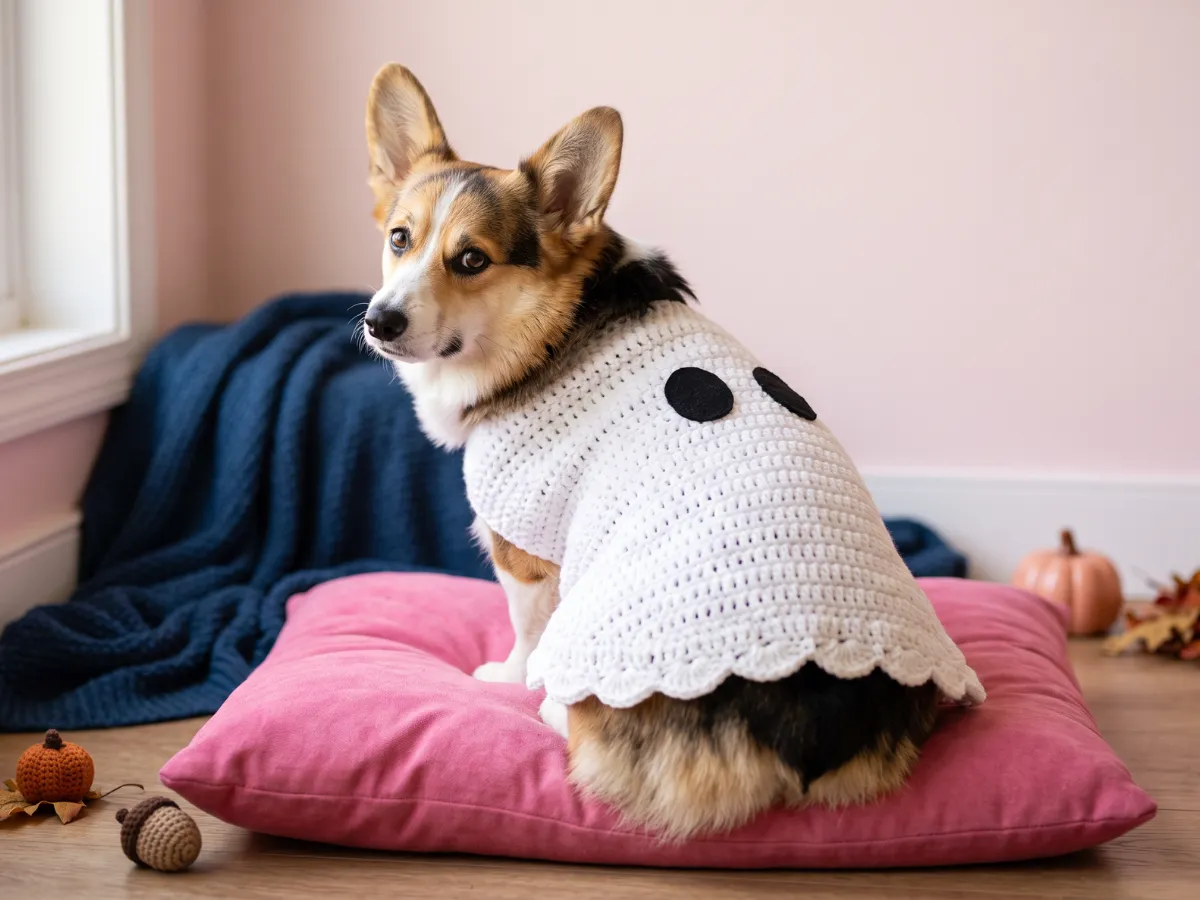
1. Classic sheet ghost, worked flat
One rectangle in double crochet: chain to the width that will wrap the chest, work rows until it drapes past the shoulders, then cut a gentle scallop along the bottom edge. This one uses chain and double crochet only and is worked flat, so it never turns inside out mid-row. Black felt ovals for eyes go on the back half so nothing sits near the face. Soft elastic loops at the chest corners hold it like a tiny saddle cloth.
No-sew backup: white felt rectangle, same scallop, same elastic, no hook needed.
2. Ear-free ghost cape
Same rectangle, shorter: it ends at mid-back so it never covers the ears or the tail base. Corgis read as ghosts from the white drape and eye dots alone; covering those satellite ears ruins both the look and the dog's mood. Short is cuter and kinder.
No-sew backup: white pillowcase cut to mid-back length, scalloped hem, ribbon chest ties.
For another Halloween no-sew build, see the no-sew bat wings for dogs, and for a paired photo see the matching owner and dog costume ideas.
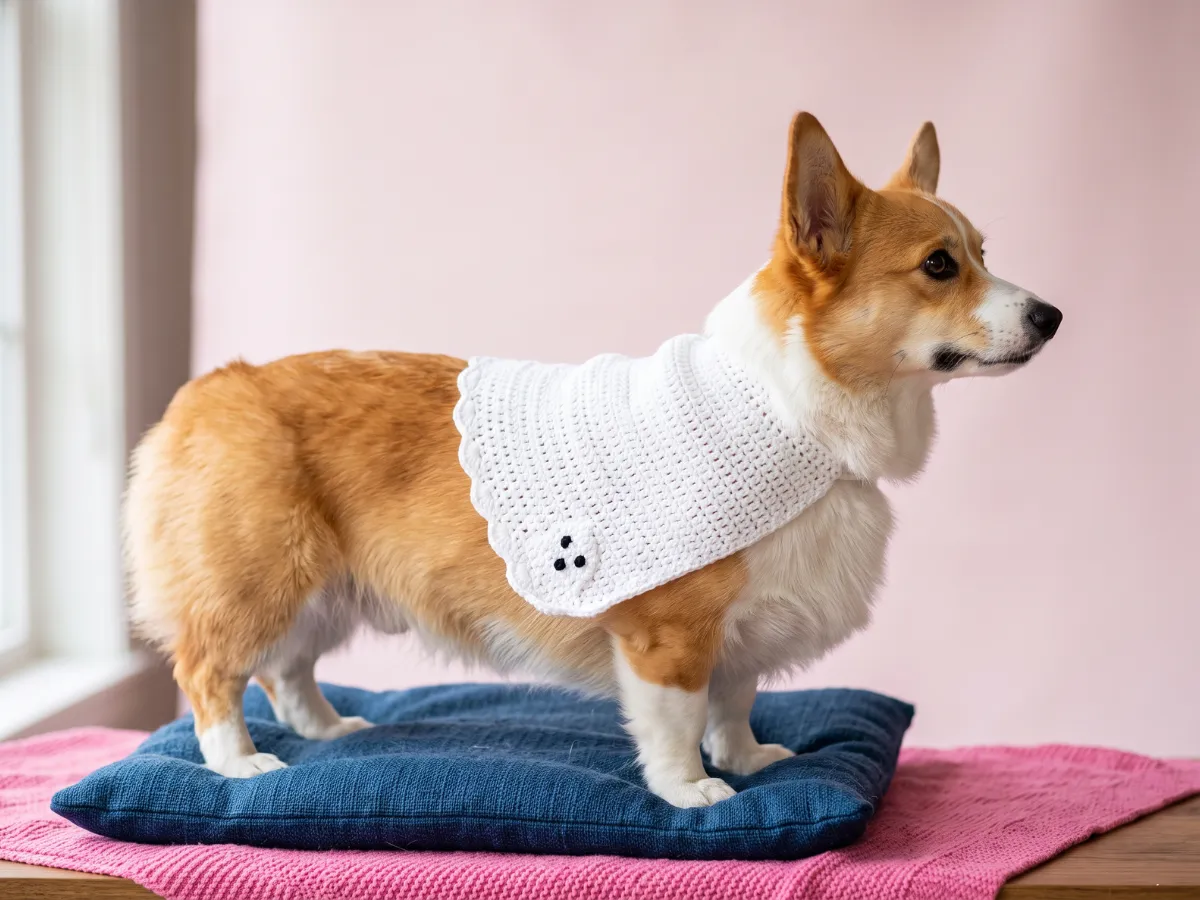
3. Granny-square ghost, worked in pieces
Join white granny squares into a rectangle big enough to drape the back, then edge the whole thing with one round of single crochet to stop the edge curling. This one is made in pieces and has one join per square, so it works as a stash-buster and it is easy to un-pick one square if the count goes wrong. Line the chest side with a soft cotton strip so openwork never rubs.
No-sew backup: white cotton tea towel with felt eye dots, open weave and no crochet at all.
4. Ghost with pumpkin trim
Classic ghost plus a crochet pumpkin applique: a flat circle in orange with a green stem, stitched to one back corner. One accent only, glued or stitched flat so little teeth can't grab it. Test with a treat first: if the nose goes straight to the pumpkin, move it higher up the back.
No-sew backup: felt pumpkin shape glued flat to a felt ghost cape.
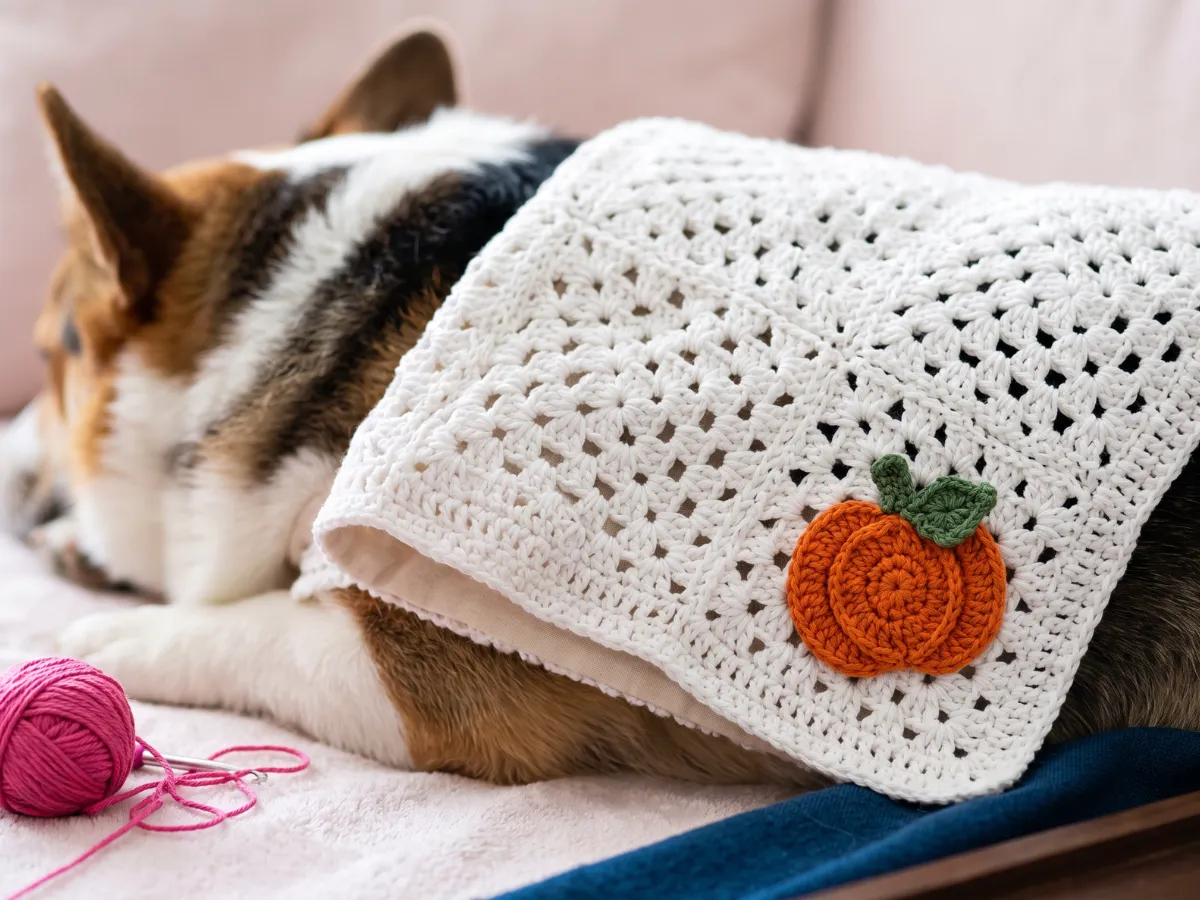
5. Puppy-mini ghost for short photo sessions
Half-size rectangle for the smallest dog in the house: it drapes the shoulders only and is held by one soft chest loop. Keep this one for short photo sessions rather than wear, take it off before the chewing starts, and let a puppy that is still teething be a photo prop instead. A dog new to anything on its back is a dog this version waits for.
No-sew backup: white napkin with eye dots and one ribbon loop, a photo prop rather than a wearable.
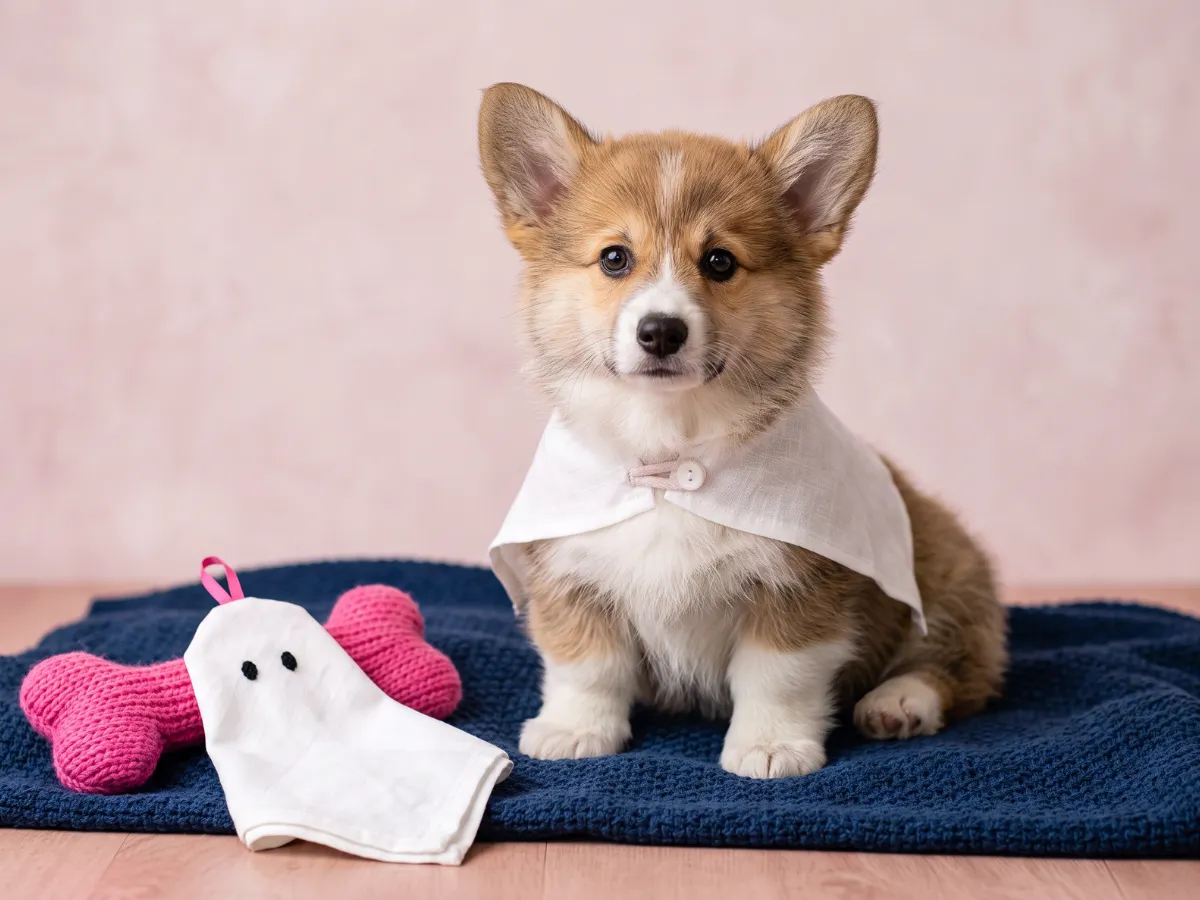
Five ghost versions
| Version | Crochet path | Time | No-sew backup |
|---|---|---|---|
| Classic sheet ghost | One double-crochet rectangle, scalloped hem, felt eyes | One evening | White felt rectangle, same scallop, no hook needed |
| Ear-free ghost cape | Same rectangle, shorter, ends at mid-back | One evening | White pillowcase, scalloped hem, ribbon chest ties |
| Granny-square ghost | Joined squares, one single-crochet edge round | One evening | White cotton tea towel with felt eye dots |
| Ghost with pumpkin trim | Classic ghost plus a flat orange applique | One evening | Felt pumpkin glued flat to a felt cape |
| Puppy-mini ghost | Half-size rectangle, one soft chest loop | One evening | White napkin with eye dots, a photo prop rather than a wearable |
Every version ends at mid-back: nothing ever covers the ears or the tail base.
Yarn and hook, matched
| Yarn | What it makes | What to watch | What to skip |
|---|---|---|---|
| Worsted acrylic | The friendly default: it drapes over the back, holds a scallop, and washes by hand without fuss | Buy the whole project in one dye lot so the finished cape reads as one white | A skein that has gone grey at the fold from last year's storage |
| Cotton blend | A lighter fabric for a dog that runs warm, with a firmer edge that holds its shape | It has less stretch than acrylic, so work the neck band a touch looser | Pure cotton in a heavy weight, which drapes flat and stiff |
| DK wool | A denser, warmer cape with a soft hand and a clean stitch definition | Wool needs a gentle hand wash and flat drying to keep its shape | A wool the dog has any reaction to, and any wool that felted last time |
| Chunky acrylic | A cape that works up fast and reads thick and cozy | It adds weight on the back, so keep the hem shorter and the body panel plain | Chunky yarn for the hood, where a thick fabric folds over itself |
| Leftover skeins | A stash-buster ghost that costs nothing and clears the bin | Weigh or count your leftovers before you chain, so you know what you have | Joining lots that differ enough in white to read as two capes |
| Scrap bin | The granny-square version, which turns short ends into squares you join later | Knot short ends into balls by weight so each square stays consistent | Pieces too short to work a square, which become ends you weave in forever |
Hook guidance follows the yarn band on the label: a 5 mm hook suits worsted yarn, and the same idea steps up or down as the yarn does.
The four stitches you need
Every ghost on this page runs on four moves. Learn these and the whole page is open to you.
- Chain: the foundation row, and the row you count to set the width of the rectangle. A chain that is too tight puckers the bottom edge later.
- Single crochet: a short, dense stitch. It is what you use for the edge round that stops a hem curling, and for any band you want to lie flat.
- Double crochet: a taller stitch that works up faster and gives the cape its drape. This is the body stitch on the classic and ear-free ghosts.
- Magic ring: the way to start a flat circle, like the pumpkin applique, without a hole in the middle. Pull it tight after the first round.
A slip stitch is the fifth move worth knowing: it joins a round shut and it travels invisibly along a seam.
Gauge, without the stress
Crochet a small swatch in your chosen stitch, about an inch wide and an inch tall. Count how many stitches sit across that inch, then compare it with the number the yarn label gives. If your count is higher, your fabric is tighter, so move up one hook size. If it is lower, your fabric is looser, so move down.
Gauge matters more here than it does for a scarf. A scarf can be any width and still warm you. A cape has to drape the same way on both sides of the dog, cover the shoulders evenly, and sit flat against the back without twisting. Two inches of drift across a scarf is a shrug; the same drift across a cape is a hem that hangs crooked.
Construction order
Build it in this order and the cape goes together in one sitting.
- Start at the neck band. Chain the width, work the first rows flat, and try the band around the neck before you go any further.
- Work the body flat from the band down, counting rows so both sides grow at the same rate.
- Cut and work the scalloped hem before you join anything, while the piece is still easy to lay flat and measure.
- Join the seam last, with slip stitches worked from the inside so the join reads as a fold rather than a ridge.
- Add the hood last, after the body hangs correctly. It is the one piece that depends on the fit of everything else.
- Weave the ends in as you go, at the end of each section, so you never finish a cape and then face a pile of tails.
Fit it on the dog
A ghost cape is fitted on the dog, not on the table. Run this check with the dog standing and relaxed.
- Measure around the neck with a soft tape, snug enough to hold and loose enough to slide a finger under.
- Check the cape clears the shoulders all the way round, with the body panel falling behind the shoulder blades rather than on top of them.
- Check the hood from the side: it should sit behind the eyes, and it should never fold forward over the face.
- Check the hem does not drag on the ground, and lift the front paws one at a time to confirm the hem is not in the way.
- Walk the dog a few steps and watch the cape from behind: it should hang even, not swing to one side or twist.
The rule to keep while you fit: a costume that limits movement, sight or breathing is a bad idea, and small dangling pieces or costume accessories are a choking hazard. If the fit fights that rule, the fit changes, not the dog.
A wear-time plan that is a habit, not a clock
Plan short sessions with a break between them, and let the dog's behavior set the length. One session for the photos, then the cape comes off, the dog moves around, and the next session starts when the dog is calm again.
Watch for three signs that the session is over: the dog freezing in place, pawing at the cape, or lying down with it on. Any one of those means the cape comes off and the day is done. A dog that walks, wags and carries on as normal is a dog that is still comfortable, and that is the only measure worth using.
Common problems and fixes
What goes wrong and what to do
| Problem | Why it happens | Fix |
|---|---|---|
| The cape twists around the neck | The neck band was joined with a seam that sits off-center, or the body was seamed to one edge only | Re-set the join so it runs down the middle of the back, and work the band in the round if you can |
| The hood falls over the eyes | The hood was attached before the body hung correctly, so it sits too far forward | Take the hood back off, re-set the join one row lower and further back, then fit it on the dog again |
| The hem drags on wet ground | The rectangle was worked longer than the dog's leg length | Work fewer rows next time, or add a row of single crochet to firm the edge so it lifts clear |
| The seam puckers | The two edges were joined with different stitch counts, so one side has to gather | Rejoin from the widest point, easing the longer edge in over several stitches rather than all at once |
| The yarn splits as you work | The skein is old, the ply has twisted back on itself, or the hook has a burr on it | Pull from the outside of the ball, let the skein hang to unwind, and change the hook if the lip is rough |
| The dog shakes it off in one move | The chest loops are too loose, or the cape sits where the dog's shoulders move most | Reset the loops to a two-finger fit, move the body panel back behind the shoulder blades, and try a shorter cape |
Each fix is a change to the cape, never a change to the dog.
Care and storage
Hand wash the cape in cool water with a gentle soap, squeeze the water out without wringing the fabric, and lay it flat to dry. Keep it out of the dryer, which is where a scalloped hem loses its shape. Re-flatten the hem with your hands once it is dry.
Fold it flat along the seams it already has and store it in a bag with the year written on the outside. Keep the bag somewhere dry and off the floor, and store the hook, the yarn band and the felt ovals with it, so next October is a re-make rather than a fresh hunt.
When to skip the ghost
Five cases where the honest answer is no costume this year.
- A dog that freezes. A dog that stands still and will not settle is telling you the cape is wrong for it, and no amount of treats makes that a good photo.
- A puppy still chewing. Everything goes in the mouth at this age, and a cape with felt ovals is a chew toy with stitching.
- A dog that has never worn anything. Start with a collar band and build up over a few days, rather than opening with a full cape.
- A day with rain in the forecast. A wet cape is heavy, it drags on the hem, and the dog spends the walk cold.
- A dog with a skin issue where a strap would rub. A band across the back is the last thing an irritated spot needs, so leave it off and let the skin settle.
Ghost costume questions
Which yarn should I use for a ghost cape?
Soft worsted acrylic is the friendly default: it drapes, it washes, and it is easy to find in white. A cotton blend is a good pick for a dog that runs warm, and a chunky acrylic works up faster but reads heavier on the back. Leftover skeins from your stash are the honest first choice, as long as the dye lots are close enough that the finished cape reads as one white. Keep the hook, the yarn band and the finished cape in one bag together so next year is a re-make and not a fresh hunt.
Which hook size goes with my yarn?
Match the hook to the yarn band printed on the label. A 5 mm hook suits worsted yarn, and the same idea steps up or down as the yarn does. If your rows come out tighter than the pattern, move up one hook size; if they come out loose and open, move down. The hook is the one tool that changes the fabric, so a small move there is the cheapest fix you have.
How do I keep the hood off the eyes?
Build the hood last and fit it on the dog before you attach it. Set it back from the face so it sits behind the eyes, then check it from the side, not just from the front. If it still slides forward, take it back off and re-set the join one row lower rather than adding a strap. The cape itself ends at mid-back, so nothing covers the ears or the tail base.
Does the cape need a lining?
A lining is optional, and a solid-fabric ghost does not need one at all. The granny-square version is the one that benefits: a soft cotton strip along the chest side keeps the openwork from rubbing. A lining is also the easiest place to add a second layer of drape, and it takes a scratchy-feeling cape and settles it. For informational purposes, consult your vet.
How do I wash the ghost after the walk?
Hand wash it in cool water with a gentle soap, squeeze the water out without wringing the fabric, and lay it flat to dry. Keep it out of the dryer, which is where a scalloped hem loses its shape. Wash it before you store it, not before you wear it, so the yarn does not sit damp against the dog.
How do I store it until next year?
Fold it flat along the seams it already has and put it in a bag with the year written on the outside. Store the bag somewhere dry and off the floor, and keep the hook, the yarn band and the felt ovals with it. Re-flatten the hem before it goes in the bag, so next October opens with a ghost that is ready.
What if the dog hates wearing it?
Take it off and stop there. A costume that limits movement, sight or breathing is a bad idea, and small dangling pieces or costume accessories are a choking hazard. Loosen the chest loop to a two-finger fit, or simplify to the felt backup, or skip the costume this year. Wear stays supervised the whole time, and the costume comes off for eating, sleeping and walks. Some dogs will wear a cape and never a hood, and some will wear neither, and that is a full answer.
Is a sheet ghost easier than a crochet one?
A white pillowcase cut to mid-back length is the fastest ghost on this list, with a scalloped hem and ribbon chest ties. It is also the easiest one to re-cut and re-hem next year. The crochet versions stretch with the dog and hold a shape over the years, so the trade is one evening of work now against a re-cut later.
Can the costume cover the ears?
Never. The cape ends at mid-back so it never covers the ears or the tail base, and black felt eye dots go on the back half only so nothing sits near the face. Corgis read as ghosts from the white drape and eye dots alone, and covering those satellite ears ruins both the look and the dog's mood.
What if the dog freezes or scratches at the ghost?
Take it off. A costume that limits movement, sight or breathing is a bad idea, and small dangling pieces or costume accessories are a choking hazard. Loosen the chest loop to a two-finger fit, simplify to the felt backup, or skip the costume this year. Wear stays supervised the whole time, and the costume comes off for eating, sleeping and walks.
How long should the wear last?
Think in short sessions with a break between them, not in a clock time. Plan one sitting for the photos, take the cape off, and let the dog move around before the next one. Watch for the dog freezing, pawing at the cape, or lying down, and end the session there. A dog that carries on as normal is a dog that is still comfortable.
Supply checklist: copy this before you start
- Soft acrylic yarn in white (or white felt for no-sew)
- Hook to match yarn band; blunt tapestry needle for ends
- Black felt ovals for eyes, glued flat, back half only
- Soft elastic or ribbon for chest loops; two-finger fit
- Treats for the wear test; scissors for the scalloped hem
- Supervised wear only; costume off for eating, sleeping, walks
What we use
What we use for crochet ghost costumes
Soft yarn, blunt needles and felt ovals cover all 5 builds; hooks and starter picks in one place.
See what we use →As an Amazon Associate we earn from qualifying purchases.
Save these on Pinterest
Pin the ghost that matches your week: crochet when you have an evening, felt when you do not. The Holiday & Gifts collection holds the bat-wing and matching-duo guides.
Keep ears, eyes, and movement fully free, the same ask the ASPCA makes for every pet costume: ASPCA Halloween safety tips.