 PawStyle Daily
Best Pet Supplies & Gift Guide
Funny Dog Collars and Tags That Get Read
A funny collar is a joke told to the neighborhood, and a tag is a message told to a stranger on the sidewalk. The first one only has to land. The second one has to be read, out loud, by somebody who is holding the dog on a borrowed leash and needs a phone number. Those two jobs pull in opposite directions, and the collar that works is the one where the joke earns the read instead of crowding it. This page owns the message, the fit check, and the materials. For the rest of the first-week basket, the gifts for new dog owners page covers the gear that goes beside the collar, and this one does not repeat it.
By PawStyle Daily · Updated 20 November 2026
Good to know: a short line reads best, the number goes on the back, two fingers under the band, and nylon shrugs off mud.

Two jobs, one piece of hardware
The joke lives on the band: a printed nylon webbing in a loud pattern, a leather strap with a phrase tooled into it, a bow tie clipped over the collar. The identification lives on the tag, and the tag is the part a stranger actually bends down to read. When the two are crowded onto one surface, the joke wins the first look and the number loses, which is the failure mode to design around.
The working split is a joke on the front of the tag and the contact line on the back, or a joke tag hung beside a plain ID tag on the same ring. Either way the reader gets the laugh first and the phone number second, in that order, without having to turn the tag over in the rain. A collar that only jokes is a collar that fails at the one job nobody wants to think about, and a tag that only lists a number is a tag a passerby never looks at twice.
Messages that get read out loud
A tag line works when it can be read in a breath. The dog bent down, the stranger reached in, and the words landed before anybody said anything. Short beats clever in the long version: a nickname, one joke, the catchphrase the dog has on the walk. The lines that fail are the ones written for a screen rather than for a sidewalk, because a sentence needs to be parsed and a name needs to be laughed at.
The formats that hold up are the ones spoken in the dog's own voice. "I did not eat the shoe." "Ask me about the mailman." "Will trade tricks for cheese." A first person tag reads as the dog, and a reader who laughs tends to read the rest of the tag, which is where the number sits. The second format is the understated one: a single word on a plain band, "Snack", "Nap", "The couch is mine." Both work when the letters stay big and the line stays short.
Read the message out loud at arm's length before ordering it. If the joke needs a second read to land, the tag needs fewer words. The same test applies to the lettering: a font that reads at a distance on a sidewalk beats a script that photographs well and engraves badly. Curved lettering on a round tag loses the tops of the letters, and a deep engraved line outlasts a printed one on a dog that rolls.
The fit check before the walk
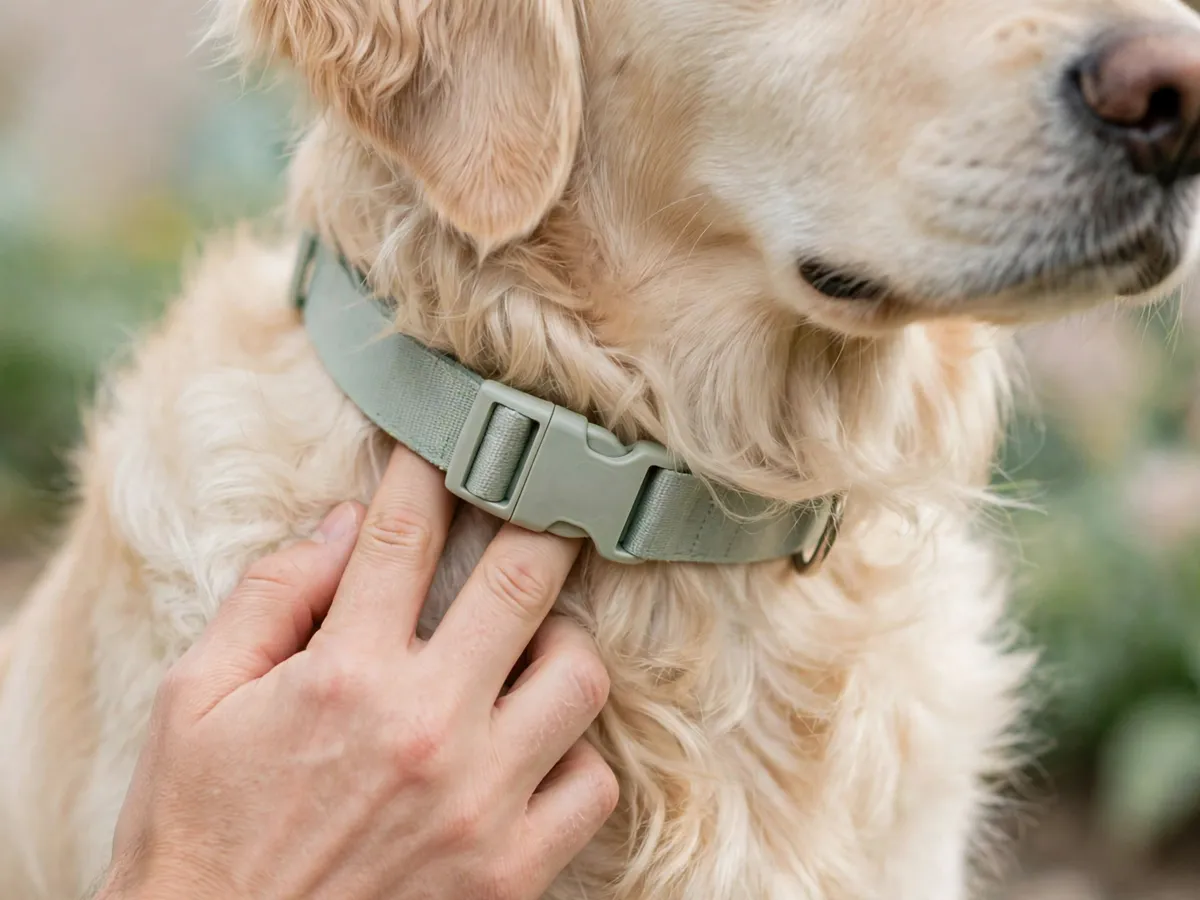
Fit is the part people skip, and it is the part that decides whether the collar stays on. Slip two fingers under the band at the neck. The fingers should go in with a little friction and should not slide freely. That is the check, and it takes the same amount of time as buckling the collar, which is why there is no reason to do it once a season instead of every time.
Too loose and the tag swings, jangles against the ribs, and slides over the eyes when the dog pulls once at a squirrel. Too snug and the edge presses into the neck fur, and a coat that carries a lighter color shows the line by the end of the week. A dog that backs out of a loose band is the reason the check matters more than the size printed on the packaging, and the reason a buckle the dog cannot work open with a tooth reads as the better buy.
A puppy collar needs the check every week, because the neck changes faster than the band does. The habit is to mark the current hole in the webbing with a pencil and tighten or loosen to that mark, then re-check on the next walk. For a dog whose neck is still filling out, a band with a long adjust range is the one that stays on the dog rather than in the drawer.
Tag shapes, metals and lettering
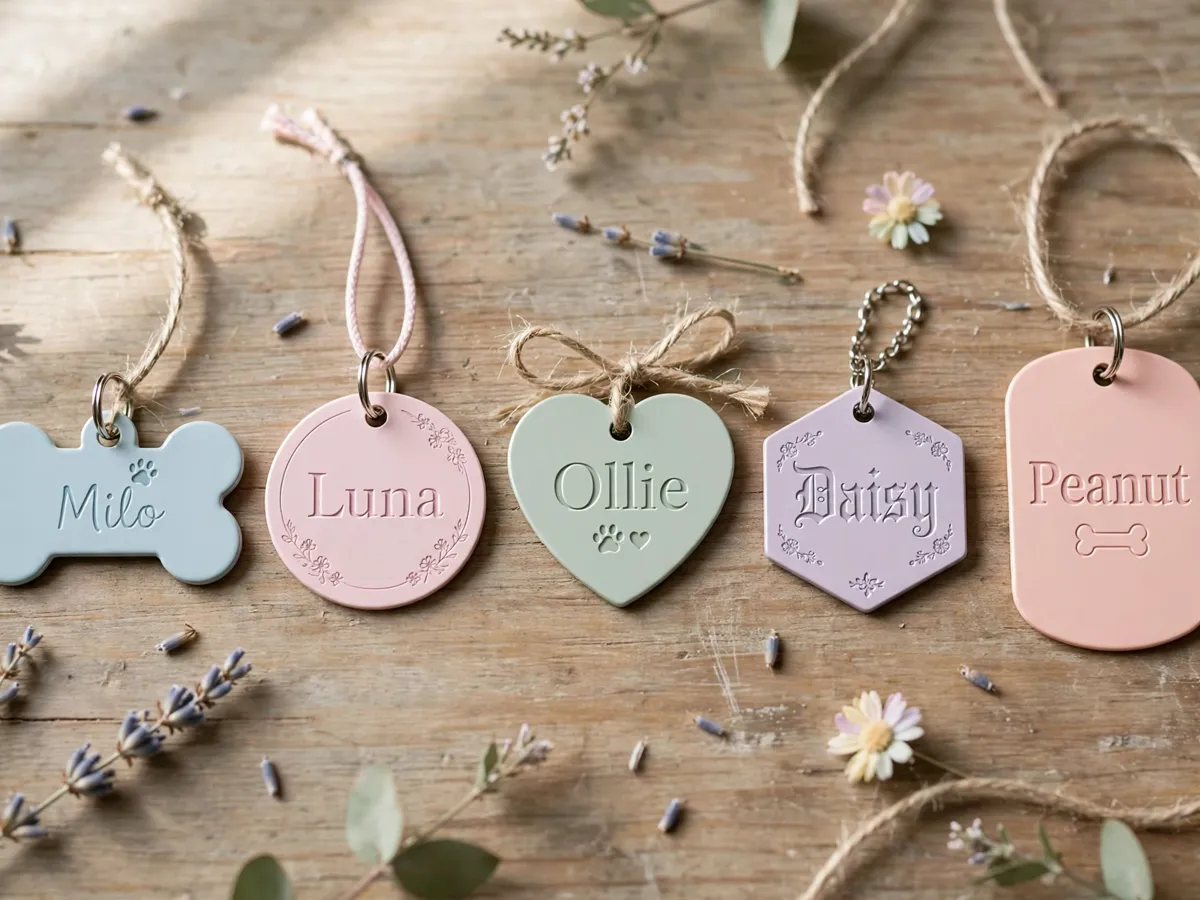
Stainless steel is the working default: it takes a deep engraving, it does not rust in a wet coat, and the lettering stays legible through a winter of walks. Aluminum is lighter, which matters on a small dog, and it dents and wears smooth faster. Brass reads as warmer and ages into a dull gold, and a household that wants the shine has to polish it. Anodized colors are the loud option that survives a printed band, and the color sits in the engraved groove where it wears slowest.
Shape does two things. It sets the noise, and it sets how much lettering fits. A bone shaped tag is the classic and it carries a short line well, but its thin waist rattles against a round tag on the same ring. A round tag holds two lines and swings less. A tag with a rubber ring around it, or a silicone sleeve over the metal, is the quiet version, and a dog that hears its own jingle all day is the reason to spend the extra on the sleeve.
Two tags on one ring is the practical answer for a joke collar: a shaped tag with the phrase, and a plain tag with the number and the name. The plain one keeps its lettering because nothing is crowded onto it, and the joke one keeps its joke because nobody has to squeeze an address onto the front. For a piece that carries a face instead of words, the custom portrait keychain guide is the route, and it belongs on a keyring rather than on a walking collar.
Care through mud and daily wear
Nylon webbing is the material that shrugs off the worst of it. Rinse the band under a tap, scrub the grit out of the weave with an old toothbrush, and hang it to dry rather than laying it flat in a wet pile. The buckle is where the mud packs, so work the prong free before the grit hardens into a stiff tongue. A printed band fades at the edges first, and the fade reads as wear rather than damage.
Leather wants a different habit. Wipe the salt and the mud off with a damp cloth, let it dry away from a heater, and work a conditioner into it now and then so the strap does not go stiff at the holes. Leather ages into a softer look, and a band that carries a tooled phrase only gets better as the surface darkens. The one thing to watch is the swelling: a wet leather band tightens as it dries against the neck, which is the reason to loosen it before the dog shakes it off rather than after.
The tag needs less, and one habit covers it. Look at the engraving once a month and run a thumbnail through the letters. When the number stops catching the nail, the tag is due for a re-cut, and a spare ordered while the old one still reads is the version that never leaves the dog without a legible line. Chain and bead collars want the links checked where they meet the ring, since that is the point that carries the pull.
Collar and tag questions
What message works on a funny dog tag?
Short lines read best: a nickname, one joke, the dog's own catchphrase. Keep the owner's phone number on the back so the joke does not crowd the ID.
How do I check a collar fits before the walk?
Two fingers should slide under the band with a little friction. Too loose and the tag jangles all day; too snug and the edge rubs at the neck fur.
Which collar material lasts longest?
Nylon webbing shrugs off mud and daily wear, and leather ages into a softer look. Metal chain reads well on a small dog but feels heavy on one.
Save this collar and tag guide
Pin it before the next order, and keep the fit check handy at every buckle. The Best Pet Supplies collection holds the gift guides, the harness fit pages, and the seasonal supply lists that sit beside this one.
For informational purposes only.
Half the fun of a good tag is the name on it, and the funny nicknames that fit the tag page sorts names by size, breed and attitude.