 PawStyle Daily
Best Pet Supplies & Gift Guide
Funny Dog Beds: Novelty Shapes Worth Buying
A novelty dog bed is the one purchase that gets judged twice: once in the photo and once on the third night, when the dog has decided whether it sleeps in it. The photo is easy. A donut, a couch, a toast slice, a flower, all of them photograph beautifully and all of them look the same on the shelf. The third night is the test, and it comes down to three things the listing rarely answers: whether the bolster holds its fill, whether the shape matches the way this dog sleeps, and whether the bed is big enough for the dog you have rather than the dog you bought it for. This page owns those three. For the rest of the new-dog basket, the gifts for new dog owners page covers what goes beside the bed.
By PawStyle Daily · Updated 20 November 2026
Good to know: judge the bolster before the print, match the shape to the sleeping pose, and size for the adult frame.

Why novelty beds fail, and the one thing that saves them
A novelty bed fails for the same reason every shaped bed fails: the shape is made of raised parts, and raised parts are made of fill, and fill is the part the listing does not describe. A donut is a ring of bolster around a well. A couch is two arms and a back around a seat. A toast slice is a slab with a crust. Every one of those is a promise that the raised part keeps its height, and when the raised part goes flat, the shape stops being a shape and becomes a lumpy mat with a seam in the middle.
The dogs that reject a novelty bed are usually rejecting the flat version of it. A dog that curls backs into a rim that holds; on a rim gone to nothing in a fortnight, the same dog sleeps on the floor beside the bed and leaves it looking used and empty. The owner reads that as disliking the shape. What the dog found was a shape with nothing in it.
So the buying order flips. Pick the fill first, then choose the shape you like from the beds whose fill holds. A plain rectangular bolster bed with a dense rim will outlast a novelty donut with thin stuffing every time.
The shapes, and the sleeper each one is built for
A donut, or round nest, is built for a curler. The raised ring runs all the way around, so a dog that circles twice and settles facing the middle has something to back into on every side and something to rest a chin on. It is the shape that reads as cozy in a photo, and it is the one a small or medium dog is most likely to actually use. Its weakness is the well: it is smaller than the printed diameter suggests, because the ring takes up the edge.
The bolster bed, rectangular with a raised rim on three sides, is the shape for a dog that sleeps on its side with a leg stretched. The rim gives the head and the back something to lean on and leaves the long edge open, so a sprawler is not wedged into a wall. This is the least novelty of the shapes and frequently the one a dog uses longest, and a couch-shaped novelty bed is essentially a bolster bed with arms.
The flat mat, with no raised part at all, suits a dog that sleeps belly-down or stretched along the floor, and a household that wants the bed to disappear under a table. With no bolster there is nothing to go flat, which makes it the most durable of the shapes and the least interesting. A novelty mat, a toast slice or a flower with a printed center, is the compromise: the joke sits in the print rather than in a raised part, so there is nothing for the dog to flatten. The hooded shapes, a cave or a den, are the ones to read twice, because a hood is a den in a photo and a heat trap in a summer, and a dog that cannot turn around inside it will not use it.
Fill: the part the listing hides
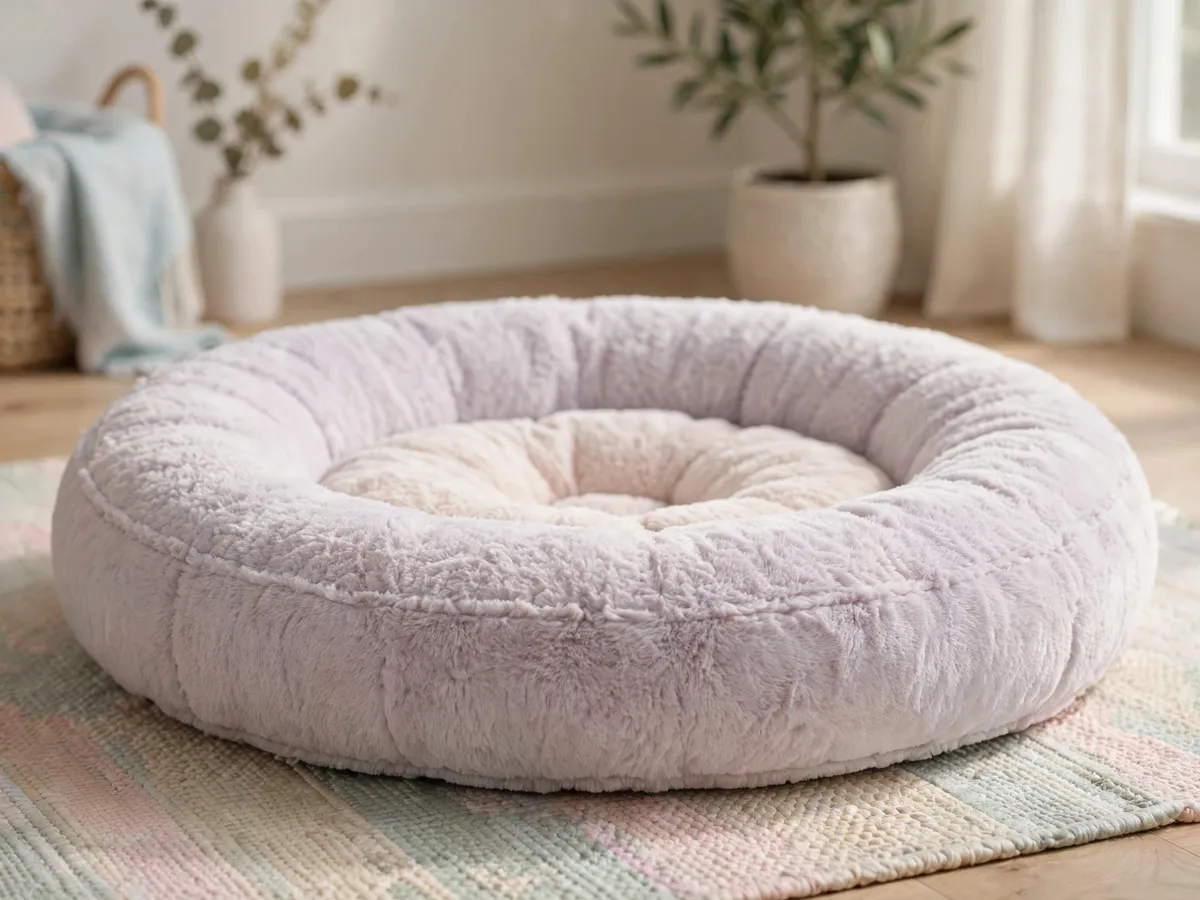
Three fill types decide whether a shaped bed survives, and the listing usually names one of them in a single adjective. Shredded foam is the soft version: it moves, it clumps at the edges after a month, and it needs a weekly fluffing to keep the well of a donut actually a well. Solid or dense foam is the version that holds: a cut block keeps its height under the same dog all year, and a rim made of it comes back up after every curl. Polyfill and loose batting are the version that goes flat fastest, and a novelty bed whose bolster is described only as "plush" or "ultra-soft" with no foam named is a bed whose rim is batting.
The hand test at the shop, or in the first hour at home, is the one that tells you everything. Press a thumb into the bolster and hold it. Batting parts under the thumb, stays parted, and comes back slowly or not at all. Dense foam resists, then returns as the thumb lifts. Shredded foam gives way and resettles with a rustle. If the bolster does not come back under a thumb, it will not come back under a dog.
The seam is the second thing to check, and it is where a novelty bed dies young. A shaped bed has more seams than a flat one, because every curve has to be sewn, and a curve under a dog that digs and circles is a curve under load. Run a hand along the join where the bolster meets the base and look for a narrow seam allowance or a stretchy stitch line. A bed whose rim is held on by a zip alone is a bed that loses its rim in a month. Press the center of the well down with both hands too: a deep well keeps its floor under a thumb, and a shallow one bottoms out immediately and lets a curling dog roll off the edge onto the floor.
The fit check, sized to the dog you have
Measure the dog, not the label. Lay a tape or a length of string from the tip of the nose to the base of the tail while the dog stands, then add the span of a hand at each end. That is the length the dog needs to stretch out fully, and it is the number the bed has to answer. A bed sold as large covers a range wider than any single dog, and the range is where novelty beds get bought wrong.
The most common mistake is buying to the puppy. A puppy bed feels kind and it is a second purchase, because a dog that sleeps stretched out as a youngster cannot do it in a bed bought while it still fits in a shoe. Pick for the adult frame you can already see in the paws and the muzzle, and put the puppy in the middle of the big bed with a folded towel at the back. The towel fills the space for a season and then comes out.
Round beds need the measure checked twice, because the printed diameter includes the ring. A round nest sold as a wide diameter may carry a usable well that is a good deal smaller, and a dog that fits the printed number does not fit the well. Measure the inside of the ring rather than the outside of the bed, and compare that number to the nose-to-tail measure.
Where the bed goes is part of the fit. Set the bed in the spot first with nothing in it, and watch which end of the room the dog chooses for the next three nights. The bed goes where the dog already lies, and the shape comes second.
Care: the cover, the wash and the fluff
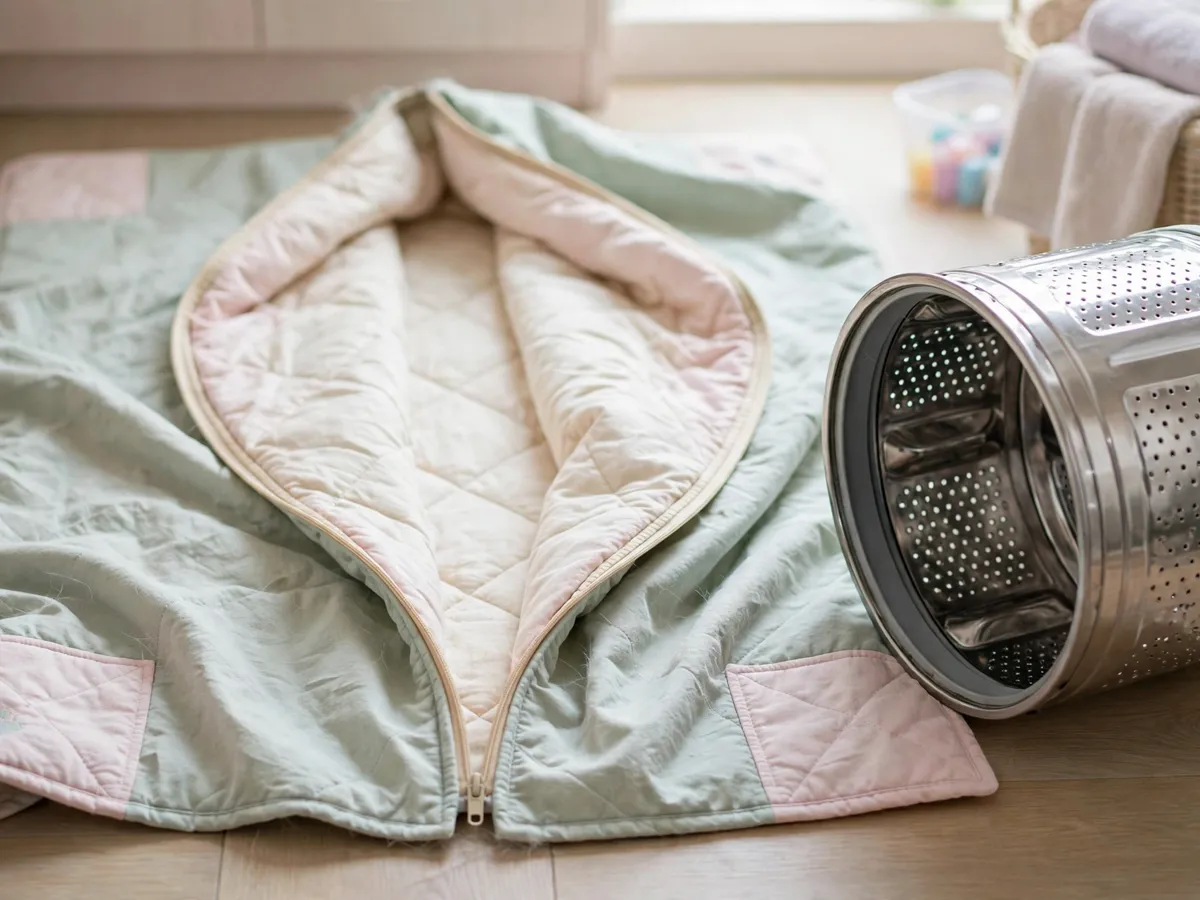
Wash the cover cold and dry it on low, or hang it, because heat is what shrinks a cover off a foam block and leaves the block naked. The block itself wants no wash at all: vacuum it, sprinkle it with baking soda, let it sit, and vacuum again. A shredded-foam block that has been soaked takes a long time to dry through the middle, and a damp block is where a bed starts to smell.
Fluffing is the habit that keeps a shaped bed shaped. A donut with shredded fill needs a hand inside the well each morning, pushing the fill from the ring back into the center, or the ring grows taller and the well grows shallower until the bed is one big lump. A dense foam block needs nothing, which is the quiet argument for paying more for foam.
Rotation buys a novelty bed life. Two covers on one block, swapped on the wash day, means the bed is never bare and the block never sits damp. And a bed that has spent a summer on a cool tile floor gets its fill resettled before the first cold night, because a flattened rim in winter reads to the dog as a floor with a seam in it. For the pieces that go beside the bed, the chew toys by chewer type page covers what a bed-sharing dog should be given to destroy instead of the corner of a pillow.
Novelty dog bed questions
Do novelty beds hold their shape?
Judge the fill, not the cover. A donut or a couch-shaped bed with thin bolsters goes flat in a week; a dense foam rim comes back up after each curl.
Which shape suits a curler?
A bolster or a round nest gives something to back into. A flat mat suits a sprawler, and a dog that sleeps on its side needs the long edge clear of any raised wall.
How do I know a bed is big enough?
The dog should stretch out fully with the head resting on the rim. A bed bought to the puppy size is outgrown in a season, so pick for the adult frame you already have.
Save this novelty dog bed guide
Pin it before the next bed order, and keep the thumb test in mind at the shop. The Best Pet Supplies collection holds the gift guides, the collar and bandana pages, and the seasonal supply lists that sit beside this one.
For informational purposes only.