 PawStyle Daily
Cute Pet Wallpaper 4K
Multiple Pet Portraits: One Artwork for Every Pet
The multi-pet portrait answers the question every household with more than one animal eventually asks: who goes on the wall? A single portrait of one pet leaves the others unnamed, and three separate frames turn the hallway into a gallery with no story. One artwork with every pet in it says the actual truth of the house - these animals share a sofa, a food bowl and a hierarchy, and the painting shows the group as the household sees it. The craft lives in three decisions: the layout that gives every pet its moment, the light that ties separate references into one scene, and the brief that keeps every face recognizable.
By PawStyle Daily · Updated 20 November 2026
One scene, not three portraits pasted together · every pet drawn from its own best photo · matched light across the group · eyes on a shared line · the hierarchy decided before the sketch.
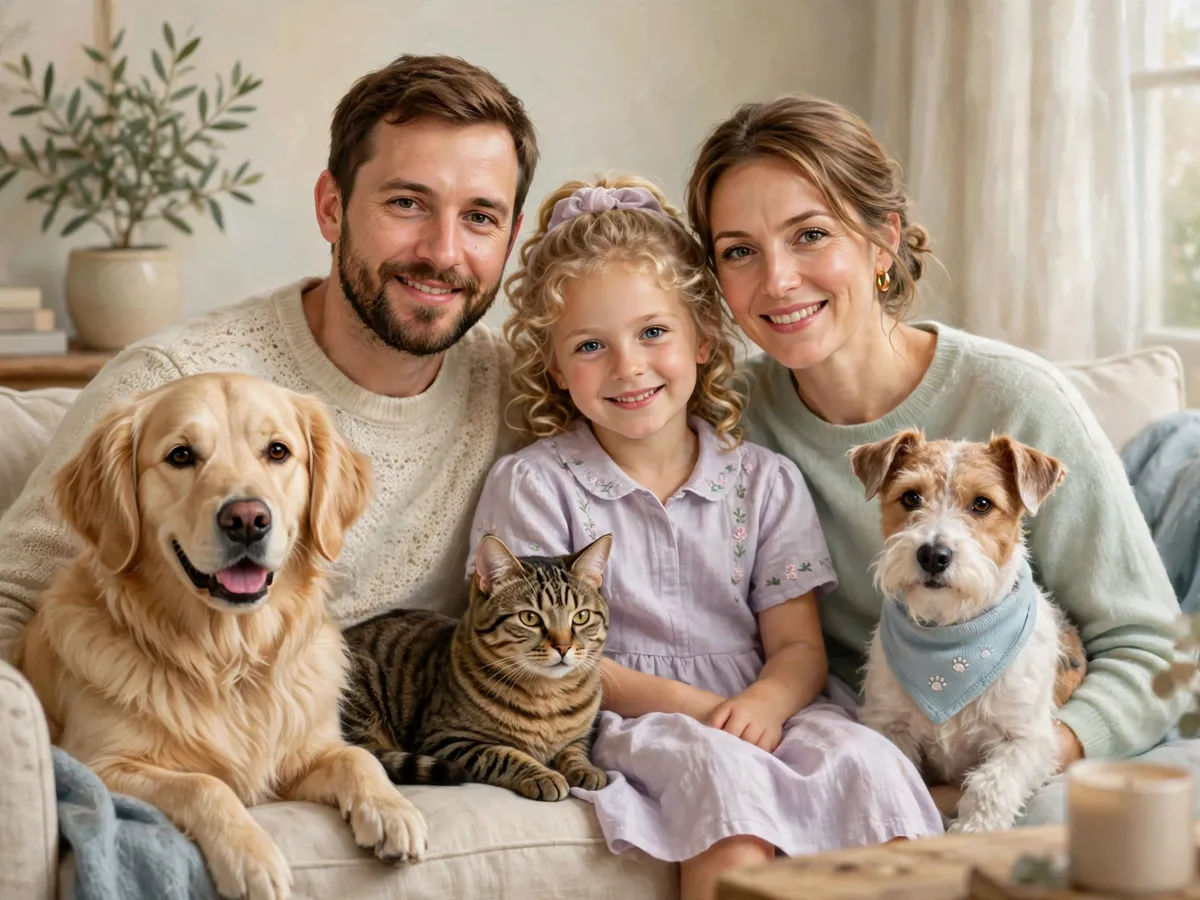
One artwork, one household
The group portrait works because it captures a relationship rather than a list of animals. A golden who rests his chin on a tabby's bed, a small dog planted squarely in front like the household's security chief - the arrangements that actually happen on the couch are the arrangements that make the painting worth hanging. A single portrait records what a pet looks like; a multi-pet portrait records how the household lives, and that is why the format keeps getting commissioned for anniversaries, new-arrival years, and memorials where one seat on the sofa went empty.
The format also solves the practical problem of mixed species. Dogs and cats photographed together rarely cooperate, and a painting built from separate references sidesteps the group shot entirely. The artist assembles what the camera could not catch: the three animals arranged exactly as the family remembers them, in the light the family prefers, on the rug they actually own. The artwork is truer than a photo would have been, because it was composed rather than waited for.
The commission mechanics - the reference set, the queue, the deposit, the delivery - sit on the commission a multi-pet portrait walkthrough this page assumes as read. What changes for a group piece is everything this page covers: how many faces the canvas can hold, how the layout gives each pet its share, and how the artist keeps three animals painted from three sessions looking like they never left each other's side.
Layout options for two or three pets
The pair layout has two classic shapes. Side by side, both animals facing forward at the same height, reads as equals - the steady choice for two pets of similar size who share the house as co-rulers. The staggered shape lifts one pet higher on the canvas, a cat on the shelf line and the dog on the floor line, and it carries two very different sizes without the small pet drowning or the large pet looming. The rule underneath both: the eye lines connect. Draw an imaginary horizontal across the two faces, and if it lands on one pair of eyes and above the other, the composition needs a height change.
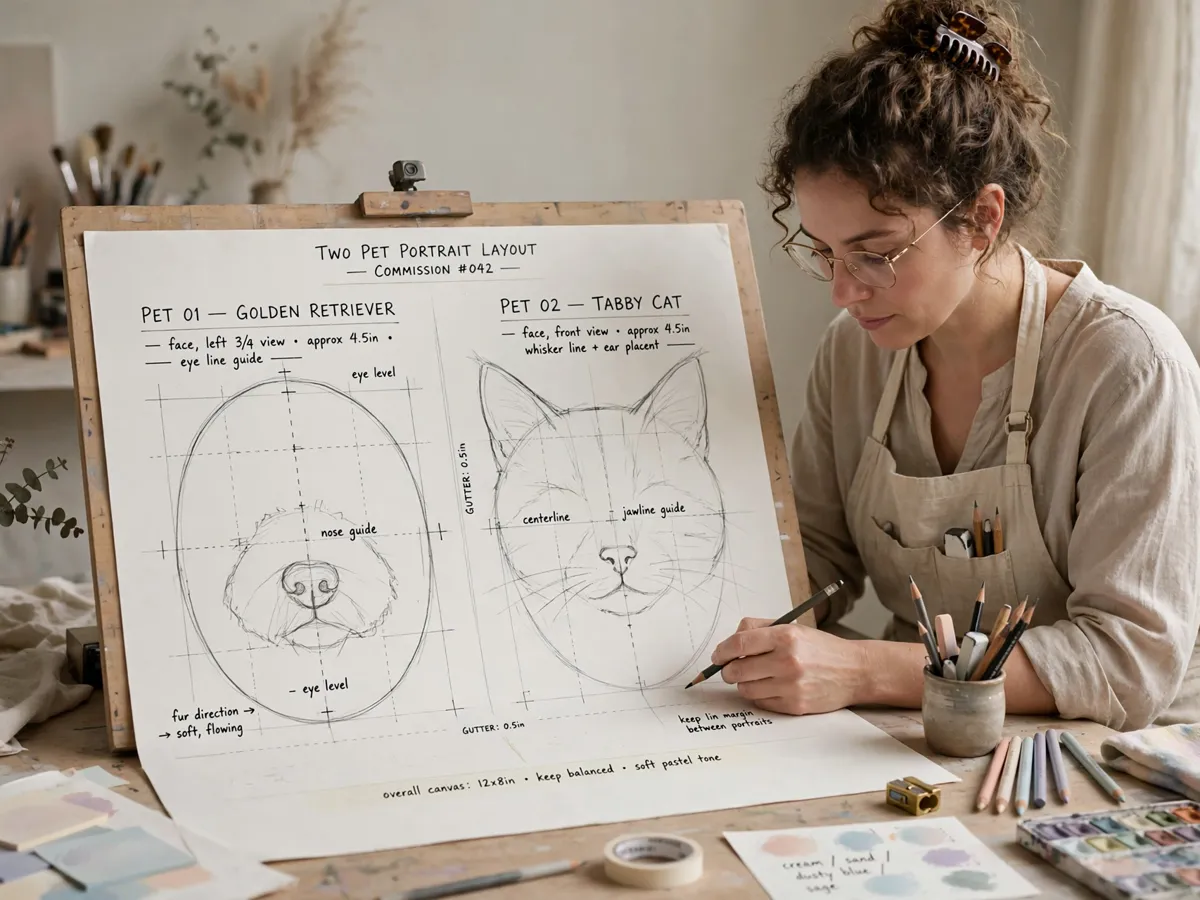
The trio adds a third variable, and the shape that holds is the triangle. One pet center and slightly forward, the flanks behind at unequal heights, and the canvas gains depth without anyone hiding. Trios fail in the row formation - three animals lined up shoulder to shoulder read as a mugshot, and the middle pet's ears overlap the neighbours. The triangle lets each face clear, keeps the eye lines stepping across the picture, and gives the painter foreground and background to work with.
Decide the hierarchy before the sketch, in writing, in the brief. Whichever pet the household pictures at the center carries the composition, and the artist builds the light and the poses outward from that seat. Families who skip this step find out at the sketch stage that the quiet cat landed behind the golden instead of beside him, and the revision at that point costs a redraw. The hierarchy sentence - "cat center, golden left and forward, small dog right and behind" - is the cheapest line in the whole commission.
Keeping every coat true in one palette
The group portrait tempts the artist toward one harmonizing palette, and harmony is the fast road to three pets that look like siblings. The golden's cream, the tabby's grey stripes and the small dog's black-and-tan face each carry their own colour story, and the household will spot a shifted coat from across the room. The reference set is the contract: each pet's true tones pinned beside the canvas, and the artist matches per animal rather than per artwork.
The light is what makes separate colour stories read as one picture. Three pets photographed in three different rooms arrive with three different colour temperatures - the warm lamp, the cool window, the yellow kitchen - and pasted together they look pasted. The fix lives in the references: shoot every pet's set in the same light, the same window on a similar day, and the artist has one temperature to paint inside. When the sets already exist in mixed light, the brief names the target - "match the golden's window light" - and the artist re-keys the others to it.
The shared accent is the painter's trick for unity without sameness. One colour repeated through the group - the red of a collar on each of the three, the blush of the rug under all three paws - ties the canvas together at the level the eye reads before it reads faces. It is the same device the regal portraits on this site use between costume and ground, turned toward the household's own objects: the matching collars already in the drawer, the blanket all three animals stole from.
Briefing the group piece
The reference set multiplies with the pets, and the discipline is per animal rather than for the group. Each pet gets the standard trio of shots - profile, face, candid - in the shared light, plus one photo of that pet with each of the others if the household owns any. The pair shots are gold for the artist: they show real scale, real spacing and the posture the animals actually hold near each other, which is the material a composed group is built from.
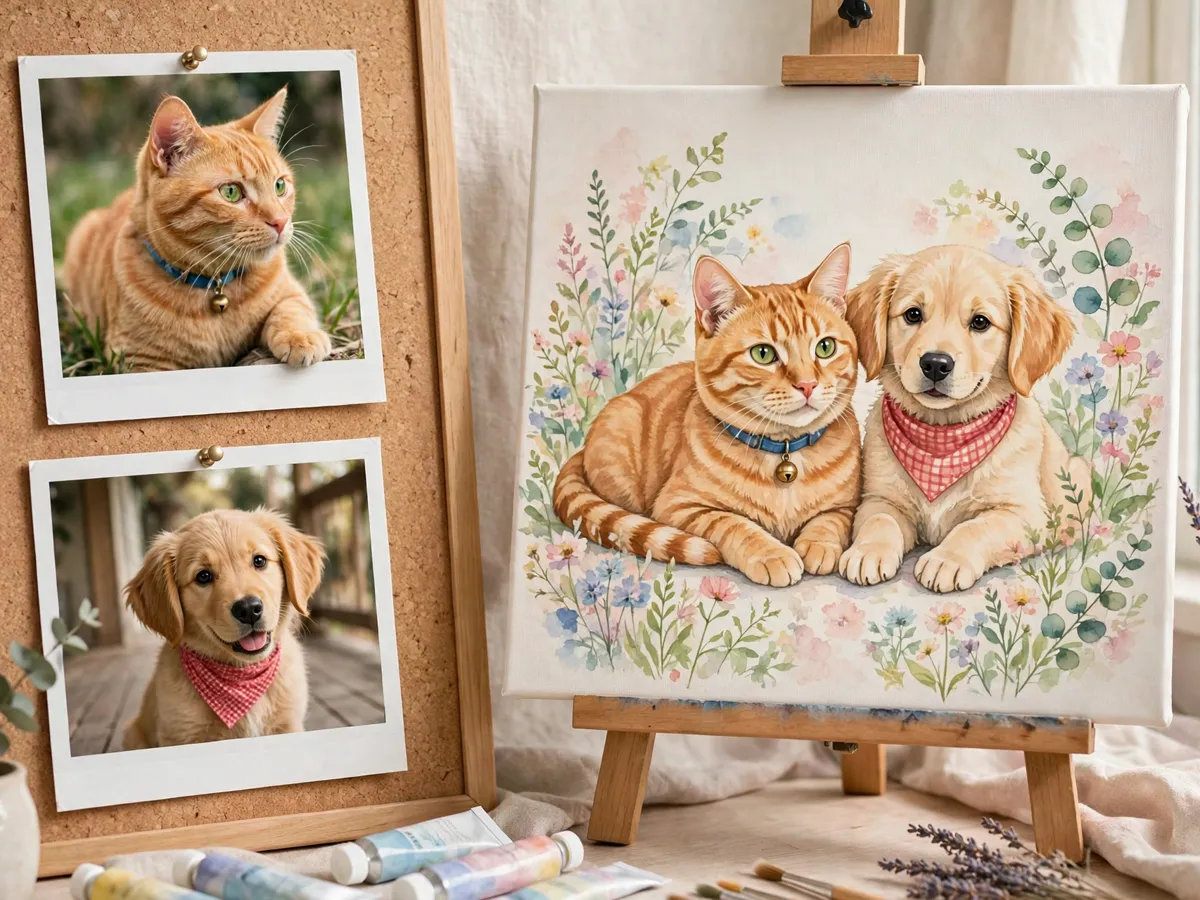
The brief answers five questions in five lines: the layout and hierarchy, the setting - sofa, rug, garden, plain ground - the light the household wants, the must-not-miss detail per pet, and the size. The detail line matters double in a group piece, because recognisability is what the format risks: three animals painted from three photo sets can blur into "a dog, a cat, another dog" without the notched ear, the leaf-shaped chest patch, the tail that curls left. Every pet's odd thing goes in the brief by name.
Pricing runs per face, and the quote arrives before the deposit. Each additional pet adds a likeness to catch, a coat to match and a region of canvas to compose, and honest artists publish the per-pet step on their terms page. The size grows with the group - a trio at the single-pet dimensions turns into a crowd - so the realistic budget conversation is "three pets at what canvas," and the artist who answers it in writing is the artist worth the queue.
From finished canvas to the wall
The group piece earns the wall it depicts. The sofa the painting shows, the hallway the animals patrol daily, the shelf above the food station - placing the artwork inside the territory it painted makes the picture read as documentation rather than decoration, and guests get the story without being told it. Size follows the room: a pair at modest dimensions suits above a console, and a trio wants the width the mantel or the sofa back gives it, because a crowded small canvas undoes the composition the artist built.
The memorial variation deserves its own mention, gently. Households that lose one of a group sometimes commission the piece while all three are present, and sometimes after - one seat painted from the old photos, the survivors rendered from fresh ones. Both routes work from the same reference discipline this page describes, and the artist's job is unchanged: match the light, hold the scale, catch the ear. The finished frame holds the household as it was, and the shelf beneath it takes the single-portrait keepsakes of whoever the family wants beside the group.
The scan travels first, as always. A photograph of the finished group goes to the family chat the day it arrives, the cousins find their favourites by name, and the canvas hangs before the week ends. A multi-pet portrait is the rare artwork every viewer has an opinion about, and the opinions are the point: the painting starts the argument about who is the real favourite, and the household gets to settle it yearly.
Questions about multiple pet portraits
How do artists handle pets that never sit together?
From separate reference photos. Each pet is drawn from its best photo, then the artist matches scale and lighting so the group reads as one scene.
Which layout works for two very different sized pets?
A staggered arrangement, one seated higher on the canvas than the other. Matching eye lines keeps neither pet looking lost.
Does a multi pet portrait cost more than a single?
Usually yes, since each additional face adds detail work. Most artists quote per pet, and the quote shows before any payment.
Save these on Pinterest
Pin the layout rules before the next artist queue opens, or send the hierarchy line to a friend whose three pets share one sofa and none of them sit for photos. The Pet Art & Wallpaper collection holds the commission walkthrough, the regal styling ideas that dress a group in court fashion, the watercolor route for the hand-painted version, and the print pairings for the wall around it - so every animal in the house ends up on it.
For informational purposes only.