 PawStyle Daily
Pet Coloring Pages & Art Prints
Dachshund Coloring Pages: Free Printables for Wiener Dogs
The dachshund is the one breed a generic dog drawing cannot fake. Stretch the body and it stops being a beagle; shorten the legs and it stops being anything at all. The pages below are drawn for the silhouette first: the long topline, the deep chest, the short legs that carry it, and a bold contour chosen so the drawing still reads after a home printer has had its say. Every page is free, printable, and drawn for one breed only.
By PawStyle Daily · Updated 20 November 2026
Good to know: bold contour over fine sketch | the topline is the breed | smooth, long and wire coats | print at full scale.
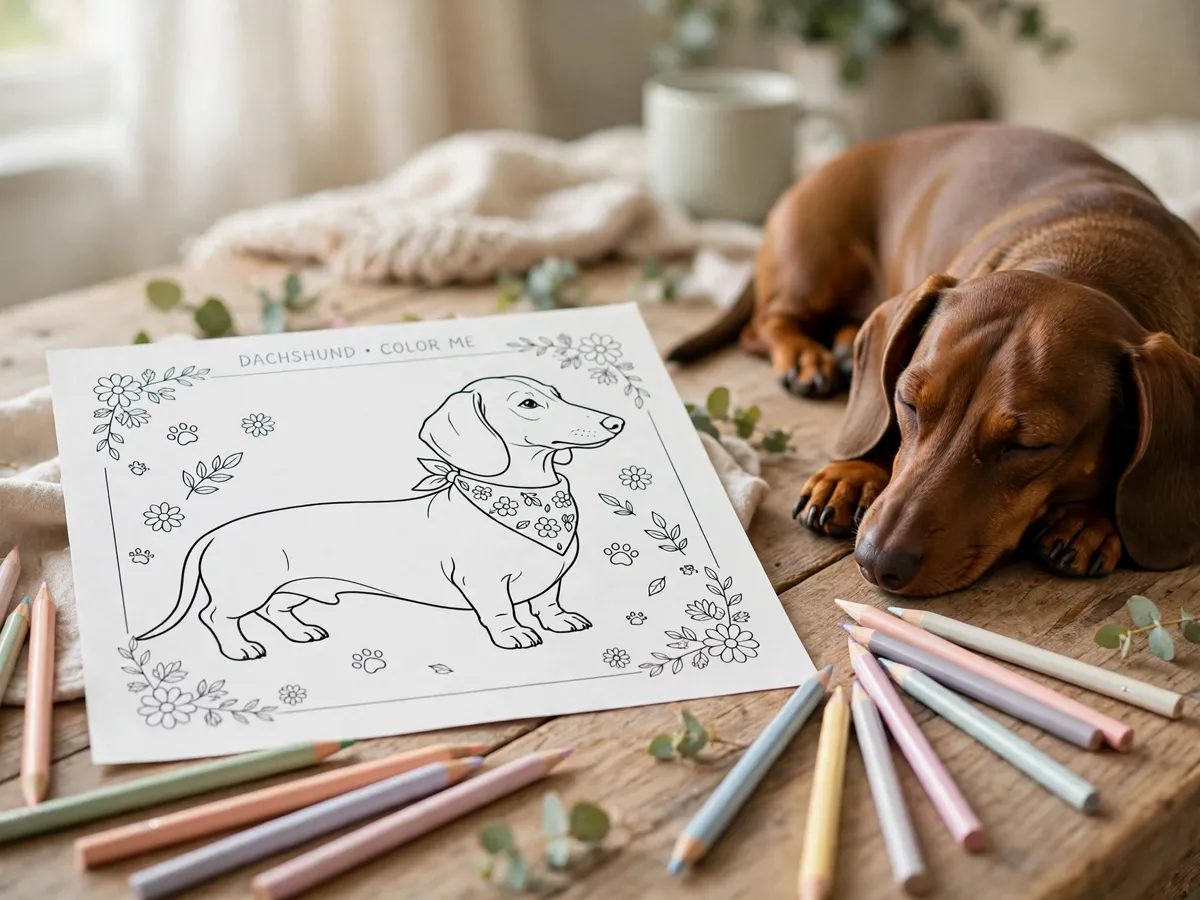
Why the wiener dog is hard to draw well
Most dog coloring pages are built from one standing template, and the template is roughly square: a head, a back, four legs of equal length. A dachshund breaks every one of those assumptions. The back runs long, the chest drops deep between the front legs, and the legs themselves are short enough that a drawing which lengthens them even slightly turns the dog into a different animal with the same ears.
That shape is also why the breed is worth a dedicated pack. A coloring page of a dachshund that gets the topline right is recognizable from across a room, in outline only, before a single pencil mark lands on it. A page that gets it wrong looks like a mistake rather than a style, and no amount of careful coloring fixes a silhouette that started in the wrong place.
One boundary before the pencils come out. This page is the breed on paper: the drawings, the line work, the printing and the finishing. The round-up of every-breed pages lives on the cute dog coloring pages collection, and the same dog on a phone screen lives on the dachshund phone wallpaper page. Three different jobs, three different pages, no overlap.
Line weight, and the tired cartridge
A home printer is the quiet adversary of every coloring page. The ink lands thin wherever the drum is worn, and a fine sketch line, the kind that looks so good on screen, is exactly the line that breaks into gray patches or vanishes at the edges of the sheet. A bold contour, drawn heavy from nose to tail, comes through the same printer with its edges intact, because there is enough ink in the line to survive an uneven pass.
The pack is drawn on the bold side on purpose. Interior detail is kept to the minimum that still says dachshund: the ear fold, the brow, the curve where the chest meets the front leg. Everything that is not the silhouette is left open for the color to define, which is the honest division of work between the artist and the person holding the pencil.
Pencils earn their place on this pack because the line art forgives. A pencil mark lifts back off the sheet with a clean eraser where a marker sits permanently, and a first pass of light color can be reworked before the darks go in. That forgiveness matters more on a breed page than on a general one, because the topline is the drawing: a colorer who darkens the wrong edge of the back loses the silhouette, and a pencil lets that edge be taken back.
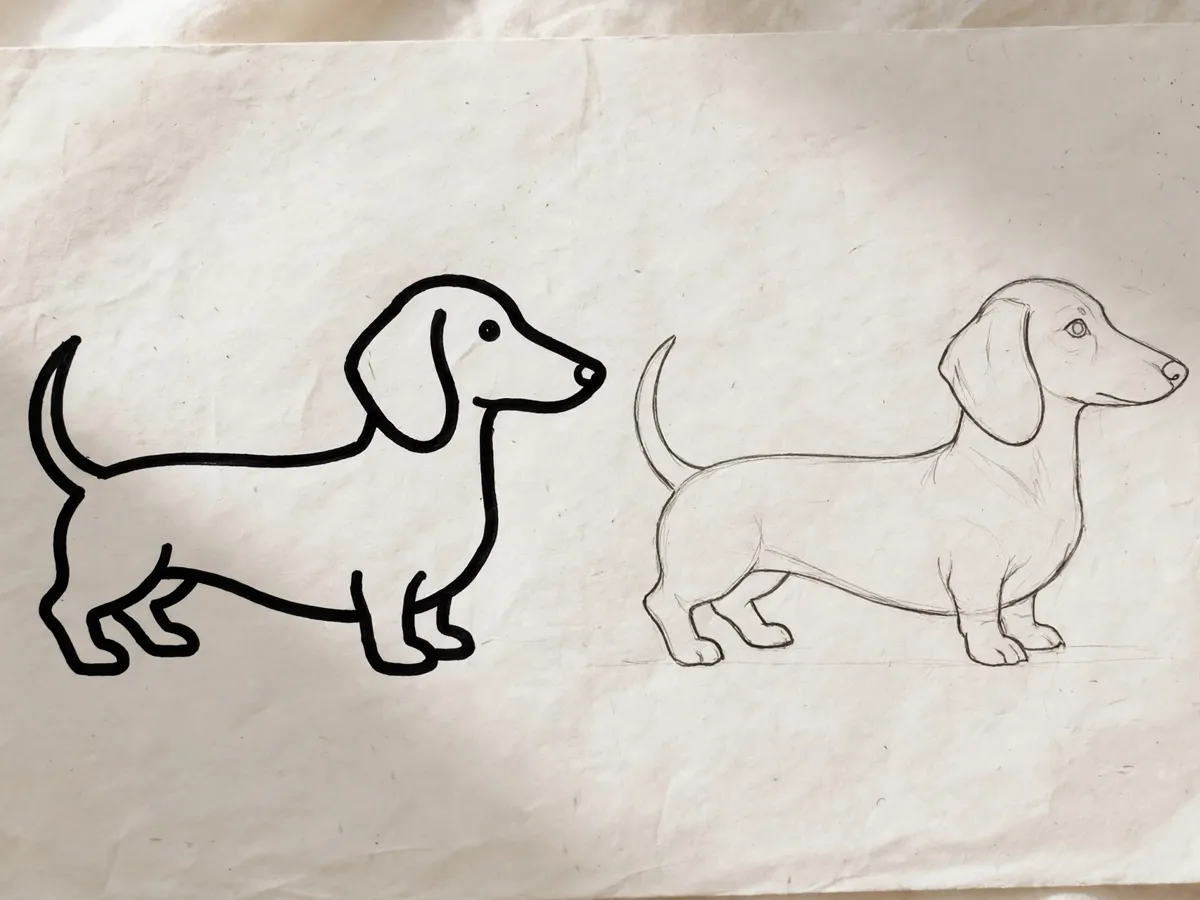
If your printer is past its best, print the bold-contour page first and compare it against a fine-lined one. The difference is the whole argument for thick lines, visible in one sheet.
The topline, the legs, and the three coats
The topline is the line that runs from the back of the skull, along the neck, over the shoulders and down the spine to the tail. On a dachshund it is the drawing. It is long, it is level, and it drops into a deep chest at the front. Every page in the pack is built by getting that line down first and hanging everything else off it, which is also how the breed is judged in the ring, and why a coloring page that starts with the head instead tends to grow the body sideways.
The legs come next, and the discipline is restraint: they are short, they are straight, and they end in compact feet. The common drawing error is lengthening them to fill the page, and the page stops being a dachshund the moment that happens. Depth in the chest and shortness in the leg are the two proportions that carry the whole silhouette, and the drawings keep both.
The coat is where the pack splits into three line problems. The smooth coat is the clean outline, all silhouette and almost no interior texture, the easiest page to color and the hardest to draw honestly. The long coat adds the ear fringe and the skirt along the body, drawn as open flowing lines rather than tight hatching, so the color can decide the direction. The wire coat is the beard and the brows, and it is drawn with short broken marks that leave the face readable. Three coats, three drawing problems, one breed underneath them all.
The wire coat deserves a slower note, because it is the page most often colored wrong. The beard and the brows are drawn as short broken marks, and the temptation is to fill them solid, which turns the face into a smudge and hides the expression the marks were protecting. Leave the spaces between the marks open, and let a light pencil pass decide how much of the texture the finished face carries. A wire dachshund colored with restraint still looks like a dog with opinions; the same page filled solid looks like weather.
Puppies and adults are kept on separate sheets for the same reason. The body is the same shape at a smaller scale, but the ears stand differently on a young dog and the eyes sit rounder and higher, and a page that blends the two ages reads as neither. The puppy sheets lean into the short leg and the big paw; the adult sheets keep the proportions strict.
Printing the page so the line survives
Print at full scale. In the print dialog that means choosing Actual Size, or the equivalent wording, with fit-to-page switched off, so the drawing lands on the sheet at the size it was drawn and the bold contour keeps its weight. Shrinking a page to fit the paper thins the line at the same time, and a bold contour printed small turns back into the fine line the whole pack was drawn to avoid.
Paper does more for a coloring page than it gets credit for. The plain thin stuff that lives in most printers is fine for a pencil and a quiet hour, but markers bleed through it and a heavy hand can cockle the surface. The heaviest paper your printer will take without complaining, or a card stock in the same tray, is the difference between a page that waves in the hand and one that sits flat while it is being worked on.
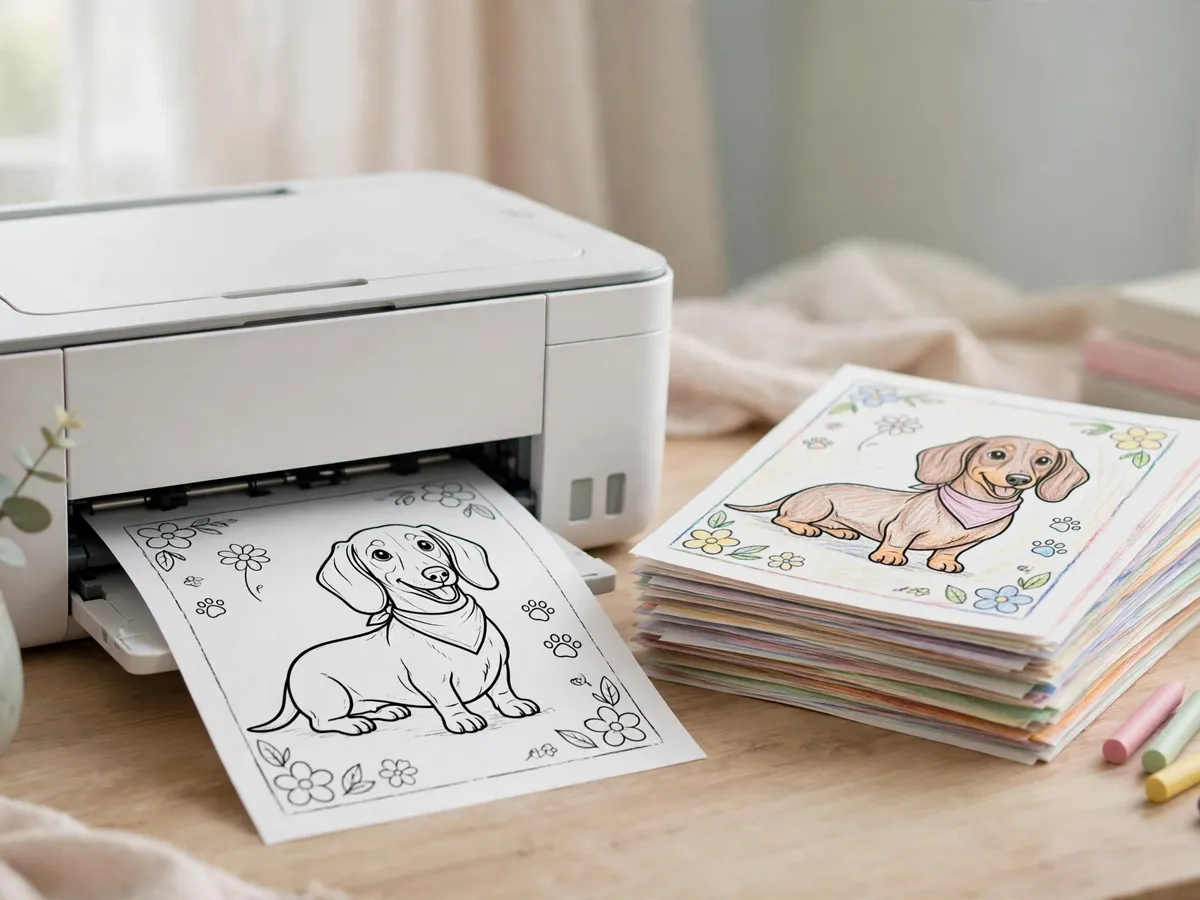
One test sheet before a stack: the same page, same settings, printed twice, shows what the cartridge is doing today. When the bold contour itself starts breaking up, the cartridge is telling you something the on-screen preview never will.
What to do with the finished page
A finished dachshund page is a piece of breed art on a budget. The strong silhouette holds up in a standard small frame, and a row of them along a shelf or a hallway reads as a proper line of dogs rather than a pile of coloring. The bold contour is doing the work: framed line art reads from a distance, which is exactly what a fine sketch never manages.
The finished pages also travel well as gifts for the household that measures everyone by their dog. Folded once inside a card they arrive flat and crease-free, and a colored page signed in the corner lands differently from anything bought in a shop. For the person who wants the breed on a wall rather than in a frame, the wallpaper pack holds the same dog drawn for a screen, and the coloring pack keeps the paper side of the hobby to itself.
Questions we get about dachshund coloring pages
Are these pages really free?
Yes. The pack downloads as a printable sheet and nothing has to be signed up for to open it. If you want the same dog on a screen instead of on paper, the wallpaper page is the one to read next.
What line weight prints best on a home printer?
Thick. A fine outline breaks into gray where the ink lands thinly, so a drawing built on a bold contour comes through a tired cartridge far better than a detailed sketch does.
Does one page work for a puppy and an adult?
The body is the same shape at a smaller scale, but the ears and the eyes sit differently on a young dog. Keep the puppy sheets apart from the adult ones, or the likeness goes the wrong way.
Save these dachshund coloring pages
Pin this pack before the printer gets switched on, so the line-weight rule and the topline rule are both at hand when the coloring starts. The Pet Art collection holds every printable set and wallpaper pack on the site. For the every-breed shelf, the cute dog coloring pages are the next stop, and for the same dog glowing on a phone screen instead of lying flat on a table, the dachshund phone wallpaper page is the one to open.
Bold contour, full scale | the topline carries the breed | smooth, long and wire coats on separate sheets | frame the strong ones.
For informational purposes only.
The breed shelf grows one pack at a time, and the the husky pack for the crayon hour page is the snow-dog one.