 PawStyle Daily
Best Pet Supplies & Gift Guide
Funny Dog Shirts: Everyday Tees That Fit and Read
A dog shirt worth owning is the one that comes out on an ordinary Tuesday, not the one that waits in a closet for a photo. It covers the ribs, it carries a joke somebody can read from the sidewalk, and it goes back in the wash on Sunday. Most shirts people buy fail on one of three things: a neck hole that will not pass the skull, a fabric that pills by the second wear, or a slogan printed so small it disappears at three paces. This page owns the cut, the cloth and the print. The neck scarf and its knot belong to the funny dog bandanas and bow ties page, the collar and tag belong to the collar page, and the paired October outfit belongs to the matching owner and dog costumes page. What is left is the everyday tee, and it has its own fitting rules.
By PawStyle Daily · Updated 20 November 2026
Good to know: the neck hole clears the widest point of the skull in one motion | cotton jersey over fleece | one short slogan, large, high on the ribs | the hem sits behind the front legs.

The garment that covers the ribs
A shirt and a bandana are not the same job. A scarf sits high on the neck and says something; a shirt drops over the shoulders and covers the barrel. That difference decides everything else on this page, because a garment that has to travel over the skull has to be cut for the skull, and a garment that has to cover the ribs has to be cut for a body that moves while it walks.
The everyday test is blunt: put the shirt on in the kitchen, let the dog walk to the front door and back, and look at what happened. Did the hem climb? Did the sleeve bunch behind the elbow? Did the print land on the side or twist under to the shoulder blade? A shirt that survives that lap earns a spot in the drawer. A shirt that fails it becomes a costume, and a costume is a garment you are already admitting you will use twice.
Buying for the ordinary day also changes the color decision. A shirt you wear on a walk gets muddy, so the practical palette runs a shade or two off white rather than at it. Save the pale one for the photo, and let the Tuesday shirt be the color that hides a season of grass.
The neck hole that clears the skull
Start at the opening, because it is where most shirts die. The skull is wider than the neck, and the widest point of the head is the only measurement that matters on a pullover garment. If the opening will not pass that point, the shirt is not a shirt; it is a garment you will fight into place at the door and take off in the yard.
The check takes one movement. Stretch the neck opening wide and run it over the skull in a single pass, ears included, with no lifting a flap and no re-angling. A ribbed crew that stretches is workable. A cut-and-sewn opening with no give is not, however honest the size label looks, because the label describes the neck and the neck is not the obstacle.
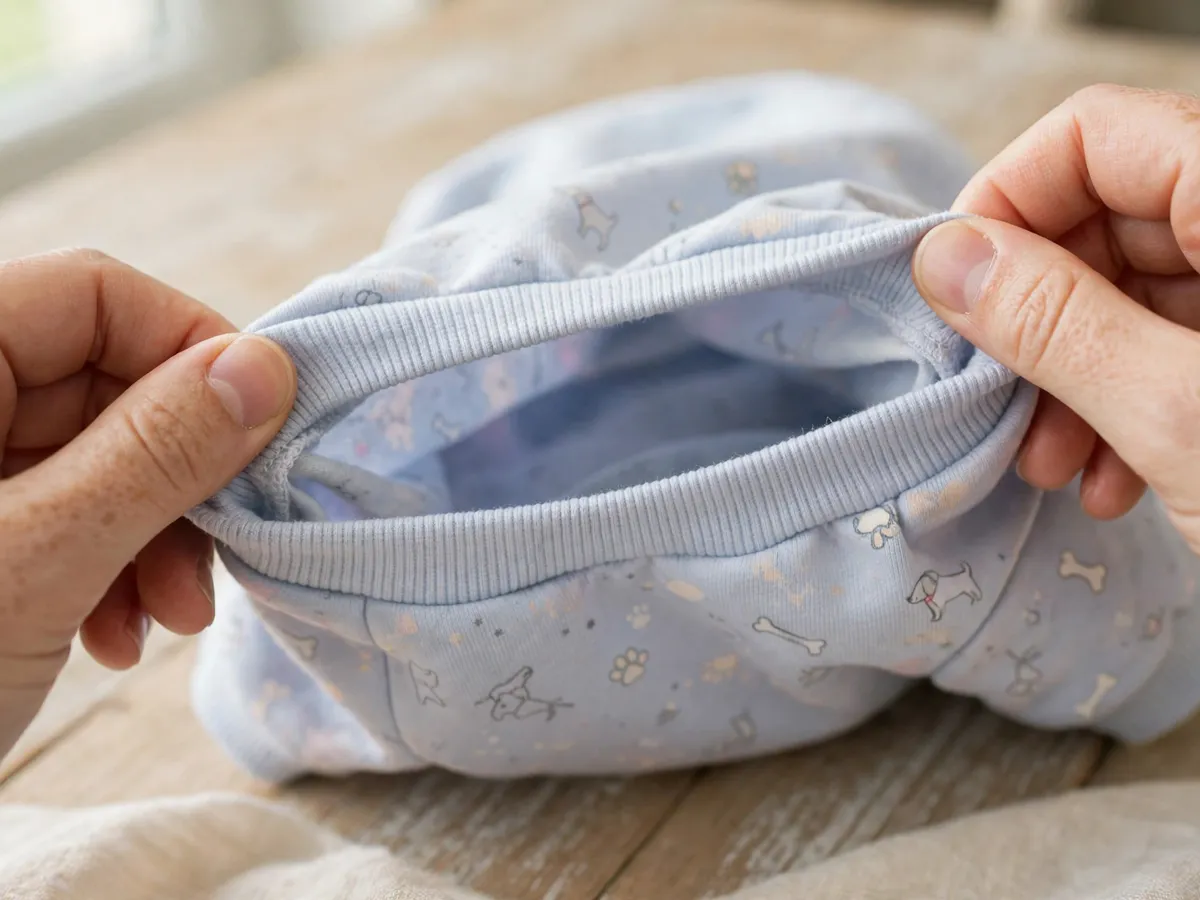
Two construction details tell you before the first try. A neck band cut on the stretch, or a shoulder seam that sits low, both give the opening room to travel. A binding sewn tight around the collar, and a head opening identical to the neck measurement, are the two shapes that make a pullover impossible. When a listing shows the flat garment only, look for the opening photographed wide.
If a shirt clears the skull in one pass and still sits flat on the neck afterwards, you have found the cut worth buying again in a second color.
Jersey, fleece, and why fleece pills
Cotton jersey is the everyday cloth, and it is the same knit a human tee is cut from: soft, slightly springy, and it drapes over the barrel instead of standing off it. It takes a print cleanly, it washes in a machine, and it dries flat in the shade. For a short-haired dog wearing a shirt on a mild day, nothing else on the rack is as dependable.
Fleece is the fabric sellers reach for because it photographs cuddly, and it fails in one specific place. The nap rubs where the collar line and the front leg meet, and that rubbing turns the fibers into pills within a few wears. A pale fleece shows it first, which is exactly why the pale fleece shirt looks tired by the end of the season. Terrycloth has the opposite problem: the loops catch grit and grass seed, and the shirt comes indoors holding a little of the yard with it.
Read the seams rather than the adjective. A twin-needle hem, a bound neck band, and a straight back seam are what keep a shirt shaped through washes. Then wash it the way you would wash your own tee: cold water, inside out so the print faces the drum, no dryer heat, and laid flat where it can dry fully. A print that stays smooth is a print that was never ironed.
A slogan that reads at distance
The joke is the reason anybody buys a funny shirt, and the joke lives or dies on size. A dog on a walk is seen from the side and from across a street, so the print has to read at that distance rather than at arm’s length. One short line, set large, high on the ribs, beats a paragraph of small lettering every time.
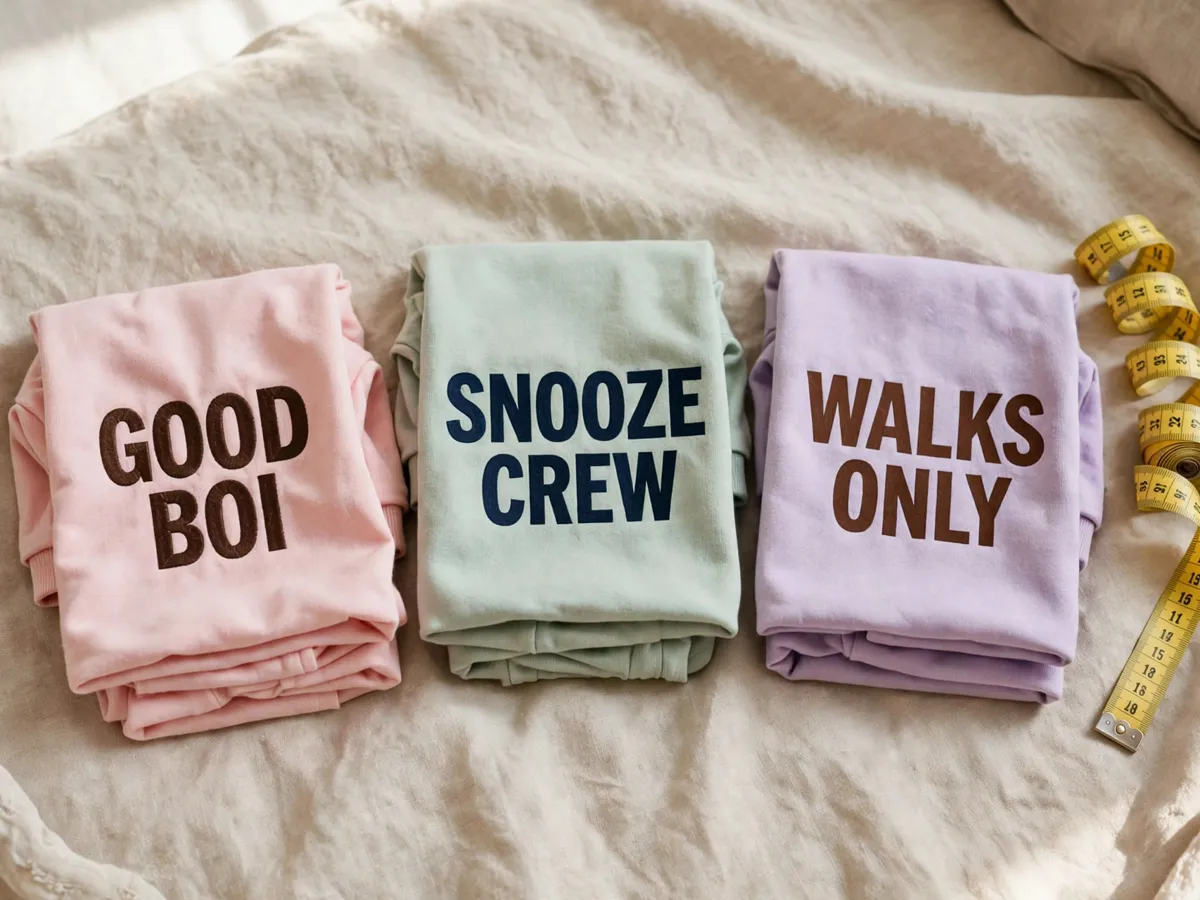
Contrast does the rest of the work. Dark lettering on a pale body, or pale lettering on a dark body, reads; a tonal print disappears into the fabric the moment the dog moves. Hold the shirt at arm’s length and squint. If the line is unreadable, so is it from the sidewalk.
Placement matters more than people expect. The print belongs on the flank, above the belly line, where the skin stays flat while the dog trots. Print low on the chest and it folds into itself with every stride; print it over the shoulder blade and it wraps out of view. A screen print sits on the cloth and sets there, while a thin transfer can crack along the fold lines after a season of washes, so for the shirt you actually use, ask which one you are buying.
Fitting the body, not the label
Three points decide the fit, and none of them is a number off a size table. The neck opening clears the skull, as above. The sleeve line sits behind the shoulder, so the leg can swing forward freely; a sleeve that cuts into the shoulder joint is the reason a dog freezes instead of walking. The hem ends before the belly, covering the ribs without pressing on the tuck.
Between two sizes, take the one with the wider neck opening and the shorter body. A shirt that is a little loose across the barrel still reads as a shirt, while one that is a little long rides up the belly and twists the print around to the side. Length is the thing a dog notices; width is the thing only you notice.
Then wear it in at home. The first outing is the kitchen, then the yard, then a short walk with a walk in the middle where the shirt can be adjusted without an audience. Pull the hem straight, smooth the print over the flank, and let the dog sit and stand a few times. If it stays put through all three, the fit is right.
Take it off when the day ends. A shirt left on unsupervised gets chewed at the hem, caught on a chair, and worn at the seams where the body rubs the floor. The drawer is where an everyday tee waits for the next ordinary Tuesday, and that is the whole point of buying one.
Questions about dog shirts
Should a dog shirt have sleeves?
Short ones or none. A full sleeve binds the shoulder on a dog that trots, and the hem rides up the belly. The shirt should sit where a bandana cannot: over the ribs, not the neck.
Which fabric lasts through a wash?
Cotton jersey, cut from the same cloth as a human tee. Fleece pills where a dog rubs the collar and terrycloth holds grit; a printed jersey rinses clean in a machine and dries flat.
How do I check the neck hole fits?
Stretch the opening wide enough to clear the skull in one motion, with no forcing over the ears. A hole that will not pass the widest point of the head is a shirt that comes off at the first door.
Save these on Pinterest
Pin the neck-hole check before the next order, or send the print-size rule to a friend whose new tee reads as a smudge from the sidewalk. The Best Pet Supplies collection holds the bandana knot, the collar and tag picks, the harness fitting pages, and the gift guides that sit beside this one.
Widest point of the skull in one motion, cotton jersey over fleece, one short slogan set large on the flank, and the hem behind the front legs.
For informational purposes only.